
Data processing clerk jobs: careful, methodical office work with records, data and detail.
JOB DETAILS — AT A GLANCE
| Category | Data Entry Jobs |
| Location | USA |
| Job Type | Full-time and part-time (varies by role) |
| Work Mode | Office, hybrid or remote (varies by role) |
| Education Required | Varies by role |
| Experience | Varies by role; some roles suit beginners |
| Skills | Accuracy, attention to detail, typing and organisation |
| Salary | Varies by role — check the official advert; no figure is stated here |
| Who Can Apply | Jobseekers in the USA who meet the employer’s eligibility requirements |
| How to Apply | Online, with a tailored CV or resume, via the employer’s official listing |
Note: details vary by role and employer. Always check the official advert before applying.
If you are organised, detail-focused, and comfortable working with information all day, data processing clerk jobs could be a practical way into office and administrative work in the United States. These roles sit at the quiet centre of many organisations: the place where orders, records, forms, and customer details are checked, entered, corrected, and kept in good order so that other teams can do their jobs properly.
This guide explains data processing clerk jobs in full. You will learn what the role actually involves day to day, how it differs from general data entry work, the duties and skills employers look for, the tools you are likely to use, who hires for these roles, how to find genuine openings, how to spot scams, and how to apply and interview with confidence. By the end, you will have a clear, realistic action plan you can start this week, whether you are looking for your first office role, a change of direction, or a steady remote or hybrid position.
What Is a Data Processing Clerk?
A data processing clerk handles information for an organisation. That information may arrive on paper forms, in emails, through online systems, or from other departments, and the clerk’s job is to make sure it is recorded accurately, consistently, and in the right place. In many workplaces, the title is used interchangeably with related titles such as data entry clerk, data clerk, or information processing clerk, although the exact duties depend on the employer and the industry.
The core purpose of the role is accuracy. A misspelled name, a wrong number, a duplicated record, or a missing field can cause problems further down the line: a delivery sent to the wrong address, a payment delayed, a customer record that cannot be found, or a report that does not add up. Data processing clerks prevent many of those problems by checking information carefully before it is filed, entered, or passed on.
Most data processing clerk jobs are office-based or computer-based roles. Some are fully in person, some are hybrid, and some are fully remote, depending on the employer and whether the source material is digital. Remote roles usually require a reliable internet connection, a quiet place to work, and the ability to follow data security rules from home. If you are exploring flexible options, it is worth comparing these roles with the wider range of remote jobs in the USA to see which working pattern suits you best.
The work itself is often structured and routine, but that does not mean it is mindless. Good clerks notice patterns, spot inconsistencies, ask sensible questions when something does not look right, and keep careful records of what they have changed and why. Employers value people who can stay focused, follow procedures, and take pride in getting the details right.
Data Processing Clerk Jobs vs General Data Entry Jobs
It is easy to confuse data processing clerk jobs with general data entry jobs, because the two overlap a great deal. In practice, many job advertisements use the terms loosely, and the same vacancy might be described in different ways by different employers. Understanding the general distinction, however, will help you read job descriptions more accurately and apply for roles that match your strengths.
General data entry work tends to focus mainly on entering information. You may be given source documents or digital files and asked to type the contents into a database, spreadsheet, or business system as quickly and accurately as possible. Speed and accuracy are the main measures of success, and the work may involve a high volume of similar records.
Data processing clerk jobs often go a step further. In addition to entering information, you may be expected to check, clean, sort, organise, and prepare data for use. That can mean comparing a new record with an existing one, removing duplicates, correcting obvious errors, updating outdated details, formatting information consistently, and preparing simple summaries or reports. In other words, data entry is often one part of the job, while data processing covers the fuller journey of information from arrival to safe, usable storage.
Neither role is automatically more senior than the other. A data entry role in a complex system can be demanding, and a data processing clerk role in a small team can be relatively straightforward. The job description matters more than the title. When you read an advertisement, look for the specific duties listed, the systems named, and the level of checking and problem-solving involved, rather than relying on the title alone.
What Does a Data Processing Clerk Do? Daily Duties Explained
The daily duties of a data processing clerk vary by employer, but most roles include a recognisable set of tasks. The list below gives a realistic picture of what a typical working day may involve.
Receiving and preparing information
Much of the work begins with incoming information. You may receive forms, applications, orders, invoices, survey responses, or customer details, and your first task is to organise them. That can mean sorting records into the right categories, checking that nothing is missing, and preparing the material so it can be entered or processed efficiently.
Entering and updating records
Entering information accurately into databases, spreadsheets, or specialist business systems is a central duty. You may also update existing records when details change, for example when a customer moves, a product code changes, or a case moves to the next stage. Careful updating matters just as much as careful first entry, because outdated records cause just as much confusion as incorrect ones.
Checking, verifying, and correcting data
Verification is what separates careful data work from simple typing. You may compare entered information against source documents, look for duplicate entries, flag records that do not match, and correct errors following agreed procedures. In some roles, a second person checks your work, or you check a colleague’s work. Either way, the habit of pausing to verify before submitting is essential.
Sorting, filing, and retrieving records
Data processing clerks also keep information retrievable. That may involve filing records in the correct digital folders, applying consistent naming and labelling, archiving completed work, and retrieving records when colleagues need them. Good filing saves everyone time and reduces the risk of working from the wrong version of a document.
Preparing simple reports and summaries
Some roles include preparing straightforward reports, lists, or summaries from the data you handle. You are not usually expected to carry out advanced analysis, but you may be asked to produce a tidy list of outstanding items, a count of records processed, or a summary of errors found. Clear presentation and accurate totals matter here.
Following data protection and confidentiality rules
Because data processing clerks often handle personal or sensitive information, following confidentiality and security rules is a core duty. That includes using approved systems only, keeping passwords private, locking screens when away from a desk, and never sharing customer or employee details outside the proper channels. Remote workers must be especially careful about working in shared spaces and using secure connections.
Communicating with colleagues
Finally, data processing clerks communicate with colleagues about the work itself: asking for clarification when a document is unclear, reporting a recurring error, confirming that a batch is complete, or handing work over at the end of a shift. Clear, polite, concise communication prevents small problems from becoming larger ones.
A Typical Day in Data Processing Clerk Jobs
A typical day often starts by checking messages, priorities, and any outstanding work from the previous day. You may then work through a batch of records, entering and checking information in the order agreed with your supervisor. There may be short breaks between batches to review errors, ask questions, or update a tracker showing what has been completed.
Later in the day, you might switch to a different type of task, such as cleaning up duplicate records, preparing a list for another team, or filing completed work. Many teams hold a brief check-in to discuss problems, deadlines, or changes to procedures. The day usually ends with a final check: unfinished work noted, completed work saved properly, and anything urgent flagged for the next day.
The pace can vary. Some days involve a steady flow of similar records, while others involve a deadline, a backlog after a busy period, or a new type of form to learn. Flexibility and a calm approach to changing priorities are useful, even in a role that looks routine from the outside.
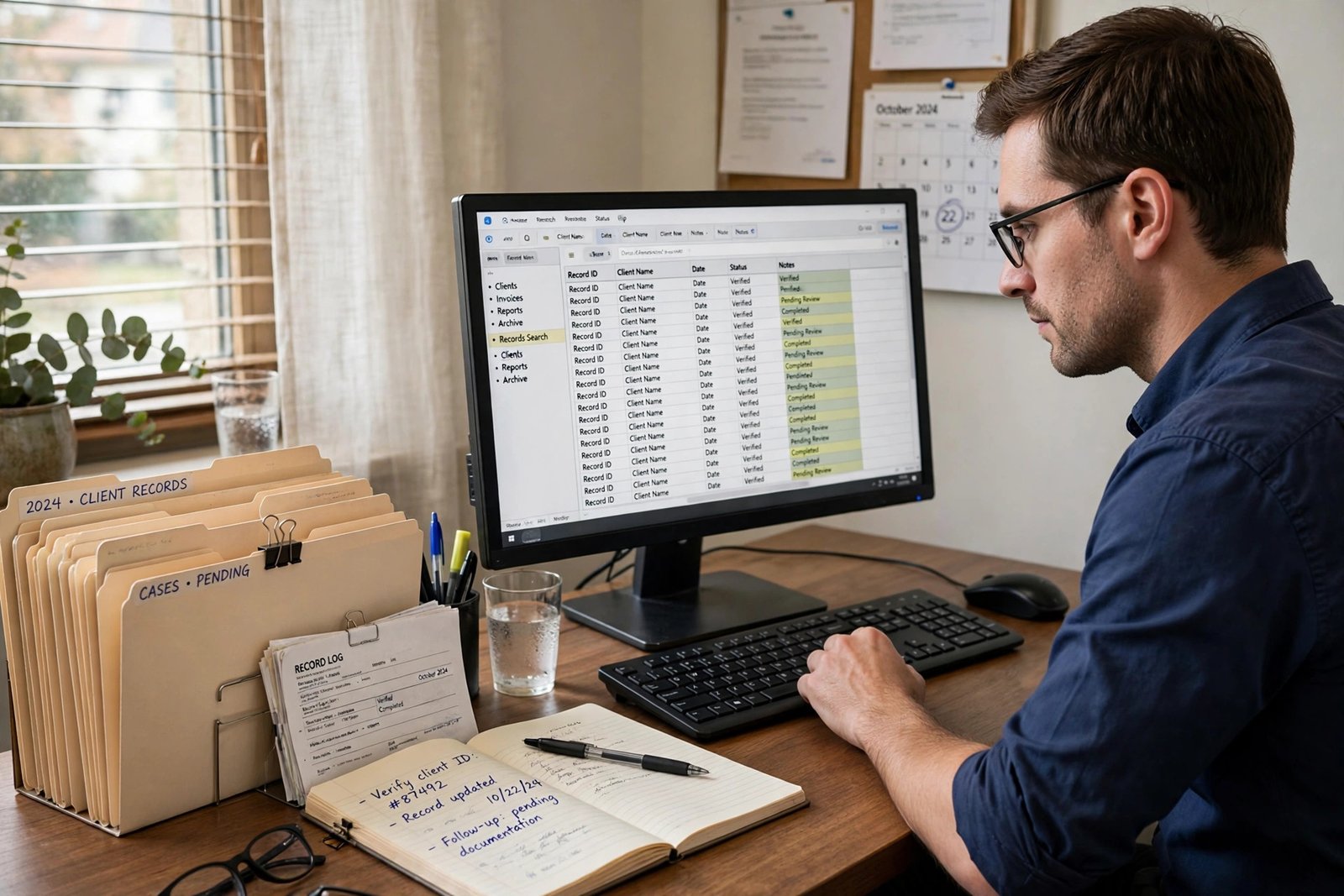
A clerk checking records on a computer screen, with tidy files and a notebook.
Skills Employers Look For
You do not need an unusual set of talents to succeed as a data processing clerk, but a combination of practical skills and personal qualities will make you a stronger candidate.
Accuracy and attention to detail
This is the most important skill in the role. Employers want people who notice small differences, such as a changed digit, a misspelled name, or a date in the wrong format, and who check their work before submitting it. If you naturally proofread messages before sending them or double-check figures, that habit will serve you well.
Typing and computer confidence
Comfortable, accurate typing is essential. You do not need to be the fastest typist in the room, but you should be able to work steadily without constantly looking at the keyboard or losing your place. General computer confidence matters too: opening and saving files, switching between programs, using email, and learning new systems without panic.
Organisation and time management
Data processing work often involves multiple batches, deadlines, and priorities. Being able to organise your workload, keep track of what is finished and what is outstanding, and manage your time sensibly will help you stay reliable under pressure.
Reading comprehension and basic numeracy
You will need to read instructions, forms, and source documents carefully and understand what is being asked. Basic numeracy helps when checking totals, dates, quantities, and reference numbers. You are not usually expected to carry out complex calculations, but comfort with numbers is an advantage.
Communication and teamwork
Even when much of the work is independent, you will work as part of a team. Clear written communication, a willingness to ask questions, and the ability to explain a problem simply are all valued. Supervisors prefer a clerk who asks about an unclear document to one who guesses and enters incorrect information.
Discretion and reliability
Because you may handle sensitive information, employers look for discretion and trustworthiness. Reliability matters too: turning up consistently, meeting deadlines, and following procedures even when no one is watching closely. These qualities are often demonstrated through references, work history, and interview answers rather than qualifications alone.
Tools and Systems You May Use
The exact tools depend on the employer, but most data processing clerks use a familiar mix of everyday office software and specialist systems. Common examples include spreadsheet programs for organising and checking lists, word processing programs for preparing documents, email and messaging tools for communicating with colleagues, and database or customer record systems for storing and retrieving information.
You may also use scanning equipment if paper documents need to be digitised, and internal company systems for orders, bookings, patient records, student records, or case files, depending on the industry. Employers usually provide training on their own systems, so you are not expected to know every specialist program in advance. What matters is a willingness to learn, careful following of instructions, and the ability to remember procedures once you have been shown them.
If you are new to office software, practising with spreadsheets is a particularly good use of your time. Learn how to sort and filter lists, check for duplicates, use simple formulas, and format information consistently. Those skills transfer to many data roles and will make training on an employer’s system much easier.
Who Hires Data Processing Clerks?
Data processing clerks are hired across many sectors, because almost every organisation handles information. Healthcare providers, insurance companies, banks and financial firms, retailers, logistics and delivery companies, government offices, schools and universities, charities, and professional services firms all need accurate records.
Staffing and recruitment agencies also place data processing clerks with client organisations, sometimes on a temporary or contract basis. Temporary work can be a useful way to gain experience, learn different systems, and build a work history, especially if you are new to the field. Some temporary assignments lead to permanent roles, although that should never be assumed in advance.
The type of data you handle often reflects the sector. In healthcare, it may be patient or appointment information, handled under strict privacy rules. In retail or logistics, it may be orders, stock, and delivery records. In finance or insurance, it may be claims, payments, or account details. When you apply, it helps to think about which sector interests you and whether you have any relevant familiarity, even from study, volunteering, or previous administrative work.
Qualifications and Experience: What Do You Really Need?
Many data processing clerk jobs do not require a university degree. Employers more commonly look for a high school diploma or equivalent, strong basic literacy and numeracy, computer confidence, and evidence of accuracy and reliability. Some roles ask for previous office or data entry experience, while others are open to beginners and provide full training.
Short courses in office administration, spreadsheets, or typing can strengthen an application, but they are not a substitute for demonstrating accuracy in practice. If you have no direct experience, think about transferable experience: school or college projects involving careful record-keeping, volunteer work involving lists or registers, retail work involving stock or till records, or any role where you handled customer details responsibly.
For readers starting from scratch, the related range of remote jobs with no experience can give a useful sense of which entry-level routes are realistic, and how data processing compares with other beginner-friendly office roles. Whatever route you take, honesty on your application matters: claim only the skills and experience you genuinely have, and be ready to demonstrate them in a short test or exercise if asked.
Data Entry Clerk Job: The Closely Related Role
Because the secondary keyword for this guide is the data entry clerk job, it is worth looking at that role directly. A data entry clerk job typically centres on entering information from source documents into a computer system. The work may include typing text and numbers, checking entries for obvious errors, and maintaining records in an orderly way. In many advertisements, the duties described for a data entry clerk and a data processing clerk are almost identical.
The practical difference, where one exists, is emphasis. A data entry clerk job may emphasise volume and speed of entry, while a data processing clerk job may emphasise checking, cleaning, and preparing data for wider use. In practice, you should treat the two titles as part of the same role family and judge each vacancy by its duties, not its label.
If you are searching online, use both phrases, along with variations such as data clerk, data entry operator, and information clerk. Employers in different industries use different titles for very similar work, and limiting yourself to one exact phrase could mean missing suitable roles. Keep a note of the titles that produce the most relevant results for you, and use them consistently in your searches.
The U.S. Bureau of Labor Statistics describes the closely related occupation of data entry keyers as operating a data entry device, with duties that may include verifying data and preparing materials for printing. That official description is a useful reality check when a job advertisement promises something very different from careful, methodical office work. You can read the official occupation information from the U.S. Bureau of Labor Statistics, 2019 edition and compare it with any vacancy you are considering. CareerOneStop, sponsored by the U.S. Department of Labor, also provides an occupation profile for data entry keyers, including what the work involves and the education or training typically needed, which you can explore through the CareerOneStop occupation profile for Data Entry Keyers.
How to Find Genuine Data Processing Clerk Jobs
Finding genuine roles takes a steady, organised approach rather than applying to everything that looks easy. Start with reputable job boards, employer careers pages, and staffing agencies with a clear physical presence and verifiable history. When you find an employer you like, visit its official careers page directly rather than relying only on a copied advertisement elsewhere.
Read each job description carefully before applying. A genuine advertisement usually names the employer clearly, describes specific duties, states the location or working pattern honestly, explains the application process, and gives a realistic picture of the work. Vague promises, missing company details, and pressure to act immediately are reasons to pause and investigate further.
Keep a simple tracker of your applications: the employer, the job title, the date you applied, the source of the advertisement, and any follow-up needed. This prevents duplicate applications, helps you prepare for interviews, and makes it easier to spot when a supposed employer contacts you about a role you never applied for — itself a warning sign.
Set aside regular search time rather than searching all day without a plan. For example, you might check new listings each morning, tailor two or three strong applications, and spend the rest of your time improving your skills or preparing for interviews. Quality applications, tailored to each role, are far more effective than large numbers of identical applications.
Many people also find it helpful to broaden their search sensibly. If a fully remote data processing role is not available in your area, a hybrid role or a related administrative role may provide the experience that makes a remote move possible later. Browsing the wider range of work from home jobs alongside data-specific listings can help you compare working patterns, duties, and requirements without narrowing your search too early.
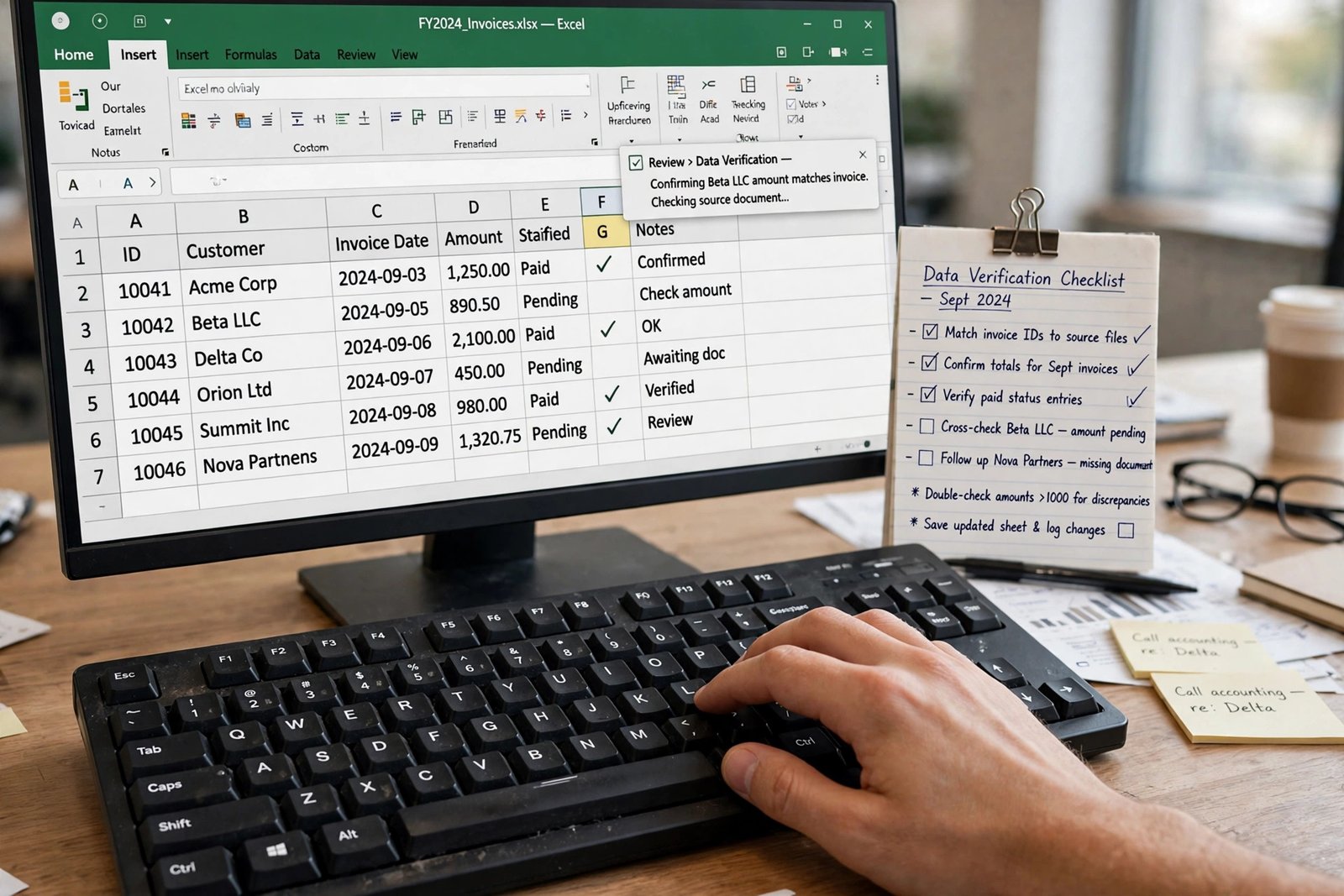
A keyboard, spreadsheet on screen and checklist, showing typing accuracy and verification.
Scams to Avoid: Red Flags in Data Entry and Data Processing Adverts
Unfortunately, data entry and data processing roles are frequently used as bait by scammers, precisely because they sound accessible and can plausibly be done from home. Knowing the warning signs will protect both your money and your personal information.
You are asked to pay to apply, train, or start work
A genuine employer does not ask you to pay a fee to apply for a job, to be considered, to receive training materials, or to buy equipment before you start. Requests for payment for starter kits, training, software, or background checks that you must pay upfront are major red flags. If payment is mentioned at all before you have a signed offer and a verified employer contact, walk away.
You are asked for sensitive personal or banking details too early
Be cautious if someone asks for your Social Security number, bank account details, or copies of identity documents during an initial chat, before any formal application or interview process. Legitimate employers collect sensitive information through secure, formal channels at the appropriate stage, not through messaging apps or personal email addresses.
The offer arrives without a proper interview
A job offer that arrives after only a brief message exchange, with no interview, no discussion of duties, and no verifiable employer contact, should be treated with suspicion. While some entry-level processes are short, a genuine employer will still want to assess your suitability and answer your questions.
You are asked to deposit a check and send money onward
This is a classic scam pattern. You are sent a check, asked to deposit it, and told to send part of the money elsewhere or buy gift cards. The check later bounces, and you are left responsible for the money you sent. A legitimate employer will never ask you to do this. The Federal Trade Commission explains this and other job scam patterns in detail in its official consumer advice on how to avoid job scams, which is worth reading before you begin applying widely.
The company cannot be verified
If you cannot find a real company website, a consistent business address, verifiable contact details, or independent reviews and mentions, be cautious. Search the company name together with words such as scam, review, or complaint, and talk the offer through with someone you trust. A lack of complaints does not prove a company is genuine, but complaints and inconsistencies are valuable warnings.
The pay promise sounds too easy
Promises of very high earnings for very little work, with no experience and no interview, are designed to create excitement and bypass careful thinking. Real data processing work is steady, methodical, and paid at ordinary office rates that vary by employer and location. If an offer sounds far better than every other similar role, ask why.
If you believe you have been targeted by a scam, stop communicating, do not send money or further personal details, keep copies of messages and advertisements, and consider reporting the matter through the reporting routes described by the Federal Trade Commission. Acting quickly gives you the best chance of limiting any harm.
Pay in General Terms Only: What Affects What You Earn?
It is natural to want a clear pay figure before applying, but pay for data processing clerk jobs varies considerably, and any single figure quoted without context can be misleading. Pay typically depends on where the role is based, whether it is full-time or part-time, the employer’s sector, the complexity of the systems involved, your experience and accuracy record, and whether the role includes additional responsibilities such as checking other people’s work or preparing reports.
Location matters because the cost of living and local labour markets differ across the United States. Experience matters because an applicant who can demonstrate reliable, accurate work on complex records is more valuable than a complete beginner. Sector matters because roles handling sensitive or specialist information may carry different responsibilities and training requirements.
Rather than focusing on one advertised figure, compare several genuine listings for similar roles in your area or working pattern, read the full job description, and consider the whole package: hours, working pattern, training, prospects for progression, and the stability of the employer. If a listing does not state pay, that is not necessarily a warning sign on its own, but it is a sensible question to ask at interview, once you understand the duties involved.
Be wary of any source that promises a precise salary for every data processing clerk job. Real pay is a range shaped by the factors above, and responsible job guides describe it in those terms rather than presenting a single invented number as a fact.
Application Tips: How to Stand Out
A strong application for data processing clerk jobs is clear, accurate, and tailored. Since accuracy is the core skill of the role, your application itself is a test: spelling mistakes, inconsistent formatting, and careless errors undermine the very quality you are claiming to offer. Proofread everything, twice, before submitting.
Tailor your CV or resume to each role
Use the language of the job description where it honestly matches your experience. If the role emphasises verification, mention experience checking records or correcting errors. If it emphasises spreadsheets, mention the spreadsheet tasks you have actually carried out. Keep your resume concise, well organised, and easy to scan, with your most relevant experience first.
Show accuracy with examples, not just adjectives
Rather than simply writing that you are detail-oriented, give a brief example: a time you spotted an error that would have caused a problem, a system you kept in good order, or a task where careful checking was essential. Short, specific examples are far more convincing than long lists of qualities.
Include a short, professional cover note where requested
If a cover note or message is requested, keep it brief and relevant. State the role you are applying for, why you are a good fit, and one or two strengths that match the job description. Avoid copying the same generic paragraph for every application, and avoid overstating qualifications you do not have.
Prepare for a skills test
Many employers use a short typing, accuracy, or data-checking test as part of selection. Practise typing steadily and accurately rather than rushing, and practise checking your work calmly under time pressure. If you make a mistake in a test, correct it methodically rather than panicking; employers notice how candidates handle errors.
Follow instructions exactly
If an application asks for a particular file format, subject line, or set of details, follow it precisely. Data processing work is full of instructions that must be followed exactly, and employers reasonably treat the application process as an early indication of how carefully you follow them.
Interview Tips for Data Processing Clerk Jobs
Interviews for these roles are usually practical and straightforward. Expect questions about your experience with data, your approach to accuracy, how you handle repetitive work, how you prioritise tasks, and how you respond when you find an error or an unclear document.
Prepare short answers that describe a situation, what you did, and what happened as a result. For example, you might describe noticing an inconsistency in a record, checking the source document, raising it with a supervisor, and correcting it following the proper procedure. That kind of answer shows judgement, not just speed.
Be ready to talk honestly about your typing and computer skills, your experience with spreadsheets or databases, and your approach to confidentiality. If you have gaps in your experience, acknowledge them calmly and explain what you are doing to close them, such as practising spreadsheet skills or completing a short office course.
Ask sensible questions of your own. You might ask what systems you would use, how work is checked, what a typical day looks like, what training is provided, and how success is measured. These questions show genuine interest and help you judge whether the role is right for you. They also help you spot problems: vague answers about the employer, duties, or working pattern deserve follow-up before you accept any offer.
After the interview, send a brief thank-you message if appropriate, restating your interest in the role. Keep your tone professional and concise, and avoid chasing repeatedly for a decision.
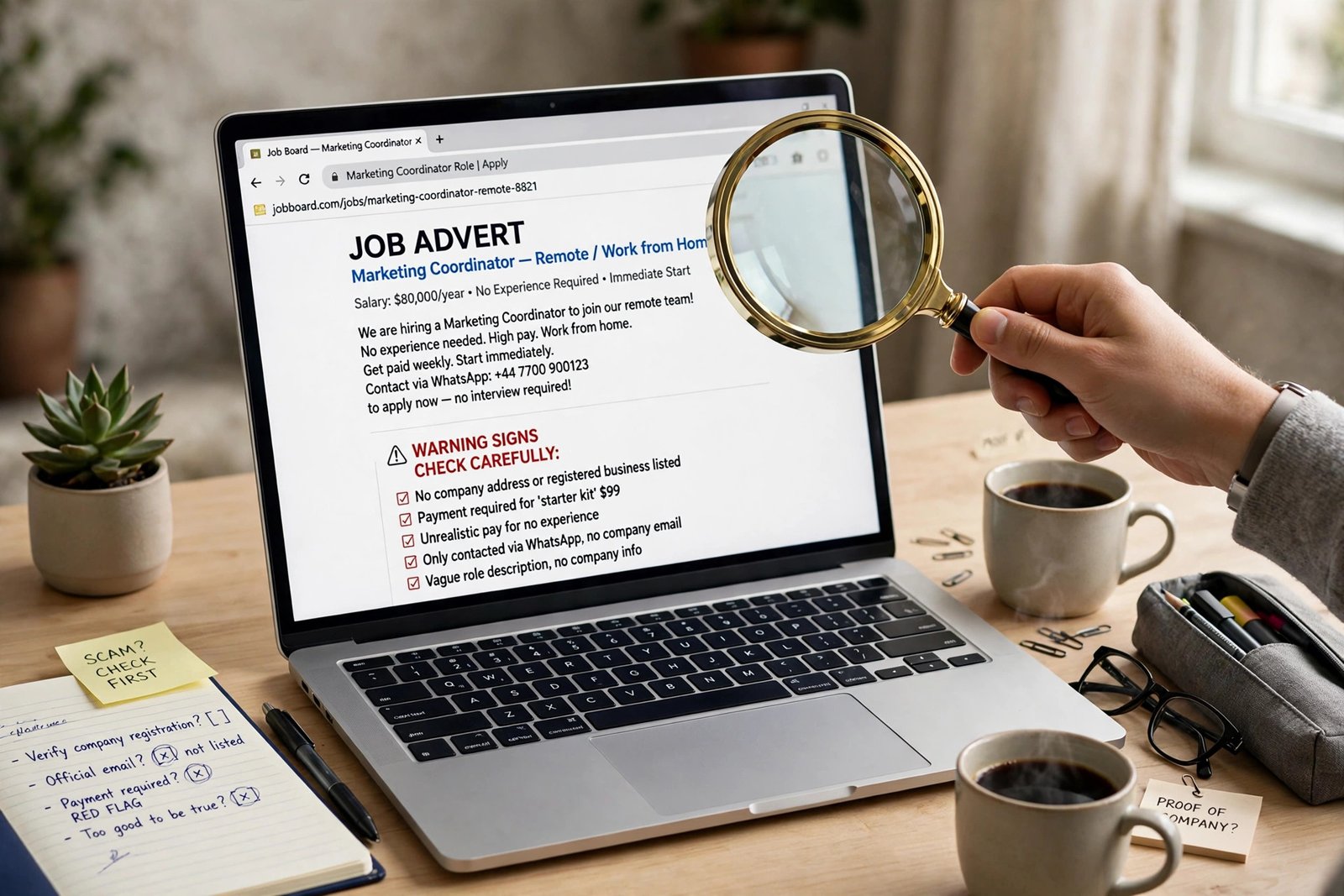
A magnifying glass over a data entry advert, checking it for scam warning signs.
A Practical Action Plan: Your Next Four Weeks
A clear plan turns reading into progress. The four-week plan below is realistic for most jobseekers and can be adjusted to your circumstances.
Week one: Prepare your foundations
Write or update your resume, focusing on accuracy, organisation, and any relevant administrative experience. Practise spreadsheet basics, including sorting, filtering, and checking for duplicates. Set up a simple application tracker and decide which job titles and working patterns you will target.
Week two: Research and apply thoughtfully
Search reputable job boards and employer careers pages, using both "data processing clerk" and "data entry clerk" as search terms. Read descriptions carefully, shortlist roles that genuinely match your skills, and submit a small number of tailored applications rather than a large number of generic ones. Note any skills gaps you discover and plan how to address them.
Week three: Practise and verify
Continue applying steadily, and practise for likely skills tests by working through sample data-checking exercises at a calm, accurate pace. Research any employer that contacts you before responding, and keep the scam warning signs in this guide in mind. If you are invited to interview, prepare examples of accurate, careful work.
Week four: Review, follow up, and adjust
Review your tracker: which applications led to responses, which search terms produced the best roles, and which skills employers asked for most often. Follow up politely on applications where a reasonable time has passed. Adjust your search if needed, for example by considering a related administrative role, a different sector, or a hybrid pattern that builds experience for a future remote move. Persistence, combined with honest self-review, is more effective than simply repeating the same approach.
For readers who need part-time hours around study, caring responsibilities, or another commitment, it can also help to compare data roles with the wider range of part-time remote jobs before deciding which pattern to prioritise. A part-time data processing role, where available, can offer the same accuracy-focused experience on a schedule that fits your life.
Frequently Asked Questions About Data Processing Clerk Jobs
Do data processing clerk jobs require a degree?
In most cases, no. Many employers ask for a high school diploma or equivalent, together with computer confidence, accuracy, and reliability. Some roles prefer previous office experience, while others provide training for beginners. Always check the individual job description, because requirements vary by employer and sector.
What is the difference between a data processing clerk and a data entry clerk?
The roles overlap heavily. General data entry work tends to focus on entering information, while data processing clerk jobs often also involve checking, cleaning, sorting, and preparing data for use. In practice, many employers use the titles interchangeably, so judge each vacancy by its listed duties rather than its title alone.
Can data processing clerk jobs be done remotely?
Some can, especially where source material is digital and the employer has secure remote systems. Others require office attendance because of paper records, specialist equipment, or data security rules. A job advertisement should state the working pattern clearly; if it does not, ask before accepting an offer.
Is a data entry clerk job a good first office job?
For many people, yes. It provides experience with office systems, record-keeping, accuracy, and teamwork, all of which transfer to other administrative and customer service roles. It suits people who enjoy structured, detail-focused work and who take satisfaction in keeping information in good order.
How can I tell if a data processing job advert is a scam?
Watch for requests for upfront payment, sensitive personal details requested too early, offers without a proper interview, requests to deposit checks and send money onward, and companies that cannot be verified. Genuine employers describe specific duties, identify themselves clearly, and use formal, secure application channels.
What skills should I practise before applying?
Focus on accurate typing, spreadsheet basics such as sorting and checking for duplicates, careful reading of instructions, and methodical error-checking. Practising these skills steadily, and being able to describe them honestly in an application, will help more than claiming advanced skills you have not yet developed.
How long does it take to find a data processing clerk job?
That depends on your location, working pattern, experience, and the number of suitable vacancies at the time. Some people find a role quickly, while others need several weeks of steady applications. A consistent routine, tailored applications, and honest review of what is and is not working will give you the best chance over time.
Conclusion: Are Data Processing Clerk Jobs Right for You?
Data processing clerk jobs offer a clear, practical route into office work for people who value accuracy, organisation, and steady, well-structured days. The work is not glamorous, and it is not for everyone: it rewards patience, focus, and care far more than speed alone or a desire for constant variety. But for the right person, it provides useful skills, experience with real business systems, and a foundation that can lead to wider administrative, customer service, or specialist data roles.
If this guide has helped you understand the role, your next step is simple. Prepare a careful, honest application, search using both data processing and data entry titles, verify every employer before you share personal details, and follow the four-week plan above. Apply thoughtfully, practise accuracy daily, and give yourself time to find a genuine role that fits your skills and your life. The best data processing clerk jobs go to candidates who do the small things well — and that is a habit you can start building today.