



Visa sponsorship jobs USA: eligibility, routes and safe application steps, explained honestly.
JOB DETAILS — AT A GLANCE
| Category | Visa Sponsorship Jobs |
| Location | USA |
| Job Type | Varies by route and role |
| Work Mode | Varies by role and visa route — check the official advert |
| Education Required | Varies by route and role |
| Experience | Varies by route and role |
| Skills | Varies by role and route |
| Salary | Varies by role — check the official advert; no figure is stated here |
| Who Can Apply | Applicants with a genuine job offer from a sponsoring employer who meet the route requirements |
| How to Apply | Via the employer’s official listing, followed by the employer’s petition process; check official guidance first |
Note: details vary by role and employer. Always check the official advert before applying.
Finding visa sponsorship jobs USA can feel confusing, and that confusion is exactly what makes this topic so important to get right. You may have seen job adverts that promise sponsorship, social media posts that claim a guaranteed work visa, or agents who ask for a large fee before you have even had an interview. Some of those offers are genuine. Many are not. And even a genuine offer does not, on its own, guarantee that a visa will be granted.
This guide is written to answer your questions in one place, in plain English. It explains what visa sponsorship actually means, who may be eligible in general terms, the main routes people hear about, how to search for genuine sponsored roles, how to spot scams, and what a realistic application journey looks like. It does not promise you a job or a visa, and it does not pretend that the process is quick or easy. What it does give you is a clear, organised way to judge opportunities, prepare properly, and protect yourself.
If you remember only one idea from this article, let it be this: in the United States, sponsorship is normally an employer-led process. In most cases, you cannot simply apply for sponsorship on your own and then look for work afterwards. An employer usually has to offer you a real job first, and then take formal steps with the government on your behalf. Understanding that order — job offer first, petition second, visa decision third — will help you recognise misleading claims straight away.
What Visa Sponsorship Really Means
Visa sponsorship is a general, everyday phrase rather than one single legal term. People use it to describe a situation where a United States employer supports a foreign worker’s immigration case so that the worker can legally work in the United States. That support can take different forms depending on the route, but the core idea is the same: the employer, not just the worker, is involved in the process.
In many temporary work routes, the employer files a petition with United States Citizenship and Immigration Services, usually known as USCIS. A petition is a formal request asking the government to recognise that a particular worker may fill a particular job under a particular category. If that petition is approved, the worker may then need to apply for a visa at a United States embassy or consulate, attend an interview where required, and meet all other conditions. Approval of a petition is therefore an important step, but it is not the same as holding a visa in your passport, and it is not the same as permission to start work on any date you choose.
In some permanent employment routes, the process is longer and involves more stages. The employer may first need to obtain a labour certification from the United States Department of Labor, showing that the required recruitment and wage steps have been followed. Only then may the employer file an immigrant petition with USCIS. After that, the worker’s case may need to wait until a visa number is available, depending on the category and the worker’s country of birth. This is why permanent sponsorship can take a very long time in some cases, and why no honest guide can give you one fixed timeline that applies to everyone.
It is also important to understand what sponsorship does not mean. It does not mean that an employer can simply write a letter and guarantee entry to the United States. It does not mean that paying a fee to an agent guarantees a visa. And it does not mean that every employer is willing, or legally able, to sponsor every role. Sponsorship usually involves cost, paperwork, legal responsibility and waiting time for the employer, so many employers only consider it for roles where they have a genuine hiring need and where the candidate clearly meets the requirements.
Another common misunderstanding is the difference between remote work and sponsored work in the United States. Working remotely for a company from your home country is not the same as being sponsored to live and work in the United States. A company may happily hire remote workers around the world, while still not offering United States visa sponsorship for that same role. When you search for visa sponsorship jobs USA, always check whether the advert actually says that sponsorship is available, or whether it only says that the role is remote. Those are two different promises, and confusing them can waste months of effort.
Who Is Eligible? The Honest, General Answer
There is no single eligibility checklist that covers every sponsored worker, because eligibility depends on the visa category, the job, the employer and your own background. Anyone who tells you that everyone is eligible, or that eligibility can be decided from one short form, is oversimplifying a complex system. What follows is a general guide to the kinds of factors that usually matter, not a personal eligibility decision.
First, the job itself matters. Many sponsored routes are tied to a specific job with a specific employer. That means the role must fit the category being used. For example, some categories are designed for specialist professional roles that normally require a degree or equivalent specialist knowledge. Others are designed for seasonal or temporary work where an employer can show a short-term need. Still others are designed for managers, executives or employees transferring within the same multinational company. If the job does not fit the category, sponsorship under that category is unlikely to work, however strong your CV may be.
Second, your qualifications and experience matter. For professional routes, employers and the government will look at your education, your work history and whether your skills match the job description. This is not only about having a certificate. It is about showing, with evidence, that you can do the job described, and that you meet any specific requirements for that category. Degrees and qualifications from outside the United States may need to be explained or evaluated, depending on the case, and you should keep clear, honest records of your education and employment.
Third, the employer matters just as much as you do. The employer must generally be a genuine United States employer offering a genuine job, and must be willing and able to complete the required steps. Some employers have experience with sponsorship and have legal support in place. Others have never sponsored anyone before and may not realise what is involved until they look into it. That is why it is helpful, during a job search, to focus on employers who have a history of hiring internationally or who state clearly in their adverts that they will consider sponsorship. Even then, willingness to consider sponsorship is not a promise to sponsor a particular candidate.
Fourth, your immigration history and personal circumstances can matter. Previous visas, previous travel, previous refusals, criminal history, health requirements and family circumstances can all affect a case, depending on the category. This guide does not attempt to list every rule, because the rules are detailed and they change. The safe approach is to be honest in every application, to keep copies of every document you submit, and to seek professional advice early if your history is complicated in any way. Hiding information or submitting false documents can cause far more harm than a delay, and can affect future applications.
Finally, timing and numerical limits matter. Some categories have annual caps or quotas. That means that even a strong candidate with a genuine offer may not be selected or processed in a particular year, depending on demand. Other categories may involve waiting for a visa number to become available. This is frustrating, but it is a normal part of the system, and it is another reason to be cautious about anyone who promises a fast, guaranteed result.
In short, eligibility is not a yes-or-no label you can claim for yourself. It is a match between you, a real job, a willing employer and a specific immigration category, all judged against rules that only the government can finally decide. A realistic approach is to ask, for each opportunity: does this job fit a recognised category, does my background fit this job, and is this employer genuinely prepared to sponsor?
Temporary Routes and Permanent Routes: The Big Difference
When people search for visa sponsorship jobs USA, they often mix together two very different ideas: working in the United States for a limited period, and moving to the United States permanently. Both can involve employer sponsorship, but they work differently, and the difference affects your planning.
Temporary, or nonimmigrant, routes allow a person to live and work in the United States for a limited period, under specific conditions. The permission is normally tied to the employer and the job named in the petition. That means you cannot usually change employer, change role or change location freely without further approval. Some temporary categories can be extended, and some people later move to a permanent route, but that later step is a separate process with its own requirements. Temporary permission should not be assumed to lead automatically to permanent residence.
Permanent, or immigrant, employment routes can lead to lawful permanent residence, often called a Green Card. These routes are generally divided into preference categories based on skills, qualifications and type of work, ranging from priority workers through professionals and skilled workers to certain special immigrants and investors. The United States Department of State publishes information about these categories, and the process often involves labour certification, an immigrant petition and a visa application stage. Because numbers are limited each year, waiting times can vary greatly by category and by country of birth, and no one can honestly promise a date on which a visa will become available.
Understanding this distinction helps you read job adverts more carefully. An advert that offers a seasonal role for a few months is very different from an advert that offers a permanent professional role with long-term sponsorship. Both may be genuine, but they lead to different rights, different lengths of stay and different next steps. Before you apply, ask yourself which kind of opportunity you are actually looking for, and whether the advert is clear about it. If it is not clear, that is a question to ask the employer directly, in writing, before you invest too much time.
Common Temporary Work Routes in General Terms
The following routes are described in general terms only, to help you recognise the names you will see in job adverts and official guidance. This is not legal advice, and the details for each route are more complex than any short summary can show. Always check the current official guidance for the exact category that applies to you.
H-1B: Specialty Occupations
The H-1B category is one of the best known routes for professional work in the United States. In general terms, it is designed for roles that are considered specialty occupations, meaning roles that normally require specialist knowledge and, in many cases, a degree or equivalent in a specific field. The employer must first take steps with the Department of Labor, including filing a labour condition application, and then file a petition with USCIS on the worker’s behalf. There are annual numerical limits for many H-1B cases, and a selection process applies in cap-subject cases, so not every petition can be filed or approved in a given year.
Because H-1B is so well known, it is also one of the categories most often misrepresented in scams. Be cautious about anyone who claims they can guarantee H-1B selection, or who asks you to pay a large fee simply to enter a lottery or register interest. The genuine process is employer-led, and the employer, not an unrelated agent, is normally the petitioner. If you are interested in this route, the most practical step is to build skills and experience in a specialist field, target employers who genuinely hire for those roles, and check current official guidance before assuming that a particular job qualifies.
H-2A and H-2B: Seasonal and Temporary Work
H-2A is generally associated with temporary agricultural work, where an employer can show a temporary or seasonal need and a shortage of available United States workers for that work. H-2B is generally associated with temporary non-agricultural work, such as seasonal roles in hospitality, landscaping, construction support and similar fields, again where the employer can show a temporary need. Both routes are employer-led, both involve petitions, and both depend on the job being genuinely temporary in nature.
These routes can be a realistic option for people with relevant experience in seasonal industries, but they are not a general route into any job in the United States. The job must fit the category, the employer must follow the required recruitment and certification steps, and the work is tied to the period and conditions approved. If an advert promises H-2B sponsorship for a permanent office job, or H-2A sponsorship for work that is clearly not agricultural or seasonal, treat that as a warning sign and check the official description of the category before proceeding.
L-1: Intracompany Transfers
The L-1 category is generally for employees of multinational companies who transfer to a United States office of the same company group. One part of the category is commonly associated with managers and executives, and another part with employees who have specialised knowledge of the company’s products, services or processes. This route is therefore most relevant if you already work for a multinational employer, or if you are planning a career path that could lead to an internal transfer in the future.
L-1 is not normally a route you can use by applying directly to an unrelated United States employer. The employment relationship with the overseas company, and the relationship between the overseas and United States companies, are central to the category. If a recruiter who has no connection to your current employer promises you an L-1 visa for a brand-new job with a different company, be very cautious and seek official guidance before paying anything.
O-1, TN and Other Specialist Categories
Other categories cover more specific situations. The O-1 category is generally associated with individuals who can show extraordinary ability or achievement in fields such as science, education, business, arts or athletics, supported by strong evidence of recognition. The TN category is generally available to certain professionals from Canada and Mexico under the United States-Mexico-Canada Agreement, for listed professions, and requires a job offer and proof of qualifications. There are also categories for treaty traders and investors, religious workers, athletes and entertainers, and other specialist situations.
You do not need to memorise every category to start your search. What matters is recognising that different categories have different purposes, and that a job advert should make sense for the category it mentions. If an advert uses an impressive-sounding visa name but the job described has nothing to do with that category, that mismatch is worth questioning. A genuine employer or adviser should be able to explain, in plain terms, which category they have in mind and why the role fits it.
Permanent Employment Routes in General Terms
Permanent employment-based immigration is organised into preference categories. The United States Department of State describes five broad employment-based preferences, covering priority workers, professionals with advanced degrees or exceptional ability, skilled workers, professionals and other workers, certain special immigrants, and immigrant investors. The details, quotas and waiting times differ by category, and some categories require labour certification while others do not.
For many professional and skilled worker cases, the employer must first obtain a labour certification through the Department of Labor’s permanent labour certification system, commonly known as PERM. In general terms, this process is designed to test whether there are qualified, willing and available United States workers for the role, and whether employing a foreign worker would adversely affect wages and working conditions for similarly employed United States workers. The employer must follow recruitment steps, offer the required wage, and file the certification application. Only after certification, where required, can the employer file an immigrant petition with USCIS.
This is a slow, evidence-heavy process by design, and it is employer-led at every stage. As a jobseeker, your practical role is to be a strong, honest candidate for a genuine permanent role, to provide accurate documents, and to understand that the employer and its legal advisers will handle the formal filings. If someone offers to sell you a permanent labour certification, or asks you to pay for a job offer that exists only on paper, that is a serious warning sign. Genuine permanent sponsorship starts with a genuine job, not with a payment.
It is also worth noting that permanent residence is not the same as citizenship, and that family members may be able to accompany or follow the main applicant in many employment-based cases, subject to the rules for that category. If you are applying with a partner or children, ask early about how the category treats dependants, and make sure you understand what permission each family member would actually hold. Do not assume that every family member automatically receives the same work rights.
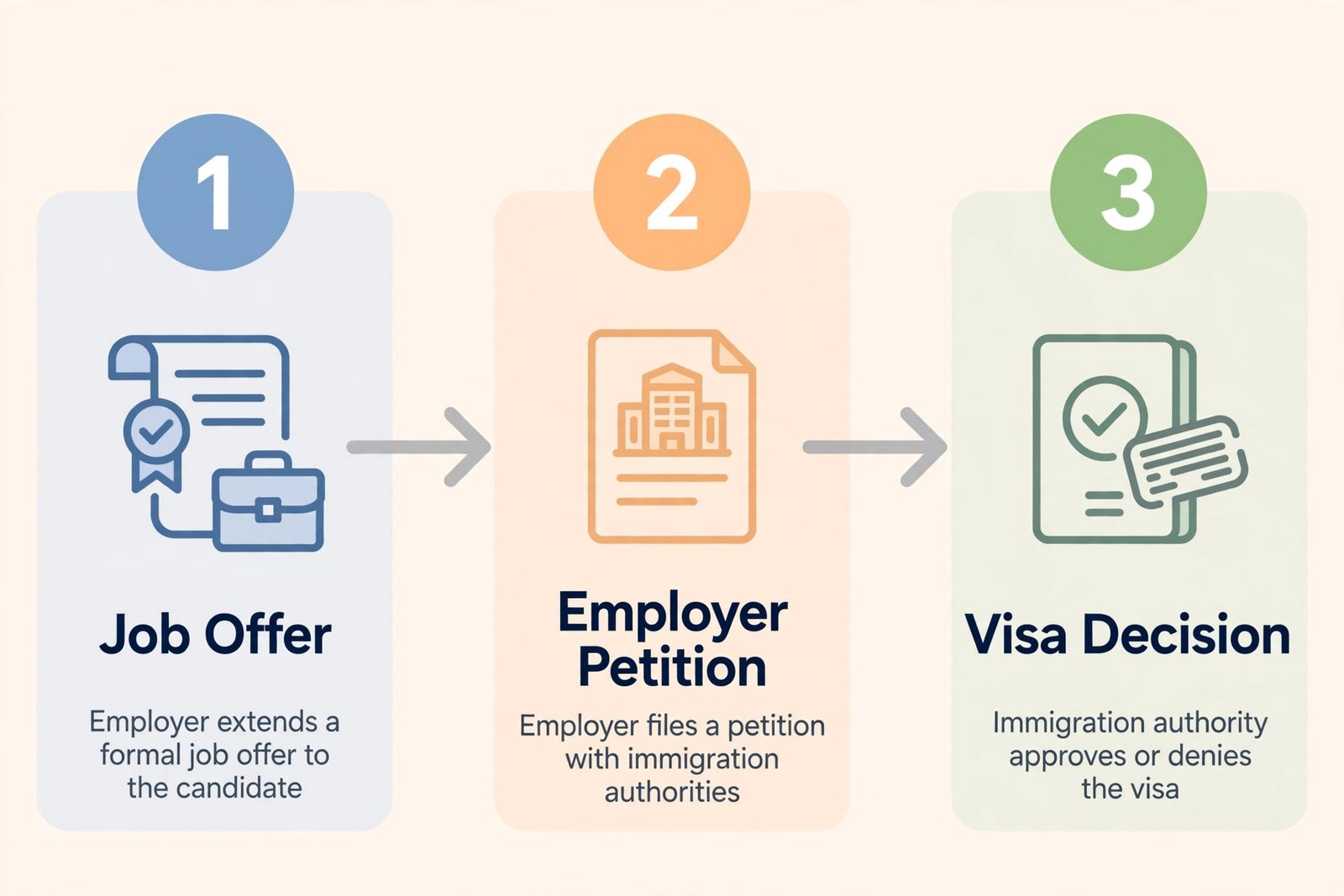
A simple three-step diagram: genuine job offer, employer petition, then visa decision.
How to Get a Job in USA With Visa Sponsorship: A Step-by-Step Guide
This section answers, step by step, the question behind the secondary phrase "how to get a job in usa with visa sponsorship". It is a practical job-search guide, not a visa guarantee, and it follows the normal order of the process: prepare, target the right employers, apply well, interview honestly, and only then deal with sponsorship paperwork.
Step 1: Be Clear About What You Can Offer
Before you apply anywhere, write down, in one page, what you actually offer an employer. List your qualifications, your work experience with dates and duties, your technical or professional skills, your English level, and any licences or certificates you hold. Be specific. Instead of writing "good at computers", write the software, tools or systems you have used, and what you did with them. Instead of writing "experienced in customer service", write the type of customers you served, the channels you used, and the results you achieved where you can honestly state them.
If you are just starting out, JobEdge’s Remote Jobs No Experience category may also be useful for building relevant experience. This clarity helps you in two ways. First, it stops you applying for roles that do not fit your background, which saves time and reduces disappointment. Second, it helps an employer see quickly why you are worth sponsoring. Sponsorship costs an employer time and money, so a clear, relevant profile matters far more than a long list of unrelated jobs. If you have gaps in your experience, do not invent experience to fill them. Instead, think about what training, volunteering, freelance work or entry-level experience could genuinely strengthen your profile over the next few months.
Step 2: Target Employers Who Actually Sponsor
Not every employer sponsors, and not every large company sponsors for every role. A more effective search is a targeted search. Look for employers who state in their job adverts that they will sponsor, or who have a visible history of hiring international workers. Check the careers pages of companies in your field, read the full job description rather than only the title, and look for phrases such as "visa sponsorship available", "will sponsor" or "sponsorship considered". Treat vague phrases with care, and be ready to ask for clarification.
It can also help to search by field rather than by visa alone. For example, technology, healthcare, engineering, research and certain skilled trades often have more structured international hiring than fields where local hiring is easier. That does not mean other fields never sponsor, but it does mean that a broad search for "any sponsored job" is less useful than a focused search in a field where your skills are genuinely in demand. Keep a simple record of every employer you target, the role, the date you applied and any reply you receive, so that you can follow up professionally and avoid applying twice for the same role. For broader United States-based remote options alongside sponsored roles, see JobEdge’s Remote Jobs USA listings.
Step 3: Search in the Right Places, and Read Adverts Properly
Use reputable job boards, company careers pages and professional networks, and read each advert in full before applying. A genuine sponsored role will normally describe the job, the location, the required qualifications, the working pattern and the application process. It will normally direct you to apply through the employer’s own system or a recognised job platform, and it will not ask you to send money, passport scans or bank details at the first contact.
When you filter for sponsorship, remember that filters on job boards are not always accurate. An advert may be tagged as offering sponsorship when it does not, or a genuine sponsored role may not be tagged at all. Use filters as a starting point, then verify by reading the advert and, if needed, by asking the employer. Also be careful with adverts that appear on social media or messaging apps but have no matching listing on the employer’s own website. A genuine role can be shared on social media, but you should still be able to trace it back to a real employer and a real application route.
Step 4: Prepare a United States-Style CV and Cover Letter
A CV for the United States market is usually concise, clear and focused on achievements and skills relevant to the role. Keep it to a sensible length, use plain headings, and put your most relevant experience first. Include your education, your work history with dates, and any skills or certifications that match the job description. Do not include a photograph, your date of birth, your marital status or other personal details that are not normally requested in a United States job application, unless the employer specifically asks for them for a lawful reason.
Your cover letter, where requested, should be short and specific. Explain why you are interested in this role, why your background fits it, and, where relevant, that you would require visa sponsorship and that you understand the process is employer-led. Being upfront about sponsorship is normally better than hiding it until late in the process, because it allows the employer to decide early whether sponsorship is possible for that role. At the same time, keep the focus on the value you bring to the job, not only on your need for a visa. Employers sponsor people because they need the worker, not because they are doing a favour.
Step 5: Apply, Interview and Be Honest About Sponsorship
Apply only for roles you genuinely fit, follow the employer’s instructions exactly, and keep copies of everything you submit. If you are invited to interview, prepare by researching the company, reviewing the job description, and practising clear answers about your experience and skills. Be ready to discuss sponsorship calmly and factually: what category, if any, you think might apply, what your current status is, and what steps you understand would be needed. You do not need to be an immigration expert, but showing that you understand the basics will reassure a genuine employer.
During interviews, do not exaggerate qualifications, invent employers, or claim experience you do not have. Employers check references and documents, and immigration authorities check petitions carefully. A small exaggeration on a CV can become a serious problem later if it appears in a formal petition. If you do not know the answer to a sponsorship question, say so honestly, and offer to check official guidance or to speak to a qualified adviser. Honesty at this stage protects both you and the employer.
Step 6: Understand the Offer, Then the Petition
If you receive an offer, read it carefully before accepting. Check the job title, duties, location, salary, working hours, start date and any conditions. Ask, in writing, whether sponsorship is included, which category is being considered, who will handle the legal filings, and what the expected next steps and timescales are in general terms. A genuine employer should be able to give you a clear, written outline, even if exact dates cannot be promised.
After acceptance, the employer normally begins the petition process, which may involve labour steps with the Department of Labor, a petition to USCIS, and then a visa application and interview stage for you. Follow instructions carefully, provide documents promptly, and keep copies of every form, receipt and decision. Do not pay fees to third parties unless you have verified, in writing, that the fee is legitimate, who it is payable to, and what it covers. If anything in the process does not match official guidance, pause and check before proceeding.
Step 7: Plan for Waiting, and Keep Alternatives Open
Sponsorship takes time, and waiting is a normal part of the process. While you wait, keep your skills current, keep records up to date, and avoid making irreversible decisions based on an expected approval date. Do not resign from a current job, sell property, book non-refundable travel or pay large sums on the assumption that a visa will be granted by a particular date, unless you have received a formal decision that allows you to do so safely.
It is also wise to keep your job search realistic. Applying for sponsored roles does not prevent you from developing your career where you live now, gaining experience, or considering other lawful routes in the future. A stronger profile today can improve your chances tomorrow, whether that means further training, a recognised qualification, or experience with an international employer. Patience and steady preparation are far more useful than rushing into a risky offer because it promises speed.
How to Find Genuine Sponsored Roles, and What to Avoid
A genuine sponsored role usually has several reassuring features. The employer is identifiable, with a real website, a real address and a real careers page. The job description is detailed and specific, with duties, requirements and a location that make sense for the role. The application route is through the employer or a recognised platform, not only through a private messaging account. The employer is willing to discuss sponsorship openly, in writing, and does not pressure you to pay quickly. And the salary, working pattern and conditions are realistic for the job and location.
By contrast, several patterns should make you pause. Be cautious if a role is advertised with a very high salary for very simple work, if the employer cannot be found online, if the job description is copied from another company, or if you are offered a job without any interview or skills check. Be cautious if you are asked to pay for a job offer, a visa, a work permit, training, travel or processing before you have a genuine offer and a clear, verifiable process. Be cautious if you are asked to send passport scans, bank details or large payments through informal channels. And be cautious if someone claims to be an agent for a well-known company but contacts you only from a personal email address or messaging account, with no way to verify them through the company itself.
One useful check is to search for the employer and the role independently, rather than only clicking links sent to you. Visit the company’s official careers page yourself, search for the job title on reputable job boards, and check whether the contact details match the company’s published details. If you cannot verify the employer, do not proceed, and do not send personal documents. You can also check official government guidance about the visa category mentioned, to see whether the job described could plausibly fit that category.
Remember that legitimate recruitment agencies do exist, but a legitimate agency should be transparent about who it represents, what it charges, if anything, and what it will and will not do for you. If an agency refuses to name the employer, refuses to put terms in writing, or pressures you to decide immediately, walk away. A genuine opportunity will survive a careful check. A scam often depends on speed, secrecy and pressure.

A jobseeker reading a sponsored job advert in full on a laptop, with a checklist beside it.
Scam Warnings: The Red Flags That Matter Most
Scams targeting people looking for visa sponsorship jobs USA are common, and they often look professional. They may use stolen company logos, fake job adverts, fake offer letters and convincing websites. The following red flags, taken together, are the most important to remember.
First, any demand for upfront payment for a job offer or a guaranteed visa should be treated as a serious warning. Genuine employers do not normally sell jobs, and government visa fees are paid through official channels, not to a private individual through a messaging app. If you are told that payment will guarantee selection, speed up a decision, or secure a visa that would otherwise be refused, that claim is not credible, however professional the message looks.
Second, be wary of guarantees. No employer, agent or adviser can guarantee that USCIS or a consulate will approve a petition or visa, because the decision rests with the government. Phrases such as "100 percent guaranteed visa", "no interview needed, guaranteed" or "visa in seven days, guaranteed" should be treated as marketing, not fact. A genuine adviser will explain risks, timelines in general terms, and the possibility of refusal, rather than promising success.
Third, watch for poor verification. If you cannot verify the employer, the recruiter, the job or the agency through independent sources, do not trust the offer on the strength of a single message or document. Fake offer letters are easy to create, and a logo or letterhead proves nothing on its own. Verify through the employer’s official website, official contact details and reputable job platforms, and keep a record of what you checked.
Fourth, protect your documents and money. Do not send passport scans, identity documents, bank details or payment information to someone you have not verified, and do not share one-time codes or account passwords with anyone claiming to help your application. If you have already shared information or paid money to someone you now suspect, keep all messages and receipts, stop further payments, and consider seeking advice from a trusted source, such as a qualified immigration lawyer, a consumer protection body in your country, or the relevant authorities. Acting quickly can limit harm, even if money already paid cannot always be recovered.
Finally, remember that desperation is part of the scam. Scammers often create urgency by saying that a role will close today, that only one place remains, or that you will lose a visa opportunity if you do not pay now. A genuine hiring process allows time for questions, checks and written confirmation. If you feel rushed, pressured or afraid to ask questions, that feeling itself is useful information. Slow down, verify independently, and do not let urgency override common sense.
Realistic Expectations: Time, Cost and Uncertainty
One of the hardest parts of searching for visa sponsorship jobs USA is managing expectations. It is natural to hope for a quick result, especially if you have family responsibilities or a strong desire to move. But a realistic view will protect you from disappointment and from risky decisions.
Time is the first reality. Even a straightforward employer-led case involves multiple stages: job search, interviews, offer, labour or petition steps, government processing, and, where required, a visa interview and travel. Each stage can take weeks or months, and some permanent cases can take far longer. Delays can happen for reasons that have nothing to do with you, such as high demand, requests for additional evidence, or changes in processing. No honest guide can give you a single timeline, and anyone who does should be treated with caution.
Cost is the second reality. There are government fees for petitions and visa applications, and employers may also pay legal costs, depending on the arrangement. The exact amounts depend on the category and change over time, so this guide deliberately does not list specific fees. What matters for you is to understand, before you proceed, who is expected to pay each fee, through which official channel, and what is not included. Never pay a fee to a private individual without written, verifiable confirmation of what it covers and who will receive it.
Uncertainty is the third reality. A strong application can still be refused, a cap can fill, a role can close, or an employer’s sponsorship plans can change. That does not mean your effort was wasted, but it does mean you should avoid putting your whole future on a single application. Keep building skills, keep records, and keep alternative plans open. Many people who eventually secure sponsored work do so after several applications, over a long period, and after improving their profile between attempts.
It is also important to be realistic about the job itself. Sponsored work in the United States is real work, with real duties, real working hours and real workplace expectations. Adverts that promise very high pay for very little work, permanent remote work from anywhere in the world with United States sponsorship, or a visa without any real job duties, are unlikely to describe genuine sponsored employment. Focus on roles where your skills are genuinely needed, and where the job description makes sense as a full, lawful job.
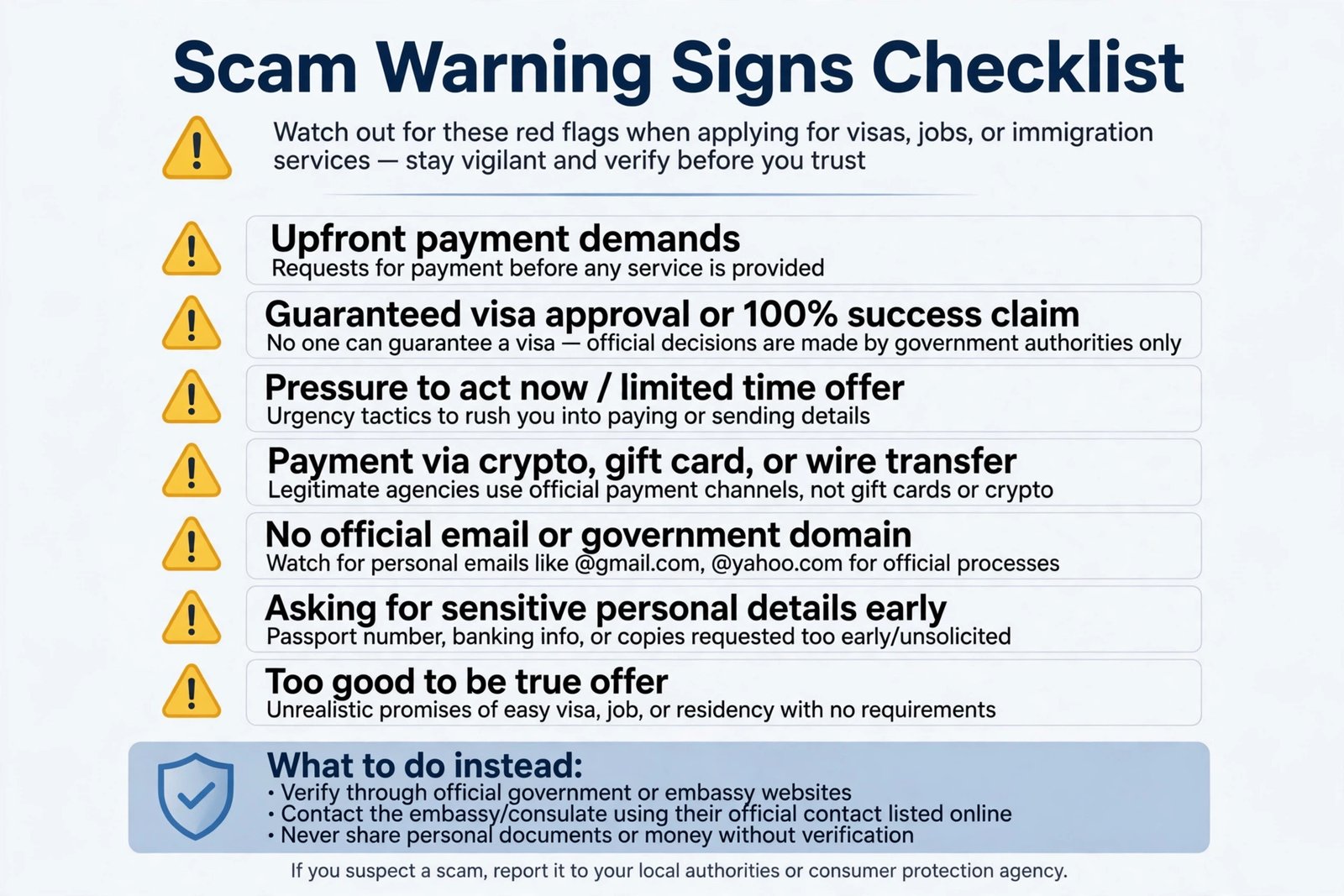
A warning checklist showing upfront-payment demands and guaranteed-visa claims as red flags.
A Simple Checklist Before You Apply
Before you send an application for a sponsored role, run through this short checklist. It takes only a few minutes, and it can save you months of wasted effort.
First, can you identify the employer independently, and does the role appear on the employer’s own careers page or a reputable job board? Second, does the job description describe real duties, real requirements and a real location, and does it fit a recognised visa category in general terms? Third, does the advert or employer state clearly whether sponsorship is available, considered or not available, rather than leaving it vague? Fourth, is the application route through the employer or a recognised platform, with no demand for upfront payment or sensitive documents at first contact? Fifth, does the salary and working pattern sound realistic for the role and location? And sixth, have you kept a copy of the advert, the application and any messages, so that you can refer back to them later?
If you cannot answer yes to most of these questions, do not rush ahead. Ask the employer for clarification in writing, check official guidance, or move on to a better-verified opportunity. A careful application to a genuine employer is worth far more than ten rushed applications to unverified adverts.
Frequently Asked Questions About Visa Sponsorship Jobs USA
Do I need a job offer before sponsorship can start?
In most employer-sponsored routes, yes. The normal order is a genuine job offer first, followed by employer filings, followed by a government decision. There are a small number of categories where self-petitioning is possible in specific circumstances, but those are exceptions with strict requirements, not a general alternative to finding an employer. If someone tells you that you can secure sponsorship without a job offer, ask them to explain exactly which category they mean, and check that explanation against official guidance.
Can any employer sponsor any worker?
No. An employer must be willing and able to sponsor, the job must fit the category being used, and the worker must meet the relevant requirements. Sponsorship also involves cost, paperwork and legal responsibility for the employer, so many employers only sponsor for certain roles or certain levels of seniority. That is why targeting employers who already sponsor, and roles where sponsorship is plausible, is more effective than applying everywhere.
Does remote work count as United States sponsorship?
Not automatically. Working remotely from outside the United States for a company is different from being sponsored to live and work in the United States. A remote role may be open to workers around the world without any visa sponsorship, or it may be limited to workers already authorised to work in the United States. Always check whether the advert actually offers sponsorship, and whether the role requires you to be based in the United States.
How long does sponsorship take?
There is no single answer, because the time depends on the category, the employer’s steps, government processing, and whether additional evidence is requested. Temporary cases can be faster than permanent cases, but even temporary cases involve several stages. This guide does not give a fixed timeline, because any fixed timeline would be misleading. Check current official processing information for the specific category, and ask the employer for a general outline of its own steps.
Do I have to pay for sponsorship myself?
It depends on the category and the arrangement, and the rules about who may pay particular fees can be complex. Some fees must be paid by the employer, while other costs may be borne by the worker, depending on the case. Do not assume that paying a large fee to an agent is normal, and never pay through informal channels. Ask for a written breakdown, verify it against official guidance, and seek professional advice if you are unsure.
Can my family come with me?
In many employment-based categories, a spouse and unmarried children under a certain age may be able to accompany or follow the main applicant, subject to the rules for that category. Work rights for family members depend on the category and on the specific permission granted, and should not be assumed. Ask early, and check official guidance for the category that applies to your case.
What should I do if I think I have been scammed?
Stop further payments, keep all messages, adverts, documents and receipts, and do not send further personal information. Consider seeking advice from a qualified immigration lawyer or a trusted consumer protection source in your country. You may also wish to report the matter to the relevant authorities, depending on where you live and where the scammer operated. Acting quickly and keeping evidence can help, even if recovery of money is not always possible.
Is search volume the same as job availability?
No. The fact that a phrase such as visa sponsorship jobs usa is searched a certain number of times each month tells you about interest in the topic, not about how many sponsored jobs are available, how many employers are hiring, or how likely any individual applicant is to succeed. Use search data as background information only, and judge each opportunity on its own merits, through verified employer and official sources.
Official sources to check before you rely on any summary: the U.S. Department of State explains employment-based immigrant visas, USCIS explains H-2A temporary agricultural workers, and the U.S. Department of Labor explains the H-1B program. Immigration rules change, so always check the official source for your route before applying.
Conclusion: A Careful Search Is a Stronger Search
Visa sponsorship jobs USA attract a great deal of interest, and that interest creates both genuine opportunity and genuine risk. The strongest approach is not the fastest approach, and it is not the approach that promises the most. It is the careful approach: understanding that sponsorship is employer-led, targeting roles and employers where sponsorship is plausible, preparing a clear and honest application, verifying every opportunity independently, and refusing to pay for guarantees that no one can honestly give.
If you take one practical plan from this guide, let it be this. Build a profile that a real employer needs, search in reputable places, read adverts properly, ask sponsorship questions early and in writing, keep copies of everything, and check official guidance before making decisions. Be patient with waiting times, be honest in every application, and be sceptical of urgency, secrecy and upfront payments. That approach will not guarantee a visa, and no honest guide can promise one, but it will give you the best possible chance of finding a genuine opportunity — and of avoiding the scams that target hopeful jobseekers.
Start with the next step, not with the whole journey at once. Browse current openings via JobEdge’s Jobs page as you build your shortlist. Choose a field where your skills fit, identify a small number of genuine employers, prepare one strong application, and verify it carefully before you send it. Then repeat that process, learn from each response, and keep improving your profile. A careful, organised search is not only safer; over time, it is also more effective.



Pingback: Green Card Sponsorship Jobs: Honest 2026 Guide
Pingback: h2b visa sponsorship jobs: USA seasonal work guide
Pingback: What Does Visa Sponsorship Job Mean? Explained