



Remote customer service jobs UK: helping customers from home, by phone, chat or email.
JOB DETAILS — AT A GLANCE
| Category | Remote Customer Service Jobs |
| Location | UK — work from home |
| Job Type | Full-time and part-time (varies by role) |
| Work Mode | Remote |
| Education Required | Varies by role |
| Experience | Varies by role; some roles suit beginners |
| Skills | Communication, problem-solving, patience and typing skills |
| Salary | Varies by role — check the official advert; no figure is stated here |
| Who Can Apply | Jobseekers in the UK who meet the employer’s eligibility and right-to-work requirements |
| How to Apply | Online, with a tailored CV and cover note, via the employer’s official listing |
Note: details vary by role and employer. Always check the official advert before applying.
If you enjoy helping people, solving problems, and working in a structured team, remote customer service jobs in the UK could be a strong fit. These are roles where you support customers from home, usually by phone, live chat, or email, instead of travelling to a call centre or office every day. For many jobseekers, the appeal is clear: no commute, a quieter working routine, and the chance to build a steady career in customer support without relocating.
But remote customer service work is also real work, with real expectations. You will usually follow set shift patterns, meet quality and response standards, handle difficult conversations calmly, and use several computer systems at once. This guide explains what remote customer service jobs UK employers typically look for, the main role types, how shifts usually work, what skills matter most, how to set up your home workspace, how to spot genuine vacancies, and how to apply with confidence. It ends with a practical action plan you can start this week.
Throughout this guide, pay is discussed only in general terms. Pay varies by employer, role, hours, location, and experience, and individual job adverts are the reliable place to check the rate for a specific vacancy. Nothing here should be read as a promise about what any particular employer pays.
What Are Remote Customer Service Jobs?
A remote customer service job is a role in which you help customers from a location outside the employer’s office, most often your home. Customers may contact you because they have a question about an order, need help with an account, want to change a booking, are experiencing a technical problem, or wish to make a complaint. Your job is to listen carefully, understand the issue, find the right solution within company policy, and leave the customer feeling heard and helped.
Remote does not mean unsupervised or unstructured. Most remote customer service teams work to rotas, use shared messaging tools, attend virtual team meetings, and have team leaders who monitor queues, coach staff, and step in on complex cases. You may work alone at your desk, but you are part of a team, and communication with colleagues is a daily part of the role.
Some roles are fully remote, meaning you work from home for all of your contracted hours. Others are hybrid, with some days at home and some days in an office or contact centre. A job advert should state which pattern applies, and it is worth checking this before you apply, because "remote" is sometimes used loosely. If an advert says "remote" but later mentions regular office attendance, ask the recruiter to clarify the expected pattern in writing before you accept an offer.
Remote customer service jobs UK vacancies appear across many sectors. Retailers, banks and insurers, telecoms providers, energy and utility companies, travel firms, delivery and logistics businesses, healthcare support services, and public-sector organisations all run customer contact teams. The day-to-day work differs by sector — for example, helping someone track a parcel is different from helping someone understand a bill — but the core skills of listening, explaining clearly, and solving problems remain the same.
Who This Kind of Work Suits
Remote customer service work tends to suit people who are patient, organised, and comfortable talking to strangers all day. You need to stay calm when a customer is frustrated, stay focused when the work is repetitive, and switch smoothly between different queries. Good written English matters too, especially for chat and email roles, where spelling, grammar, and tone are visible to the customer.
It can also suit people who value routine and clear expectations. Shifts, breaks, targets, and procedures are usually well defined, which some people find reassuring. At the same time, it is not the right choice for everyone. If you strongly dislike scripted conversations, back-to-back contact, or working to measured response times, a different kind of remote role may suit you better. Being honest with yourself about this before you apply will save you time and disappointment later.
The Main Types of Remote Customer Service Roles
Not all remote customer service jobs are the same. The channel you work on — phone, chat, or email — shapes the pace, the skills you need, and the kind of day you will have. Many employers now offer omnichannel roles, where you handle more than one channel, but most vacancies still lean towards one main channel.
Phone-Based Customer Service Roles
Phone roles are the most traditional form of customer service. You answer inbound calls, and in some roles you may also make outbound calls, for example to follow up on a query or confirm an arrangement. Phone work is fast-paced and immediate: the customer is waiting on the line, so you need to think quickly, speak clearly, and keep accurate notes while you talk.
Employers usually check your spoken communication closely in phone roles. They listen for a warm, professional tone, clear pronunciation, and the ability to explain steps without rushing or confusing the customer. A quiet home environment matters a great deal here, because background noise can make calls difficult and unprofessional. If your home is noisy during the day, a phone role may be harder than a chat or email role, and it is worth being realistic about that when you choose which vacancies to pursue.
Live Chat Customer Service Roles
Live chat roles involve helping customers through written messages on a website or app. You may handle several chats at once, which requires strong multitasking and fast, accurate typing. The advantage is that you have a few moments to check information before replying, and you do not need a silent room in the same way a phone agent does.
Chat roles suit people who write well and can keep a friendly, human tone in text. Customers can usually tell when a reply is copied and pasted without thought, so the best chat agents personalise their messages, use the customer’s name where appropriate, and explain next steps in short, clear sentences. Good spelling and grammar are essential, because written mistakes are harder to overlook than a small slip in speech.
Email Customer Service Roles
Email roles involve replying to customer messages that do not need an instant answer. This gives you more time to research a problem, check records, and draft a careful response. Email work often involves longer, more detailed cases, such as complaints, refunds, or account changes that need several steps to resolve.
These roles suit people who are methodical and detail-oriented. You need to read a message fully before replying, avoid missing a second question buried at the end of an email, and keep a clear record of what you promised. Email agents also need to manage a queue sensibly, prioritising urgent or time-sensitive cases rather than simply answering messages in the order they arrived.
Specialist and Senior Variations
As you gain experience, you may move into specialist or senior variations. These can include complaints handling, technical support, social media customer care, quality coaching, or team leadership. Complaints roles require particular care, because customers are often unhappy and the outcome may involve goodwill gestures or escalation within company policy. Technical support roles require stronger product knowledge and the ability to guide a customer through troubleshooting steps patiently.
You do not need to aim for a senior role immediately. Many people start in a generalist role, learn the systems and products, and then move sideways or upwards as vacancies open. When you read adverts, look for whether the role offers training and progression, because that tells you something about how the employer develops its team.

A customer service worker at home wearing a headset, helping a customer on a laptop.
Shift Patterns: What to Expect
Shift patterns are one of the most important details in any remote customer service job, and they vary widely. Customer contact teams often operate beyond standard office hours, because customers contact businesses in the evenings, at weekends, and sometimes around the clock. Before you apply, read the shift information carefully and ask yourself whether the pattern genuinely fits your life.
Common Shift Patterns
Many remote customer service roles use rotating rotas. You might work a mix of early shifts, late shifts, and weekend days, with rest days that fall on different weekdays each week. Others offer fixed shifts, such as weekday daytime hours, or part-time patterns covering evenings or weekends only. Some teams operate 24-hour cover, with night shifts included, while others close overnight and at weekends.
Part-time remote customer service work is common, and it can suit students, parents, carers, or anyone who wants to balance work with other commitments. However, part-time does not always mean flexible: you may still need to work set days and times each week, and weekend working may be part of the rota. Always check whether the hours are fixed, rotating, or chosen by you, because these are very different arrangements.
Breaks, Overtime, and Time Off
In most contact centre roles, breaks are scheduled so that enough staff remain available to handle customer demand. You will usually know your break times in advance, and you will be expected to return on time. Overtime may be offered during busy periods, but it is not guaranteed, and it should not be relied on as part of your regular income when you are budgeting.
Annual leave is normally booked in advance and may be restricted during peak periods, such as sales events or holiday seasons, depending on the sector. If time off at a particular time of year matters to you, it is worth asking about leave rules during the recruitment process, rather than discovering a restriction after you have started.
Working Evenings, Weekends, and Bank Holidays
Evening and weekend work is normal in customer service, and some employers pay an enhancement or premium for unsocial hours. The exact arrangement varies by employer and contract, so check the advert and contract rather than assuming a premium applies. If you are applying for a role that covers weekends, think about how that will affect your family life, social life, and transport, even though you will be working from home.
Bank holiday working is another detail to confirm. Some teams close on bank holidays, some operate a reduced service, and some work as normal. If you are unsure, ask the recruiter. A clear question now prevents an unwelcome surprise later, and recruiters expect these questions from serious applicants.
Pay in General Terms: How to Think About It
Pay for remote customer service jobs in the UK varies, and this guide deliberately avoids quoting specific salary figures, because a single number would quickly become outdated and misleading. Pay depends on the employer, the sector, the complexity of the role, the hours and shift pattern, your experience, and whether the role is full-time or part-time. A specialist technical support role, for example, may be paid differently from a generalist entry-level role, and a night-shift pattern may be treated differently from a weekday daytime pattern.
When you compare vacancies, look at the full package, not just the headline rate. Consider whether the role is permanent or fixed-term, whether hours are guaranteed, what training is paid, whether equipment is provided, and what benefits are offered, such as pension contributions, annual leave entitlement, and staff discounts. Two roles with similar headline pay can feel very different once hours, shift premiums, and benefits are taken into account.
Also check whether pay is quoted hourly, weekly, monthly, or annually, and whether the figure is pro rata for part-time hours. A part-time annual figure that looks low may simply reflect fewer hours, not a lower hourly rate. If an advert is unclear, ask the recruiter to confirm the hourly rate, the contracted hours, and how overtime, if any, is paid.
Finally, be cautious about adverts that promise unusually high earnings for straightforward customer service work, especially if the details are vague. Genuine employers state the role, hours, and pay structure clearly. If an advert avoids those details while emphasising easy money, treat it as a warning sign and read the scam section of this guide before applying.
Skills Employers Check in Remote Customer Service Jobs UK
Employers hiring for remote customer service jobs UK roles look for a mix of communication skills, practical ability, and personal qualities. Formal qualifications are not always required, and many employers provide full training, but the skills below are checked again and again in applications, assessments, and interviews.
Communication Skills
Clear communication is the foundation of the role. On the phone, this means speaking at a steady pace, pronouncing words clearly, and checking that the customer has understood you. In writing, it means using plain English, short sentences, and a polite, professional tone. In every channel, it means listening properly before you respond, rather than guessing what the customer wants.
Employers often test communication through role-play exercises, written tests, or recorded voice assessments. Practise explaining something simple out loud, such as how to reset a password or return an item, and notice whether your explanation is easy to follow. Ask a friend to listen and tell you honestly where you rushed, mumbled, or skipped a step.
Problem-Solving and Judgement
Customers rarely present neat, single-issue problems. A customer may be upset about a late delivery, confused by a bill, and worried about a payment all at once. Good agents break the problem down, deal with one issue at a time, and know when to escalate. Escalation is not failure: knowing when a case needs a specialist, a manager, or a different team is an important professional judgement.
In assessments, employers may give you a scenario and ask what you would do first. The strongest answers show that you would listen, gather the facts, check the relevant policy or record, explain your next step to the customer, and follow through. Avoid answers that jump straight to a refund, a promise, or a guess without checking the facts first.
Computer and Typing Skills
Remote customer service work is computer-based work. You will use customer record systems, knowledge bases, messaging tools, and sometimes several screens at once. You do not need to be a technology expert, but you do need to be comfortable typing, navigating between windows, copying and pasting accurately, and learning new software quickly.
Typing speed and accuracy matter most in chat roles, where slow typing can leave customers waiting. If your typing is slow, practising for a few minutes a day can make a real difference before you apply. Equally important is accuracy: a mistyped account detail or a wrongly copied reference number can cause a serious problem, so double-checking your work is part of the job.
Patience, Empathy, and Resilience
Patience and empathy are not soft extras in customer service; they are core skills. Customers may be stressed, confused, or angry, and they may repeat themselves or blame you for a problem you did not cause. Staying calm, acknowledging their frustration without taking it personally, and focusing on a solution is what separates a good agent from an average one.
Resilience matters too, because difficult calls and messages are part of every week. Employers look for evidence that you can recover after a tough interaction, ask for support when you need it, and return to the next customer with a fresh, professional attitude. In interviews, examples from retail, hospitality, volunteering, or any public-facing work can demonstrate these qualities well, even if you have never worked in a contact centre before.
Organisation and Attention to Detail
Remote agents work without a colleague sitting beside them to catch mistakes, so organisation and attention to detail are essential. You need to keep accurate notes, follow up on promises, manage your queue, and meet deadlines for callbacks or emails. Small errors, such as forgetting to log a call or sending a reply to the wrong customer, can have real consequences.
Show employers that you are organised by being organised in your application itself: follow instructions exactly, submit documents on time, and keep a record of the roles you have applied for. Your application is often the first evidence an employer sees of how you work.
Home Setup: What You Need to Work Remotely
A good home setup helps you do the job well and protects your health. Before you accept a remote customer service role, think carefully about whether your home can support the work, and ask the employer what equipment and support they provide.
Your Workspace
You need a quiet, private space where you can work without interruption and where customers cannot overhear household conversations or be overheard themselves. Customer conversations often involve personal information, so privacy is not just a comfort issue; it is a professional and data-protection responsibility. A separate room is ideal, but a quiet corner with a door you can close and a headset can work well if your home allows it.
Your chair and desk matter more than people expect. You will sit for long periods, so a supportive chair, a desk at the right height, and a screen positioned so you are not straining your neck or eyes will make a real difference. Take regular breaks, stand up and move, and follow any display screen guidance your employer provides. If you have a health condition or disability that affects how you work at home, discuss reasonable adjustments with the employer; Acas guidance stresses that home workers should have the same access to support and opportunities as office-based colleagues.
Internet, Equipment, and Power
A stable, reliable broadband connection is essential for remote customer service work. Calls, chats, and customer systems all depend on it, and a connection that drops frequently will disrupt your work and frustrate customers. Check your broadband speed and stability before you apply, and ask the employer about their minimum requirements.
Many employers provide a computer, headset, and sometimes a monitor, while others expect you to use your own equipment or a mix of both. Always clarify who provides what, who pays for repairs, and what happens if equipment fails during a shift. Keep your work devices and accounts separate from personal use where the employer requires it, and follow their rules on passwords, data handling, and software installation. A backup plan for a power cut or internet outage, such as knowing who to contact and how, is also worth agreeing in advance.
Boundaries Between Work and Home Life
Working from home can blur the line between work and personal life, especially when your desk is in a living space. Setting clear boundaries helps: start and finish at your scheduled times, take your breaks away from your desk where possible, and let household members know when you are on a call and should not be interrupted. A short routine at the start and end of your shift, such as tidying your desk or reviewing the next day’s rota, can help you switch off.
It is also important to stay connected with your team. Remote work can feel isolating, so use team chats, virtual meetings, and check-ins with your manager. If you feel isolated, overloaded, or unsure about a task, raise it early. Good managers would rather help you early than discover a problem later, and asking for help is a professional strength, not a weakness.
How to Find Genuine Remote Customer Service Roles
Finding genuine roles takes a structured approach. Rather than applying for everything labelled "remote", focus on vacancies where the employer, role, hours, and location are clearly stated.
Start with the job description. A genuine advert normally names the employer or recruitment agency, describes the role and its main duties, states whether the role is fully remote or hybrid, gives the contracted hours and shift pattern, and explains the application process. Vague adverts that promise easy work, high earnings, and immediate starts without describing the job deserve extra caution.
Use reputable job boards, employer careers pages, and recruitment agencies that specialise in customer service or contact centre work. When you find a role on a job board, try to cross-check it on the employer’s own careers page where possible. If the same role appears there with matching details, that is a reassuring sign. Keep a simple tracker of the roles you apply for, including the employer, role title, closing date, and any reference number, so you can follow up and avoid applying twice.
You can also browse related remote roles on JobEdge to compare patterns and requirements. For example, looking at remote jobs in the UK can help you see how different employers describe home-based work, while work from home jobs gives a broader view of home-based roles beyond customer service. If you are open to part-time hours, the part-time remote jobs section is worth checking too, and the main JobEdge jobs page brings current listings together in one place.
Tailor each application to the role. A generic CV sent to twenty employers is less effective than a focused application that shows you have read the job description and can match your experience to it. Use examples from any customer-facing experience you have, including retail, hospitality, volunteering, or community work, and explain what you learned from each example, not just what your duties were.

A shift rota and clock beside a laptop, showing varied shift patterns.
Scams to Avoid
Sadly, remote job adverts attract scammers, because the promise of working from home is appealing and the recruitment process often happens online. Knowing the warning signs can protect your money, your personal information, and your identity.
The clearest warning sign is any request for money during recruitment. A genuine employer will not ask you to pay for training, equipment, a background check, or an administration fee to secure a job. GOV.UK guidance on fake DBS check scams warns jobseekers that fraudsters persuade victims to pay upfront for supposedly necessary checks, and advises checking who is processing any check and verifying their legitimacy before parting with money. If you are asked to pay anything before you have a signed contract, stop and verify the employer independently before proceeding.
Other warning signs include job offers for roles you never applied for, interviews conducted only by text message with no video or phone conversation, pressure to accept immediately, requests for bank details or identity documents before an offer, and contact through personal email addresses or messaging apps rather than official company channels. Be wary of adverts with poor spelling, copied company branding, or salaries that seem far higher than similar roles.
To protect yourself, verify the employer before sharing sensitive information. Check the company’s official website and contact details independently, rather than trusting contact details given in a suspicious message. Search for the company name alongside words like "scam" or "review" to see whether others have reported problems, and be cautious about any employer that cannot be verified at all. If something feels wrong, pause the process. A genuine employer will understand a careful applicant; a scammer will pressure you to hurry.
If you believe you have been targeted by a scam, do not send money or further personal information, keep copies of messages and adverts, and consider reporting the matter through the appropriate fraud-reporting channels in the UK. Acting quickly can help protect others as well as yourself.
Application and Interview Tips
A strong application for a remote customer service role shows that you understand the job, can communicate clearly, and are reliable. Start with your CV. Keep it clear, concise, and tailored: put your most relevant experience first, use bullet points for duties and achievements, and avoid long paragraphs that a recruiter must wade through. Include any customer-facing experience, language skills, typing ability, and familiarity with common software where relevant.
Your cover letter or application answers should address the specific role, not customer service in general. Mention why the channel appeals to you — for example, why you prefer phone work, or why your written communication suits chat — and give a short example of a time you helped someone solve a problem. Keep the tone professional and warm, as if you were already speaking to a customer.
Many remote customer service employers use online assessments before or alongside interviews. These may test typing, written communication, situational judgement, or basic computer skills. Practise in a quiet space, read instructions carefully, and do not rush. For situational judgement questions, think about what a calm, customer-focused professional would do, not what would be quickest or easiest.
In interviews, expect questions about difficult customers, teamwork, working under pressure, and handling repetitive work. Use the STAR approach where helpful: describe the Situation, the Task, what Action you took, and the Result. Keep examples honest and specific, and explain what you learned, even when the outcome was not perfect. Interviewers value reflection and honesty more than polished stories that sound rehearsed.
Also prepare questions for the interviewer. Ask about training, shift patterns, how performance is measured, what equipment is provided, and how team communication works remotely. Good questions show that you are serious about the role and help you decide whether the job genuinely suits you. Finally, test your technology before a video interview: check your camera, microphone, internet connection, and background, and join a few minutes early.
Your Rights and Flexible Working: What to Know
It is useful to understand your basic rights before you start a remote role, without needing to become an employment law expert. In the UK, employees have the legal right to request flexible working from their first day in a job. GOV.UK guidance on applying for flexible working explains that a statutory request must be made in writing, must state that it is a statutory request, and must describe the change requested and when it should start. The employer must discuss the request before refusing it, and must give business reasons for any refusal.
This right is a right to request, not an automatic right to work from home, and employers can refuse for genuine business reasons. Still, knowing the process helps you make a clear, professional request if your circumstances change, for example if you need different hours or a different working pattern. Keep a copy of any request and response, and note agreed changes in your contract or in writing.
Acas guidance on managing staff who work from home also emphasises fairness: home workers should not be disadvantaged compared with office-based colleagues, and should have the same access to support, training, development, and promotion opportunities. If you feel you are missing out on training or progression because you work remotely, raise it with your manager and keep a record of the conversation. Clear, calm communication usually resolves these issues, and official guidance gives you a solid reference point for the discussion.
Finally, read your contract carefully before you sign it. Check your place of work, contracted hours, shift pattern, notice period, pay arrangements, and any rules about equipment, data protection, and confidentiality. If anything differs from what was discussed during recruitment, ask for clarification in writing before you start. A careful check now prevents misunderstandings later.
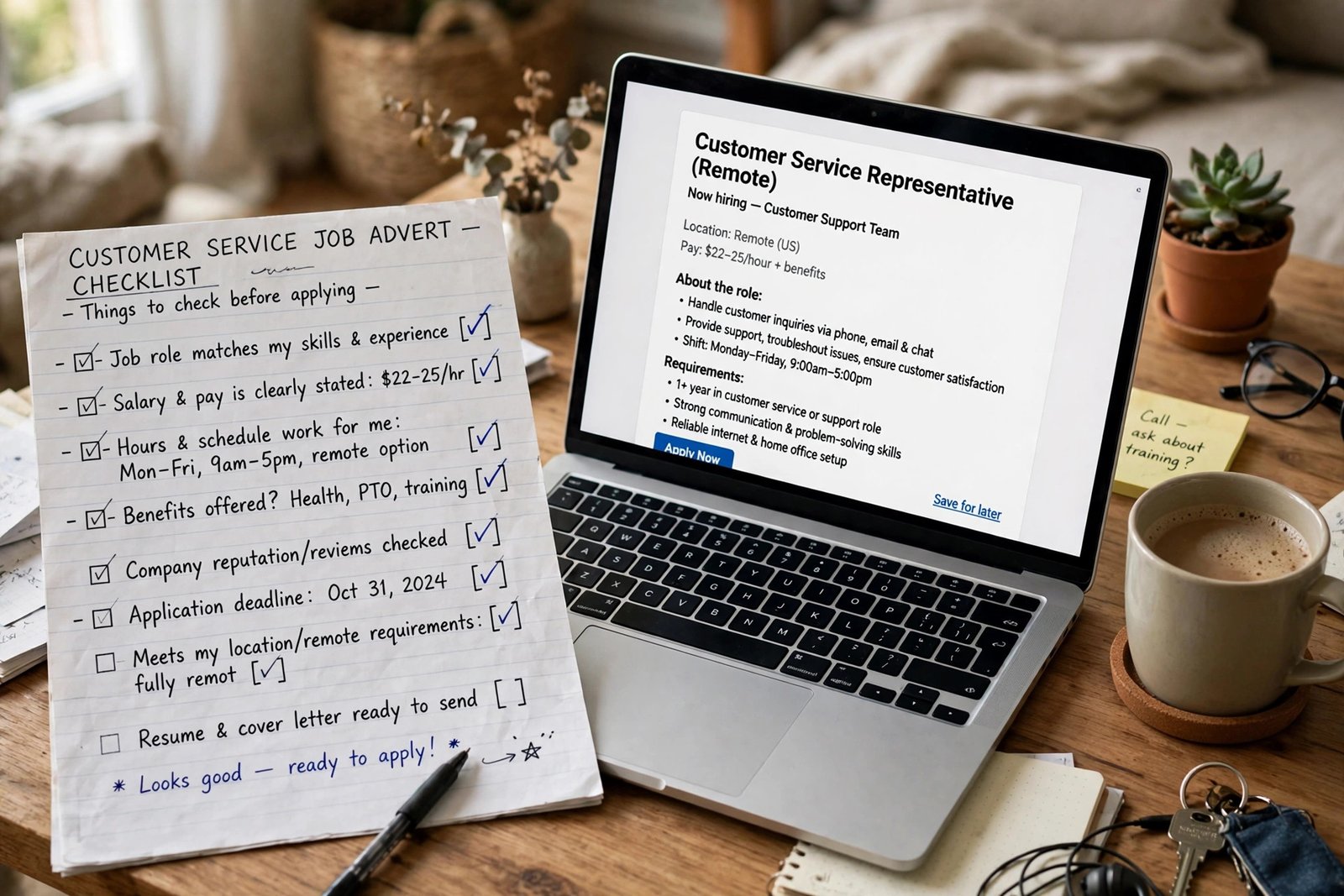
A checklist for checking a customer service job advert before applying.
A Practical Action Plan: Your Next Four Weeks
A plan turns reading into progress. The steps below are designed to take you from browsing to applying with confidence over four weeks, without rushing or burning out.
Week 1: Clarify Your Preferences and Prepare Your Space
Decide which channel suits you best — phone, chat, email, or a mix — and which shift patterns you can genuinely work. Check your broadband, test your headset if you have one, and set up a quiet workspace. Update your CV, and write a short paragraph about your customer service strengths that you can adapt for different applications.
Week 2: Research and Shortlist Roles
Search reputable job boards and employer careers pages, and shortlist roles that match your channel and shift preferences. Read each job description fully, note the closing dates, and check the employer independently where you can. Aim for quality over quantity: a shortlist of well-matched roles is better than dozens of rushed applications.
Week 3: Apply and Practise
Submit tailored applications to your shortlisted roles, keeping a tracker of each one. Practise common interview questions, typing if you are targeting chat roles, and explaining a problem-solving example out loud. If an employer invites you to an assessment, prepare in a quiet space and follow the instructions exactly.
Week 4: Follow Up and Review
Follow up politely on applications where you have not heard back, and review what is working. If you are getting interviews but no offers, ask for feedback where it is offered and adjust your examples. If you are not getting interviews, revisit your CV and application answers, and consider whether you are targeting the right channel or shift pattern. Keep applying steadily rather than stopping after one setback; persistence, combined with reflection, is what leads to offers.
Throughout this process, protect your wellbeing. Job searching can be discouraging, especially if replies are slow. Set a daily limit for applications, take breaks, and celebrate small steps, such as completing a strong application or performing well in an assessment. A steady, organised search is more sustainable than an intense burst followed by exhaustion.
Frequently Asked Questions About Remote Customer Service Jobs UK
Do I need previous customer service experience to apply?
Not always. Many entry-level remote customer service roles provide full training and welcome applicants from retail, hospitality, volunteering, or other public-facing work. What matters most is evidence of communication skills, patience, reliability, and a willingness to learn. Read each advert carefully, because some specialist roles do ask for relevant experience.
Is a remote customer service job fully home-based?
It depends on the employer and the role. Some roles are fully remote, while others are hybrid, with some office attendance. Always check the advert and confirm the pattern with the recruiter before accepting an offer, especially if the advert uses the word "remote" without explaining the pattern.
What equipment do I need for a remote customer service job?
Requirements vary by employer. Some provide a computer, headset, and monitor, while others expect you to use your own equipment or a combination. A stable broadband connection and a quiet, private workspace are almost always essential. Ask the employer exactly what is provided, what you must supply, and who is responsible for repairs.
Are remote customer service jobs suitable for part-time work?
Yes, part-time remote customer service roles are common, but the hours may still be fixed or rotating, and weekend work may be included. Check the contracted hours, the days required, and whether the pattern is fixed or flexible before you apply.
How can I tell if a remote customer service vacancy is genuine?
Look for a clearly named employer, a detailed job description, stated hours and working pattern, and a professional application process. Be cautious about any request for payment during recruitment, offers for roles you did not apply for, and pressure to accept immediately. Verify the employer independently through its official website and contact details.
Can I progress from a remote customer service role?
Yes. Many people move into complaints handling, technical support, quality coaching, training, or team leadership as they gain experience. Ask about training and progression during recruitment, and look for employers that invest in developing their teams.
Conclusion: Is a Remote Customer Service Job Right for You?
Remote customer service jobs UK vacancies offer a genuine route into steady, home-based work for people who enjoy helping others and can work in a structured, customer-focused way. The work is varied, the skills are transferable, and the experience you build — in communication, problem-solving, and handling difficult situations — will serve you well in many future roles.
The strongest applicants are not necessarily those with the longest CVs. They are the people who choose the right channel for their strengths, understand the shift pattern before they apply, prepare their home workspace properly, and apply carefully to genuine roles. They also protect themselves by recognising scam warning signs and by checking contracts and working patterns before they sign.
If this guide has helped you see that remote customer service work suits you, start with the action plan above. Clarify your preferences this week, shortlist well-matched roles next, and apply with tailored, honest applications. Browse the remote customer service jobs category on JobEdge to keep your search focused, and return to this guide whenever you need a reminder of what to check before you apply. With patience, preparation, and a careful eye for genuine opportunities, you can find a remote customer service role that fits your life and helps you build a career you are proud of.



Pingback: Fully Remote Sales Jobs: USA Work-From-Home Guide
Pingback: Customer Service Jobs in Des Moines Iowa: 2026 Guide
Pingback: Remote Jobs England: A Complete UK Guide
Pingback: Companies with Remote Positions: USA Guide
Pingback: Online Chat Support Jobs: Work From Home Guide