



Work from home jobs UK: genuine roles, a calm home setup and a careful application.
JOB DETAILS — AT A GLANCE
| Category | Work From Home Jobs |
| Location | UK — work from home |
| Job Type | Full-time and part-time (varies by role) |
| Work Mode | Work from home (some roles are hybrid — check the advert) |
| Education Required | Varies by role |
| Experience | Varies by role; some roles suit beginners |
| Skills | Communication, organisation and digital confidence (vary by role) |
| Salary | Varies by role — check the official advert; no figure is stated here |
| Who Can Apply | Jobseekers in the UK who meet the employer’s eligibility and right-to-work requirements |
| How to Apply | Online, with a tailored CV and cover note, via the employer’s official listing |
Note: details vary by role and employer. Always check the official advert before applying.
Work from home jobs UK searches have become a normal part of how people look for work. For some, working from home means escaping a long commute. For others, it means fitting work around caring responsibilities, health needs, study, or a move away from a city centre. Whatever your reason, the goal is the same: a real role, with a real employer, that you can do well from your own home.
This guide explains what work-from-home jobs in the UK actually involve, which roles are most commonly home-based, who hires for them, how to tell a genuine opportunity from a scam, and how to apply with confidence. It also covers the skills and home setup that help, what to expect around pay, contracts and rights in general terms, and a practical action plan you can start this week.
You do not need to read it in one sitting. Use the headings to jump to the part you need, then come back to the action plan at the end.
What Are Work From Home Jobs in the UK?
A work-from-home job is a role in which your normal place of work is your home, rather than an employer’s office, shop, warehouse or other site. You may still attend occasional meetings, training days or team events in person, depending on the employer, but your day-to-day work happens at home.
It helps to understand three terms that are often used interchangeably, even though they mean different things:
Fully remote roles
In a fully remote role, you work from home all of the time. Your team may be spread across the UK, and communication usually happens by email, messaging tools, phone and video calls. Some fully remote roles still ask you to live in the UK, even if you never visit an office, because of tax, data protection, employment law or the need to serve UK customers during UK hours.
Hybrid roles
In a hybrid role, you split your time between home and another workplace. The split varies widely. It might be a fixed pattern, such as three days at home and two days in the office, or it might be flexible, with office days agreed week by week. If you see a role described as hybrid, always check the advert and ask at interview how many office days are expected, where the office is, and whether the pattern can change.
Freelance and self-employed work
Some home-based work is freelance or self-employed rather than employed. In that case, you are not an employee of one company. You may work for several clients, invoice for your work, and manage your own tax and record-keeping. Freelance work can offer flexibility, but it does not usually come with the same employment protections, sick pay or holiday arrangements as an employed role. Read the terms carefully before you accept, and do not assume a freelance listing is the same as a salaried job.
When you search for work from home jobs UK, filter carefully. A role described as "remote" may still require occasional travel. A role described as "UK-wide" may still expect you to be in a particular region for training or meetings. The safest approach is to treat the advert as a starting point, then confirm the working pattern in writing before you accept an offer.
Types of Work From Home Jobs in the UK
Home-based work covers a wide range of roles. Some need specialist qualifications, while others focus more on communication, organisation and reliability. Here are the types you are most likely to find.
Customer service and support
Customer service is one of the most common home-based areas. Roles may involve answering phone calls, replying to emails or live chat messages, helping customers with orders, accounts or technical problems, and recording information accurately. Employers often look for clear spoken and written English, patience, good listening skills and the ability to stay calm under pressure. You will usually need a quiet space for calls and a reliable internet connection.
If this area interests you, you may also want to explore remote customer service jobs on JobEdge.
Administration and virtual assistance
Administrative roles support a team or a business with tasks such as managing inboxes and calendars, preparing documents, updating records, booking appointments and handling routine enquiries. Virtual assistants often do similar work for one or more clients. Strong organisation, attention to detail and comfort with common office software are usually more important than a particular degree.
Data entry and data processing
Data entry roles involve entering, checking, cleaning or updating information in spreadsheets, databases or internal systems. Accuracy matters more than speed alone, because errors can cause problems further down the line. Some data roles also involve simple quality checks, such as spotting duplicates or missing information and flagging them correctly. If you are detail-oriented and enjoy structured work, this can be a good fit.
Writing, editing and content support
Some employers hire home-based writers, editors, proofreaders, social media assistants and content coordinators. These roles may involve writing product descriptions, help articles, newsletters or social media posts, or checking other people’s writing for clarity and correctness. A portfolio of short, well-written examples is often more persuasive than a long list of qualifications.
Sales, recruitment and business support
Home-based sales roles may involve speaking to new or existing customers by phone or video, following up enquiries, or supporting a sales team with research and administration. Recruitment support roles may involve searching for candidates, arranging interviews and keeping records up to date. Both areas reward clear communication, persistence and good organisation.
IT, technical support and software roles
Technical support roles help users solve problems with software, devices or online services, often by phone, chat or remote tools. Software, testing, design and data roles may also be home-based, although these usually require specific technical skills or training. If you are building technical skills, look for roles that match your current level rather than applying only for senior positions.
Tutoring, training and coaching
If you have subject knowledge or a professional skill, tutoring and training can sometimes be done from home by video call. This may include academic tutoring, language teaching, music lessons, professional training or coaching. Requirements vary, so check whether a qualification, background check or particular experience is needed for the role you want.
Finance, bookkeeping and compliance support
Bookkeeping, payroll support, accounts assistance and compliance administration can often be done remotely, especially when systems are cloud-based. These roles usually require accuracy, discretion with sensitive information, and familiarity with the relevant software or processes. Formal qualifications may be required for some finance roles, while others focus on experience.
Not every home-based role will suit every person, and that is fine. The best approach is to start from your strengths: the tasks you can do reliably, the hours you can genuinely work, and the environment you can offer at home.
Who Hires for Work From Home Jobs?
Home-based roles are advertised by a wide mix of employers. Large companies may have remote customer service, administration or technical teams. Smaller businesses may hire one remote assistant, bookkeeper or support worker. Public-sector bodies, charities, health and education organisations, and professional services firms also advertise home-based and hybrid roles, depending on the work involved.
Rather than focusing on a single famous employer, it is more useful to think in terms of sectors and tasks. Ask yourself:
- Which tasks can genuinely be done by phone, email, video or online systems?
- Which sectors already work that way, such as customer support, administration, digital services and professional support?
- Which of those tasks match your experience, even if your previous job had a different title?
Your previous experience may transfer more than you expect. Retail experience, for example, often builds customer service, problem-solving and cash-handling skills. Hospitality experience builds communication, teamwork and working under pressure. Office experience builds administration, record-keeping and diary management. When you write your CV, describe the task and the result, not just the job title.
You should also consider remote jobs UK listings alongside work-from-home listings. The two phrases overlap, and some employers use one term rather than the other, even for very similar roles.

A calm, organised home workspace with a laptop, notebook and a cup of tea.
How to Tell Genuine Roles From Scams
This is one of the most important parts of a home-based job search. Sadly, the popularity of working from home attracts scams, and a careful check can save you time, money and stress.
A genuine employer will normally:
- Advertise a clear job title, main duties, working pattern and location requirements.
- Give a company name you can research, with a website and contact details that match.
- Explain the application process, such as an application form, interview or assessment.
- Discuss pay, hours and contract type before or during the offer stage, in writing.
- Never ask you to pay to apply, to secure a job, or to receive equipment.
Treat an opportunity with caution if it:
- Promises unusually easy work for very high pay, with little or no experience required.
- Asks you to pay an upfront fee for training, equipment, software, a background check or "starter materials".
- Asks for your bank details, passwords, or copies of identity documents before you have had an interview or a formal offer.
- Uses a free email address, vague company details, or pressure to accept immediately.
- Sends a cheque or payment and asks you to forward money, buy gift cards, or move funds on behalf of someone else.
- Has poor spelling, inconsistent job details, or a job description that does not match the title.
If you are unsure, pause. Research the company independently, rather than clicking links in a suspicious message. Search for the company name and the job title, check whether the role appears on the company’s own website, and look for reviews or warnings from other jobseekers. If something feels wrong, trust that feeling and walk away. A real employer will not mind you taking time to check, and will not pressure you into paying money or sharing sensitive information.
It is also worth remembering that genuine home-based work still involves real work. Tasks, targets, training, supervision and quality checks are normal. A listing that suggests you can earn a full-time income with almost no effort is a warning sign, not a shortcut.
Skills That Help You Succeed Working From Home
Employers hiring for home-based roles often value a similar set of skills, whatever the job title. You do not need all of them on day one, but it helps to show evidence of the most relevant ones.
Communication
Clear writing and speaking matter even more when you cannot walk over to a colleague’s desk. Practise writing short, polite emails that state the point, the action needed and the deadline. On calls, listen fully before replying, summarise what you have understood, and confirm next steps.
Organisation and time management
Working from home requires you to manage your own day. Employers look for people who can prioritise tasks, meet deadlines, keep records up to date, and ask for help early when a problem arises. A simple daily plan, a to-do list and regular check-ins with your manager can make a real difference.
Digital confidence
You do not need to be a technology expert for most home-based roles, but you do need to be comfortable learning new systems. This may include email and calendars, video calls, spreadsheets, customer service software, or internal databases. If you are learning a new tool, practise the basics before interview, so you can talk about it honestly.
Reliability and self-motivation
Managers cannot see you working, so they rely on the quality and consistency of your output. Turning up on time for shifts and meetings, completing tasks as agreed, and communicating promptly when you are delayed all build trust. If you work better with structure, create it for yourself with fixed start times, breaks and a finish time.
Problem-solving and attention to detail
Many home-based roles involve solving routine problems, following procedures, and spotting errors before they grow. When you apply, give a brief example of a problem you solved, the steps you took, and the outcome. Concrete examples are far more convincing than general claims such as "I am a good problem solver."
If you are new to home-based work, you may also want to look at remote jobs with no experience on JobEdge. These listings can help you understand which entry-level skills employers are asking for, and where you can build experience step by step.

A jobseeker on a video call from home, taking notes.
Setting Up Your Home Workspace
You do not need an expensive office to work from home, but a few basics will help you work comfortably and professionally.
Space and comfort
Choose the quietest suitable space you have, ideally where you can close a door or reduce background noise during calls. A supportive chair, a desk or table at a comfortable height, and good lighting can reduce strain over a long day. If space is limited, a consistent corner that you use only for work can still help you switch into work mode.
Internet, equipment and security
A stable internet connection is essential for most home-based roles. Some employers provide a laptop, headset or other equipment, while others expect you to use your own device and will set out minimum requirements in the advert. Always clarify who provides equipment, who pays for repairs, and what software you will need.
Take security seriously. Use strong passwords, keep work systems and personal accounts separate where possible, and follow your employer’s guidance on handling customer or business information. Never share work logins with others, and be cautious about using public Wi-Fi for work tasks unless your employer has approved a secure method.
Boundaries and wellbeing
Working from home can blur the line between work and home life. Try to keep regular start and finish times, take proper breaks away from your screen, and avoid checking work messages constantly outside your working hours unless your role genuinely requires it. If you live with others, agree on quiet times for calls and meetings, and let your manager know if caring responsibilities or other commitments affect your availability at certain times.
If your health, caring responsibilities or home circumstances affect how you work, you do not need to share private details in an application. Focus on the practical arrangements you can offer, such as the hours you can work and the quiet space you have, and discuss any adjustments you may need once you are in conversation with an employer.
How to Apply for Work From Home Jobs UK
A focused application usually works better than sending the same CV to every listing. Use these steps for each role you genuinely want.
1. Read the advert properly
Before you apply, check the working pattern, location requirements, hours, contract type, essential skills and application deadline. If the advert is vague about whether the role is fully remote or hybrid, note that as a question to ask later. Do not assume; confirm.
2. Tailor your CV
Keep your CV clear, honest and relevant. Start with a short profile that explains the type of home-based work you are seeking and your strongest relevant skills. Then list experience in reverse order, with brief bullet points that show tasks and results. For example, instead of writing "responsible for customers", write "answered customer enquiries by phone and email, resolved routine issues, and kept accurate case notes".
If you have gaps in employment, caring responsibilities, study or volunteering, you can still include relevant experience. Focus on transferable skills and what you can do now.
3. Write a short, specific cover note
Unless the employer asks for a full cover letter, a short note is often enough. Mention the role, why it fits your skills and availability, and one or two relevant examples. Avoid copying the job description word for word, and avoid claiming skills you do not have. Honesty at this stage prevents problems later.
4. Prepare for a remote interview
Many home-based roles are interviewed by phone or video call. Test your camera, microphone and internet connection in advance. Choose a tidy, well-lit background, and keep water and a pen nearby. Practise answering common questions, such as why you want to work from home, how you manage your time, how you handle a difficult customer, and what you would do if you were stuck on a task.
Prepare questions of your own, such as:
- Is this role fully remote, hybrid, or a mix that may change?
- What equipment and training are provided?
- What are the working hours, and how are shifts or rotas arranged?
- How is performance measured, and how often will I speak to my manager?
- What does the first month in the role normally look like?
Good questions show that you are thinking seriously about doing the job well, not just about working from home.
5. Complete assessments honestly
Some employers use short written tests, typing checks, scenario questions or trial tasks. Complete them yourself, follow the instructions, and do not use tools or help that the employer has not allowed. If you need an adjustment for a disability or health condition, ask the employer in good time; genuine employers should have a process for this.
6. Check the offer in writing
Before you accept, make sure you have the key terms in writing: job title, working pattern and location, hours, contract type, start date, pay arrangements, holiday and notice terms, and any probation period. If anything differs from what was advertised or discussed, ask for clarification before you resign from another role or turn down other opportunities.
Pay, Contracts and Rights in General Terms
Pay for home-based work varies by role, sector, experience and hours, so this guide does not quote salary figures. Instead, focus on understanding the structure of the offer. Is the role paid hourly or as an annual salary? Is it full-time, part-time or variable hours? Are shifts fixed, rotating or agreed in advance? Does the role include paid holiday, sick pay arrangements, pension contributions or other benefits? These questions matter more than a headline figure alone.
Contract type also matters. An employee, a worker and a self-employed contractor have different rights and responsibilities in the UK. An employee usually has the strongest set of employment rights, while a contractor is generally responsible for their own tax and business arrangements. If a listing is unclear about your status, ask directly and get the answer in writing.
In general terms, employees in the UK have the right to request flexible working, which can include working from home, and employers must handle such requests in a reasonable manner. That is a right to request, not an automatic right to work from home, and an employer may refuse for a good business reason. GOV.UK explains how to apply for flexible working, including what a written request should include and the timescale for a decision. You can read the official guidance here: GOV.UK: Applying for flexible working.
Acas also provides guidance on managing staff who work from home, including treating home-based and hybrid workers fairly and giving them the same access to support, training and promotion opportunities. That guidance is useful whether you are applying for a role or already working from home: Acas: Treating employees fairly when working from home.
If you need help with career choices, CV writing or interview preparation, the National Careers Service provides careers information and advice, including how to contact a careers adviser: National Careers Service: Help and support.
This article is general information, not legal advice. If you have a specific question about a contract, a flexible working request, or a dispute with an employer, seek advice from a qualified adviser or an official source before acting.
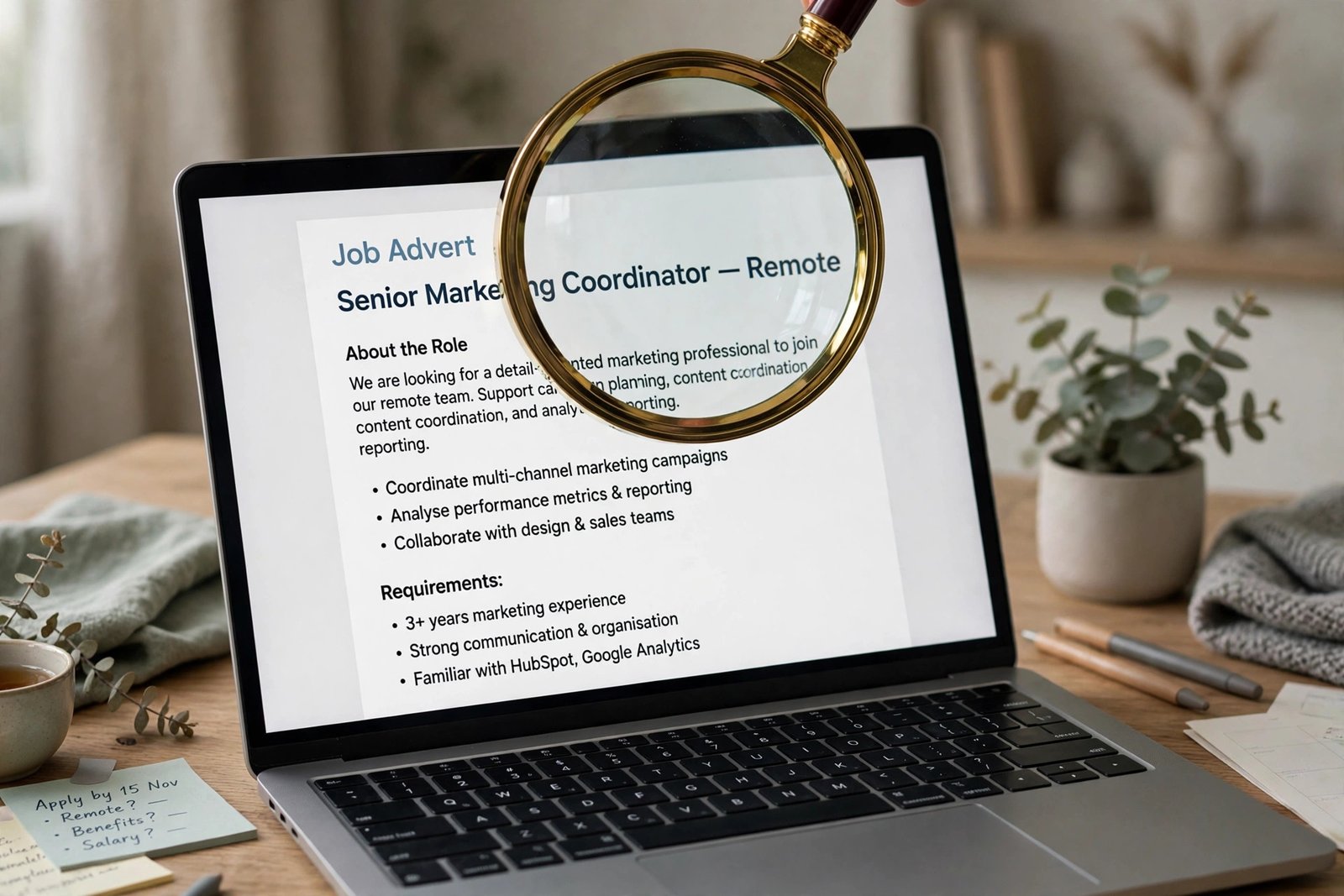
A magnifying glass over a job advert, checking it carefully for scam warning signs.
Your Practical Action Plan
Use this plan to turn reading into progress. You can adapt the pace to your circumstances, but keep the steps in order.
Week 1: Get clear and get ready
- Write down the hours you can genuinely work, the tasks you do well, and the type of role you want.
- Set up a quiet workspace, test your internet connection, and check your headset and camera if you have them.
- Update your CV, and write a short profile tailored to home-based work.
- Save a simple tracker with the role, employer, date applied, working pattern and next step for each application.
Week 2: Search with focus
- Search daily for a short, focused period rather than scrolling all day.
- Shortlist roles that match your skills, hours and working pattern, and discard vague or suspicious listings.
- Apply for a small number of well-matched roles, tailoring each application.
- Prepare answers to common remote-interview questions, and practise one video call with a friend if possible.
Week 3: Follow up and learn
- Follow up politely if an employer gave a timescale and it has passed.
- After each interview or rejection, note one thing that went well and one thing to improve.
- If you are repeatedly missing the same requirement, consider a short free or low-cost course, volunteering, or a related role that builds that skill.
- Keep your tracker up to date so you do not apply twice for the same role or miss a deadline.
Week 4: Review and adjust
- Review which types of roles produced interviews, and which produced no response.
- Adjust your search terms, CV wording or target roles based on that evidence.
- If you have an offer, check the written terms carefully before accepting.
- If you have not yet found the right role, keep going with a sustainable routine. A steady, focused search is more effective than a frantic one.
For broader inspiration, you may also browse work from home jobs on JobEdge, where home-based listings are grouped together in one place.
Frequently Asked Questions
Do I need experience to get a work from home job in the UK?
Not always. Some home-based roles are entry-level and focus on communication, reliability and willingness to learn. Others require specific experience or qualifications. Read the essential requirements in each advert, and apply for roles where you can honestly show most of what is asked for, even if your experience comes from a different sector.
Can I work from home anywhere in the UK?
It depends on the employer. Some roles are open across the UK, while others require you to live in a particular area, work UK hours, or attend occasional in-person training. Always check the location requirements in the advert, and confirm them before you accept an offer.
Do employers provide equipment for home working?
Sometimes. Some employers provide a laptop, headset or monitor, while others expect you to use your own equipment that meets a minimum standard. The advert or interview should make this clear. If it does not, ask who provides equipment, who pays for repairs, and what internet speed or software you will need.
Is working from home the same as freelancing?
No. Many home-based roles are employed positions with a contract, regular hours and employment rights. Freelance work is different: you work for clients, usually on a project or hourly basis, and you manage your own tax and business affairs. Check the contract type before you apply, so you know which arrangement you are choosing.
How do I avoid work from home scams?
Never pay to apply or to start a job, never share bank details or passwords before a formal offer, and be wary of pressure to act immediately or move money on someone else’s behalf. Research the employer independently, check that the role appears through a credible route, and walk away if the details do not add up.
What if I do not have a separate home office?
A separate room is helpful, but not always essential. A quiet corner, a consistent workspace, a headset for calls, and agreed quiet times with others in your home can be enough for many roles. Be honest with yourself about noise and interruptions, and choose roles whose call or meeting requirements fit your home situation.
Conclusion: Find Work From Home Jobs UK That Work for You
Work from home jobs UK offer real opportunities, but they reward a careful, honest approach. The strongest candidates are not necessarily those who apply for the most roles. They are the ones who understand what the role involves, can show relevant skills with concrete examples, have a workable home setup, and check the details before accepting.
Start with clarity about your hours, skills and working pattern. Focus on roles that genuinely fit. Watch for scams, prepare properly for remote interviews, and read every offer in writing. Then follow the action plan week by week, learn from each application, and adjust as you go.
Your next step is simple: update your CV, set up your workspace, and make your first focused applications. With patience and a steady routine, working from home can become a practical, sustainable part of your working life in the UK.



Pingback: Remote Jobs in the UK: Complete Guide