


Table of Contents

Remote jobs with no experience: start where you are and build from there.
JOB DETAILS — AT A GLANCE
| Category | Remote Jobs No Experience |
| Location | USA — work from home |
| Job Type | Full-time and part-time (varies by role) |
| Work Mode | Remote |
| Education Required | Varies by role |
| Experience | Entry-level roles may accept no experience; requirements vary by role |
| Skills | Communication, reliability and basic digital skills (vary by role) |
| Salary | Varies by role — check the official advert; no figure is stated here |
| Who Can Apply | Beginners in the USA who meet the employer’s eligibility requirements |
| How to Apply | Online, with a tailored CV and cover letter, via the employer’s official listing |
Note: details vary by role and employer. Always check the official advert before applying.
Searching for remote jobs with no experience can feel like a closed loop. Almost every posting seems to ask for experience, yet you cannot gain experience until someone gives you a first chance. If that frustration sounds familiar, you are not doing something wrong. You are simply at the hardest part of the journey: the beginning.
The good news is that “no experience” does not mean “no skills”, and it does not mean you have nothing to offer. In search terms, this is the world of remote jobs no experience listings: roles open to beginners who can show the right qualities, even without a previous remote job title. Employers hiring for beginner remote roles are usually looking for reliability, clear communication, attention to detail, and a willingness to learn. Those qualities can be shown, even if you have never held a remote job before.
This guide explains what no-experience remote jobs really are, which kinds of roles suit beginners, what employers actually check, how to build proof of your ability without a work history, where to find genuine roles, how to avoid scams, and how to present yourself well in a CV and interview. By the end, you will have a practical action plan you can start this week.
What “No Experience” Really Means in a Remote Job Posting
When a posting says “no experience required” or “entry level”, it rarely means the employer expects nothing from you. It usually means one of three things. First, the employer will train you in their own systems, tools, and procedures, so previous experience in that exact role is not required. Second, the role uses skills that many people already have from school, volunteering, everyday life, or personal projects, such as writing clearly, organising information, or helping others solve problems. Third, the employer is open to transferable experience, which means experience from a different kind of job, study, or responsibility that shows you can do the work.
It is also important to understand what “no experience” does not mean. It does not mean no effort, no preparation, or no standards. Remote work still requires discipline. You will be expected to turn up on time for virtual shifts or meetings, follow instructions carefully, meet deadlines, and communicate when you are stuck. In fact, because no one can see you working across a desk, remote employers often pay even closer attention to reliability and communication than office-based employers do.
Another common misunderstanding is that remote jobs with no experience are all the same. They are not. Some are full-time employee roles with training, a fixed schedule, and a team manager. Others are part-time, seasonal, or project-based. Some involve talking to customers all day, while others involve quiet, focused work such as entering, checking, or organising information. Knowing which type suits you is the first step towards a search that actually leads somewhere, rather than applying to everything and hoping for the best.
Before you apply, read the full posting carefully. Look for what the role involves day to day, what hours or time zones are required, what equipment or internet connection you need, and whether training is provided. A posting that explains the work clearly, names the employer, and describes a normal hiring process is a much better sign than a vague posting that promises easy work with little detail. If a posting is unclear, that is useful information too: you can ask a question before applying, or simply move on to a clearer opportunity.
Realistic Remote Roles for Beginners
There is no single “best” beginner remote job, because the right fit depends on your strengths, your schedule, and how you like to work. The roles below are commonly open to beginners in the United States, and each one rewards a different set of everyday strengths. Use them as a starting point for thinking about where you fit, not as a promise that every role will be available at all times.
Customer support and service roles
Remote customer service is one of the most common entry points into remote work. In these roles, you help customers by chat, email, or phone, answering questions, solving straightforward problems, and recording what happened so the next person can follow up. You do not need to be an expert in the product on day one; employers typically provide training on their systems and common questions. What matters most is patience, clear and polite communication, and the ability to stay calm when a customer is frustrated.
If you enjoy helping people and you are comfortable talking or writing clearly, this area is worth exploring. It also builds skills that transfer well: problem-solving, written communication, time management, and working with software tools. Many people start here and later move into training, quality checking, team support, or specialist support roles. You can explore this area further in our remote customer service jobs section.
Data entry and administrative support
Data entry and remote administrative roles suit people who are careful, organised, and comfortable working quietly with information. The work may involve entering details accurately, checking records for errors, updating spreadsheets or databases, scheduling, or preparing simple documents. Speed matters, but accuracy matters more. An employer would much rather have careful work that is right than fast work that has to be redone.
These roles are a good fit if you notice details other people miss, enjoy tidy and well-organised work, and can focus for steady periods. You can learn more about this kind of work in our data entry jobs section. Keep in mind that genuine data entry work is ordinary office work done remotely. It is not a scheme for quick or effortless income, and any posting that presents it that way should be treated with caution, as explained in the scams section below.
Virtual assistance, scheduling, and coordination
Virtual assistants and remote coordinators help businesses and busy professionals stay organised. Tasks can include managing calendars, booking appointments, replying to routine emails, preparing documents, keeping records up to date, and following up on small tasks. This is a good beginner path if you are organised, dependable, and good at keeping track of details across several small jobs at once.
You do not need to offer every virtual assistant service at once. In fact, beginners do better when they focus on a few clear strengths, such as scheduling, email organisation, or document preparation, and build confidence in those areas first. Over time, as you learn what clients or employers need most, you can add new skills deliberately rather than trying to learn everything at the same time.
Content, moderation, and community support
Some beginner remote roles involve written communication: moderating online communities, reviewing content against clear guidelines, helping with social media scheduling, or supporting customers through written messages. These roles suit people who write clearly, follow guidelines carefully, and can make fair, consistent decisions. They also require good judgement, because you will often need to decide whether something follows the rules or needs to be passed to someone else.
Sales support, appointment setting, and outreach
Entry-level remote sales support roles may involve following up with interested customers, booking appointments, answering basic questions, or keeping customer records up to date. These roles suit people who are comfortable talking to others, can follow a script or process without sounding robotic, and can handle rejection without taking it personally. Not everyone enjoys this kind of work, and that is fine. It is better to choose a role that fits your temperament than to force yourself into a role you dislike simply because it is labelled entry level.
Tutoring support, grading assistance, and learning support
If you are strong in a school subject, comfortable explaining ideas simply, or patient when someone is learning, learning-support roles may be worth considering. These can include online tutoring assistance, homework help, or support roles for education programmes. Requirements vary, and some roles ask for a qualification in a subject or a background check, especially when working with children. Always check the requirements in the posting itself rather than assuming a role is open to everyone.
Across all of these areas, one principle holds: the best beginner role is the one you can do reliably and well, not the one that sounds easiest. Employers remember reliable beginners. A strong first role, even a modest one, can open doors to better roles later.
Skills Employers Actually Check When You Have No Experience
When you have no previous remote job to point to, employers look for evidence in other places. They are not expecting a long work history. They are trying to answer a simple question: can this person do the work, communicate clearly, and be relied upon? Here are the skills that matter most, and how employers tend to judge them.
Clear written communication comes first. In remote work, most communication happens in writing: emails, chat messages, tickets, and notes. Employers look at your application itself as a sample. A CV and cover note that are clear, correctly spelled, and easy to follow tell an employer far more than a claim that you are a “great communicator”. Write in plain language, keep sentences short, and check your work before sending it.
Reliability and timekeeping come next. Remote teams depend on people showing up when they say they will. If you have school, volunteering, caregiving, or any regular commitment you managed responsibly, that is relevant. Mention it briefly and honestly. For example, managing a regular schedule, meeting deadlines for coursework, or being trusted with a responsibility over time all show reliability.
Attention to detail is essential for many beginner roles, especially data, administration, and support work. Employers may test this directly with a short task, such as following instructions carefully, spotting errors in a sample, or completing a form accurately. Take these tasks seriously, read the instructions twice, and do not rush. A careful, complete attempt is better than a fast, careless one.
Basic digital confidence matters more than advanced technical skill for most beginner roles. You should be comfortable using email, video calls, shared documents, spreadsheets, and a web browser. You do not need to be an expert, but you should be willing to learn new tools and to ask for help in a clear, specific way when you are stuck. Saying “I tried this, and this is where I got stuck” is much more useful to a manager than silence.
Problem-solving and initiative are also valued. Employers do not expect beginners to know everything, but they do value people who try a sensible first step, check available guidance, and then ask a focused question. In your application, you can show this by describing a time you worked out a problem, helped someone, organised something, or learned a new skill on your own. Keep the example short and specific: what happened, what you did, and what the result was.
Finally, employers check attitude and fit for remote work itself. Can you work without constant supervision? Can you stay focused at home? Can you ask for help rather than guessing? Honest answers help here. If you have a quiet workspace, a reliable internet connection, and a realistic plan for managing distractions, say so. If you are still setting up your workspace, say what you are doing about it. Employers respect honesty and preparation far more than overconfidence.
How to Build Proof Without Experience
“I have no experience” often really means “I have no proof yet”. The solution is to build small, honest pieces of proof that an employer can actually look at. You do not need a long portfolio or an expensive course. You need a few clear examples that show you can do the kind of work the role involves.
Start with a short skills project. Choose one skill linked to the roles you want, and practise it in a realistic way. If you want data entry work, practise entering and checking information accurately from a sample set, and keep a note of your method for checking errors. If you want customer service work, practise writing polite, helpful replies to common questions, such as a delivery delay, a forgotten password, or a request to change an appointment. If you want administrative work, practise organising a messy set of information into a clear spreadsheet or document.
These exercises are not pretend experience, and you should never present them as paid work. They are practice, and you can describe them honestly as such: “I practised this skill by completing sample tasks and checking my work for accuracy.”
Volunteering, community work, and personal responsibilities also count as evidence when described well. Helping to organise an event, supporting a community group online, managing a club page, helping family members with paperwork, or completing a course project all involve real skills. The key is to describe what you actually did, not just the title. Instead of writing “volunteered”, write what you did: replied to messages, kept records up to date, organised schedules, or helped people find information. Specific duties are far more convincing than vague claims.
Short, free or low-cost learning can help too, but choose carefully. A short course in spreadsheets, customer service basics, written communication, or a tool used in the role you want can be useful if you actually complete it and can show what you learned. Avoid collecting certificates without practice. Employers are more impressed by one completed course plus a small practice project than by a long list of unfinished courses.
A simple one-page portfolio can bring this together. This does not need to be a website, although a simple online document can work. It can be a single page that lists the kinds of work you can do, two or three short examples of practice or volunteer work, and the tools you are comfortable using. Keep it honest, keep it short, and only include work you actually did. When an employer asks for experience, you can point to this page as evidence of your preparation.
References also matter. If you have a teacher, volunteer coordinator, mentor, or previous supervisor who can speak about your reliability and attitude, ask their permission before listing them. Even one thoughtful reference can help a beginner stand out, because it gives the employer someone else’s view of how you work.
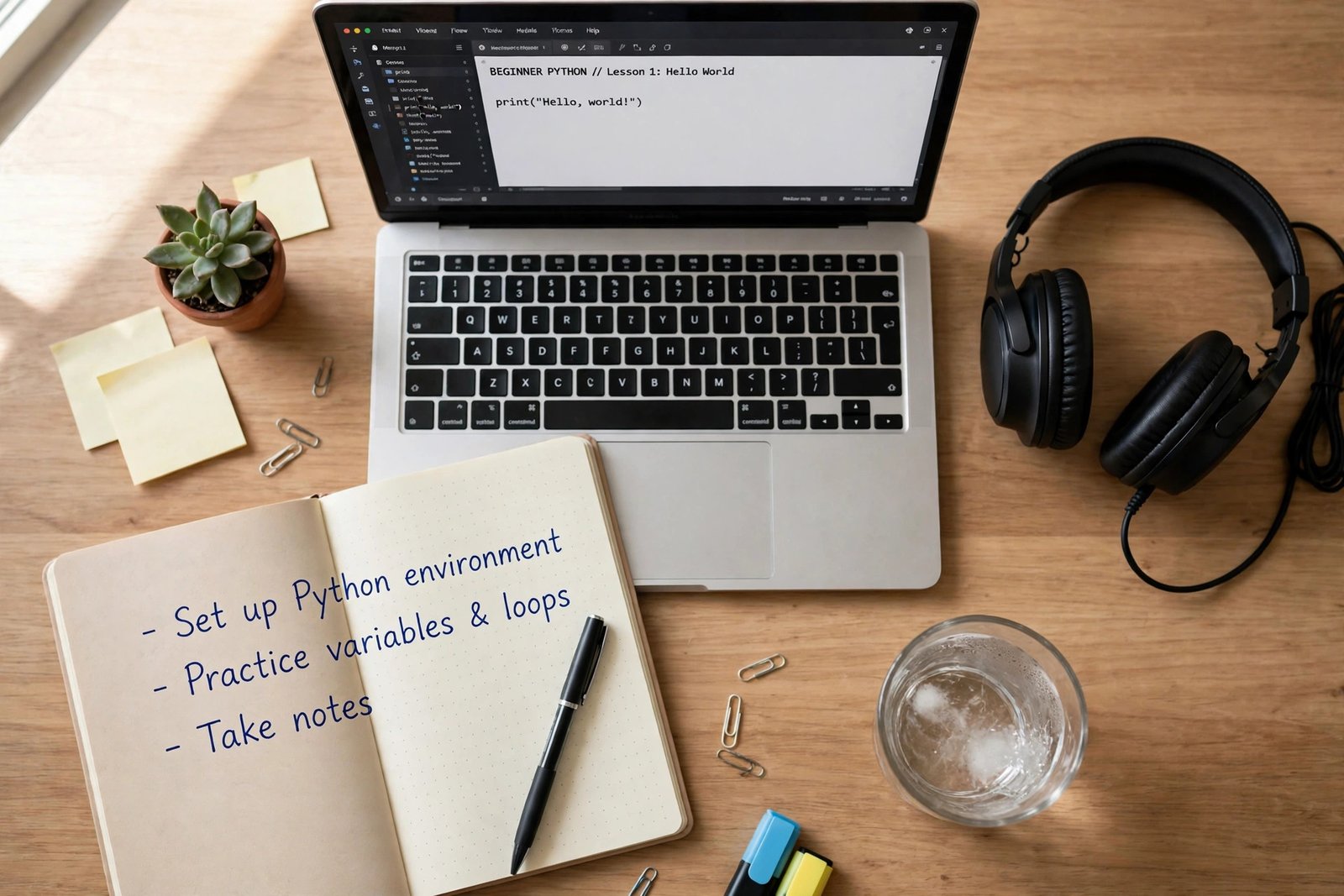
A beginner’s home desk setup: laptop, headset and notebook in natural light.
Where to Find Genuine Remote Jobs With No Experience
Finding genuine remote jobs no experience roles takes a little more care than searching one phrase and applying to everything. A focused search will save you time and protect you from scams.
Start with broad, reputable job sources, and then narrow your search. Use filters for “remote”, “entry level”, or “no experience” where available, and read postings in full before applying. Pay attention to whether the employer is named, whether the duties are described clearly, and whether the hiring steps make sense: application, interview, and then an offer. Be cautious of any process that skips interviews entirely, moves very fast, or asks for personal or financial information before you have even spoken to anyone.
Official career resources are a good place to ground your search. CareerOneStop, sponsored by the U.S. Department of Labor, offers free career exploration tools, job search guidance, and information about occupations. The U.S. Bureau of Labor Statistics also publishes the Occupational Outlook Handbook, which describes what different occupations involve and what preparation they typically require. These sources will not hand you a job, but they will help you understand roles, requirements, and next steps from an authoritative source rather than from a random post.
On JobEdge, it helps to browse by the kind of work you want, rather than only by a single keyword. If you are open to different kinds of remote work, our remote jobs in the USA section is a useful starting point, and if you need fewer hours to begin with, our part-time remote jobs section can help you find a gentler starting point. Browsing by category also helps you notice roles you might not have searched for by name, and it keeps your search organised.
Keep a simple record of your applications. A basic spreadsheet with the company name, role title, date applied, link or reference, and any follow-up date is enough. This prevents duplicate applications, helps you follow up politely, and shows you which kinds of roles are getting responses. If one kind of role is getting replies and another is not, that is useful feedback: adjust your CV or your target roles accordingly.
Set a realistic daily routine. Searching for hours without a break leads to rushed, low-quality applications. A better pattern is to spend a focused period researching roles, a focused period tailoring applications, and then stop. Quality matters more than quantity. Five thoughtful, well-matched applications are usually stronger than fifty identical applications sent to roles that do not fit.
Finally, use your network honestly. Let friends, family, former teachers, and community contacts know you are looking for a beginner remote role and what kind of work you do well. Many jobs are filled through recommendations, and a simple, clear message — “I am looking for an entry-level remote customer service or data role, and I am reliable, careful, and comfortable working online” — is far more effective than a vague request for “any job”.

A jobseeker building a simple CV and examples of transferable skills on a laptop.
Scams to Avoid: Protecting Yourself as a Beginner
Beginners are a favourite target for job scammers, precisely because they are eager for a first chance. Knowing the warning signs can protect both your money and your personal information.
The clearest warning sign is any request for payment. A genuine employer will not ask you to pay for training, equipment, a starter kit, a background check fee, or access to a job. If a “job” requires you to pay first, treat it as a scam and walk away, no matter how professional the message looks. The Federal Trade Commission gives the same advice in its guidance on how to avoid work-from-home job scams, including searching for the company name together with words like “scam”, “review”, or “complaint”, and talking the offer over with someone you trust before accepting it.
Other warning signs include vague job descriptions with very little detail about the actual work, promises of unusually easy work, pressure to decide immediately, interviews conducted only by text message with no real conversation, and requests for sensitive personal information very early in the process. Be especially careful with unexpected messages offering you a job you never applied for, particularly through messaging apps or social media. Genuine employers do not normally recruit that way.
Fake cheque scams are another common trick. A scammer sends a cheque, asks you to deposit it, and then asks you to send part of the money back or buy gift cards. The cheque later bounces, and you are left responsible for the money you sent. No genuine employer will ask you to do this. Similarly, be cautious of “task” schemes that ask you to deposit your own money to unlock earnings, or to rate products and pay fees as you go. Real work pays you; it does not require you to pay to keep working.
Protect your information step by step. Share only what a normal application requires at each stage: your name, contact details, and work or education history. Do not share bank details, passwords, or identification documents until you are confident the employer is genuine, you have had a proper interview, and you understand why the information is needed. If you are unsure, pause. A genuine employer will understand a careful applicant. A scammer will pressure you to hurry.
If you spot a scam, do not feel embarrassed. Scams are designed to look convincing, and reporting them helps others. You can report suspected scams to the Federal Trade Commission, and you can also report suspicious postings to the platform where you found them. Keep copies of messages if you can, but do not engage further or send money in the hope of recovering anything.
CV Tips for Beginners: Show What You Can Do
A beginner CV does not need to be long. In fact, a clear one-page CV is often stronger than a long CV padded with vague claims. Employers hiring beginners want to see, quickly, who you are, what you can do, and why you are a safe choice.
Start with a short personal summary of two or three sentences. State the kind of role you are seeking, your strongest relevant qualities, and your availability or remote setup in plain terms. For example: “Reliable and organised beginner seeking an entry-level remote customer service role. Strong written communication, careful attention to detail, and comfortable using email, chat, and shared documents. Available for a fixed remote schedule with a quiet home workspace.”
Next, list skills that match the role, not every skill you have ever heard of. If the posting asks for written communication, accuracy, and basic spreadsheet use, show those skills first. If you have practised a skill, say so honestly. “Practised data checking using sample records, with a focus on accuracy” is honest and useful. “Expert in data management” when you are a beginner is not.
Then describe any experience you do have, including study, volunteering, projects, and responsibilities, using short bullet points that start with what you did. Focus on duties and results, not just titles. “Replied to messages for a community group and kept a simple record of requests” tells an employer more than “volunteer”. “Completed coursework on time while managing a regular weekly schedule” shows reliability. Keep each point to one or two lines.
Include education and any completed short courses, with dates, but keep this section brief. If you are still studying, say so. Employers appreciate honesty about availability and timelines.
Finally, check the details. Use a simple, readable format, consistent headings, and no spelling errors. Save and send your CV in the format the employer asks for, and name the file clearly. Before sending, read the posting once more and adjust your summary and skills so they match the role. A CV tailored to one role will almost always perform better than the same CV sent everywhere unchanged.
You do not need a long cover letter. A short note explaining why you want this kind of role, what you bring, and that you are keen to learn is enough. Mention one specific thing about the role that interests you, so the employer can see you read the posting rather than sending a generic message.
Interview Tips for Beginners
Interviews for beginner remote roles are usually less about testing expert knowledge and more about checking communication, attitude, and reliability. Preparation, therefore, matters more than perfection.
Before the interview, research the employer and the role in basic terms: what the company does, what the role involves, and what a normal day might look like. Prepare short answers for common questions, such as why you want remote work, why this kind of role interests you, how you organise your time, and how you handle a difficult situation. Use real examples from study, volunteering, or everyday life, even if they are small. A short, honest example is better than a grand claim you cannot explain.
Prepare for the practical side of a remote interview too. Test your camera, microphone, and internet connection beforehand. Choose a quiet, tidy background with good lighting on your face. Keep water nearby, keep notes out of camera view but within reach, and close unrelated tabs or apps so you are not distracted. If something goes wrong technically, stay calm and explain the problem clearly. Employers understand that technology fails; they notice how you handle it.
During the interview, listen carefully and answer the question asked. It is better to give a clear, short answer and then stop than to talk at length without reaching a point. If you do not know something, say so honestly and explain how you would find out or learn it. Employers value honesty and a willingness to learn far more than guessing.
Have two or three questions ready to ask. Good beginner questions include: what does training look like for someone new, what does a typical day involve, how does the team communicate during the day, and what does success look like in the first few months? Asking questions shows interest and helps you judge whether the role is genuinely right for you.
After the interview, send a short thank-you message if the employer provided contact details. Thank them for their time, restate your interest briefly, and mention one point from the conversation that you found helpful. Keep it short and polite. Then be patient. If the employer gave a timeline, wait until it passes before following up once, politely.
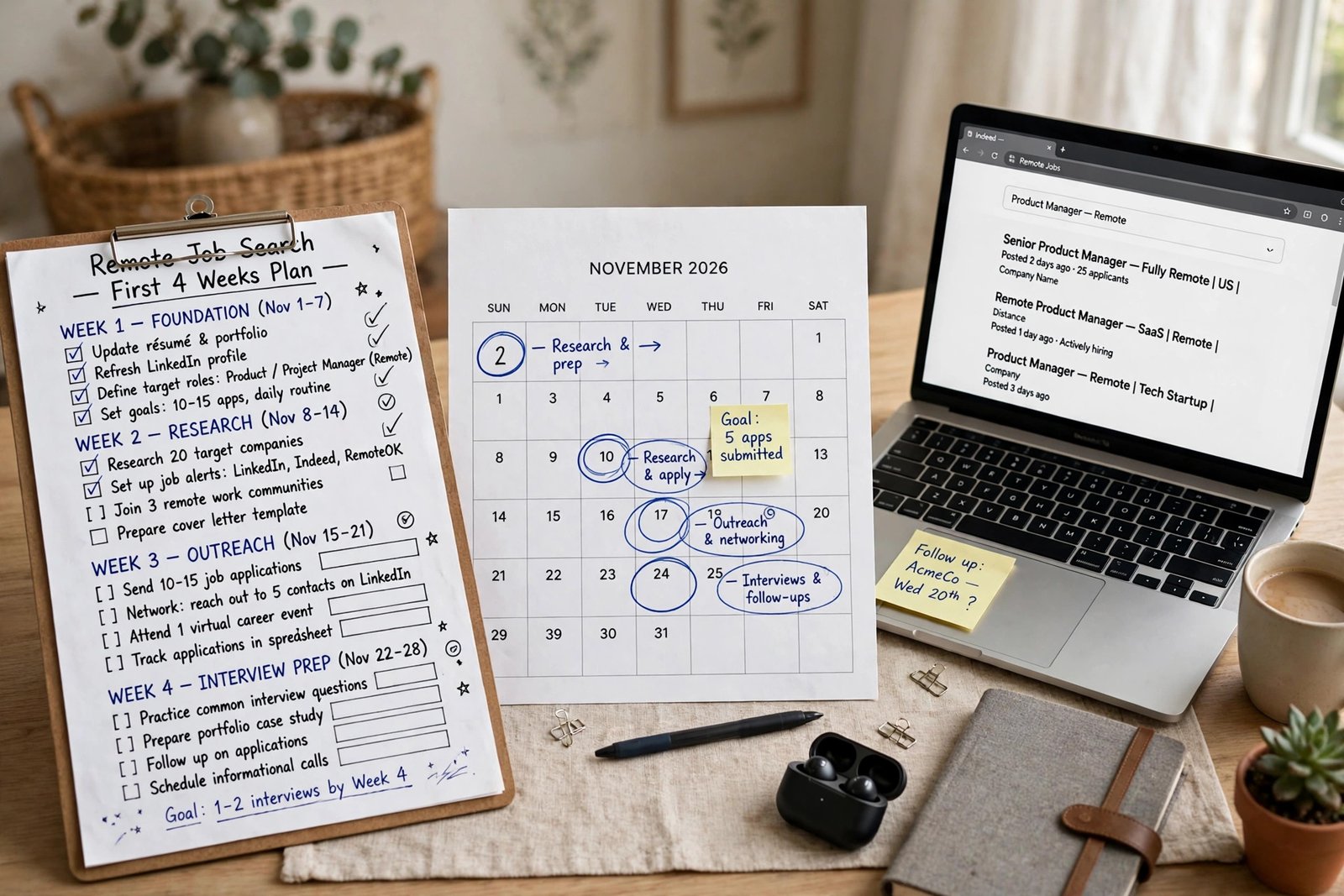
A checklist and calendar for the first four weeks of a remote job search.
A Practical Action Plan for Your First Four Weeks
A plan turns a large goal — “get a remote job” — into small steps you can actually complete. Here is a simple four-week plan for a beginner. Adjust the pace to your own schedule, but keep the order: understand, prepare, apply, and review.
- In week one, focus on direction. Choose one or two role types that fit your strengths, such as customer service and data entry, or administration and virtual assistance. Read several real postings for those roles and note the skills, hours, and requirements that appear most often. Set up a quiet workspace as far as you can, test your equipment, and create a simple application tracker. This week is about clarity, not rushing to apply.
- In week two, focus on preparation. Write a clear one-page CV and a short cover note template that you can tailor for each role. Complete one small practice project linked to your chosen role type, and write a short, honest description of it for your CV. Ask a trusted person to read your CV and point out anything unclear or any spelling errors. If you have a possible reference, ask their permission now, so you are ready when an employer asks.
- In week three, focus on thoughtful applications. Apply to a small number of well-matched roles each day, tailoring your summary and skills to each posting. Use reputable sources, check each employer carefully, and record every application. Avoid applying to roles that show scam warning signs, even if they look easy. Spend part of each day on learning too: practising a relevant skill, improving your typing or spreadsheet confidence, or preparing interview answers.
- In week four, focus on review and follow-up. Look at your tracker: which roles replied, which did not, and what might explain the pattern? If you had interviews, note what went well and what you would improve. Follow up politely on applications where a reasonable time has passed. If nothing has worked yet, do not assume you have failed. Adjust one thing at a time: try a different role type, improve your CV summary, or widen your search to part-time roles as a first step. Progress in a job search is often slow at first and then changes quickly with a single good opportunity.
- Throughout all four weeks, protect your confidence. Rejection is a normal part of searching for remote jobs no experience roles, and it is not a judgement on your worth. Employers reject many good applicants simply because another candidate was a closer fit for that particular role. Keep your routine steady, celebrate small wins such as a completed application or a good interview, and keep learning from each step.
Frequently Asked Questions
Can I really get a remote job with no experience?
Yes, beginner remote jobs no experience roles do exist, particularly in customer service, data entry, administrative support, and similar areas where employers provide training. “No experience” usually means no previous experience in that exact role, not no skills at all. You still need to show reliability, clear communication, and a willingness to learn, and you will usually need a suitable home workspace and reliable internet.
Do I need a degree for remote jobs with no experience?
It depends on the role. Many beginner remote roles do not require a degree, and instead focus on skills, attitude, and trainability. Some roles, especially in education, healthcare support, or specialist areas, do ask for qualifications or checks. Always read the posting itself rather than assuming. If a role asks for a qualification you do not have, focus on roles where your skills are the main requirement.
How long does it take to get hired?
There is no fixed timeline, and it varies by role, employer, location, and how well your applications match the postings. Some beginners hear back quickly; others search for weeks. A steady routine of well-matched applications, plus preparation and follow-up, gives you a better chance than a short burst of rushed applications. If your search is taking a long time, review your CV, your target roles, and your application quality before assuming the problem is your lack of experience alone.
Should I take a part-time remote job first?
For many beginners, yes. A part-time remote role can be an excellent first step: it gives you real remote work experience, a reference, and proof that you can work reliably from home, while leaving time for learning or other commitments. It can also help you discover what kind of remote work you enjoy before committing to a full-time role.
What equipment do I need to work remotely?
Requirements vary by employer, and the posting should state them. In general, beginners need a reliable computer, a stable internet connection, a headset for roles involving calls, and a quiet space where you can work without frequent interruption. Some employers provide equipment or software; others expect you to have your own. Check the posting and ask during the hiring process if anything is unclear, rather than buying expensive equipment before you have an offer.
How can I tell if a remote job posting is genuine?
Look for a named employer, a clear description of the work, realistic duties, and a normal hiring process that includes an interview. Be cautious of vague postings, pressure to decide quickly, requests for payment, requests for sensitive information too early, and offers for jobs you never applied for. When in doubt, search for the employer and the role, and discuss the offer with someone you trust before proceeding.
What should I do if I keep getting rejected?
First, review the basics: is your CV clear and tailored to each role, are you applying for roles that genuinely fit your skills, and are your applications complete? Consider asking a trusted person to review your CV and a sample application. Try adjusting one thing at a time, such as your target role type or your personal summary. Also consider a small practice project or short course that directly matches the roles you want, so your next applications carry stronger proof.
Conclusion: Start Where You Are, and Build From There
Finding remote jobs no experience roles is not about pretending you have experience you do not have. It is about showing, clearly and honestly, that you are ready to learn, ready to work reliably, and ready to do the job well. Choose a role type that fits your strengths, prepare a clear CV, build a small piece of honest proof, search through reputable sources, and protect yourself from scams along the way.
You do not need to have everything perfect before you begin. You need a clear direction, a workspace that works, and a steady routine of thoughtful applications. Your first remote role may be modest, and that is fine. It is a starting point, not a final destination. The skills, confidence, and references you gain there will make your second role easier to reach, and your third easier still.
Start this week. Pick your role type, write your CV, complete one practice task, and apply to your first well-matched roles. Remote work with no experience begins not with a perfect background, but with a clear, honest, and prepared first step — and that step is entirely within your reach.



Pingback: Work From Home Jobs Georgia: Complete Guide
Pingback: Remote Jobs No Degree Part Time: Honest Guide
Pingback: Remote Chat Support Jobs: Work From Home Guide
Pingback: Big Companies with Remote Jobs: USA Guide
Pingback: What Are Some Legit Work from Home Jobs?