



A bright, dedicated workspace is the foundation of successful remote work from Georgia.
If you live in Georgia and want to earn a living without commuting, work from home jobs georgia employers are hiring for span far more than most people expect — customer service, tech support, administration, sales, tutoring, and data work, all done from a home office anywhere in the state. You do not need to move to Atlanta to access them, and you do not need a rare degree to start.
Georgia has some genuine advantages as a remote-work base. The entire state sits in the Eastern Time Zone, which lines up neatly with the business hours of most American employers. Internet coverage keeps improving, the cost of living is manageable compared with coastal hubs, and a growing mix of industries means remote-friendly skills are in demand locally as well as nationally.
This guide gives you the full picture: who can apply, the role types you will actually see advertised, Georgia-specific practical notes on taxes, internet, and time zones, the skills and equipment to prepare, typical responsibilities, a step-by-step application plan, and the scams to avoid. Everything here is honest and general — no invented employers, no made-up salaries, no hype.
By the end, you will have a realistic plan for finding legitimate work from home jobs georgia residents can genuinely land, whether you are in Atlanta, Savannah, Augusta, Columbus, Macon, or a small town in between.
JOB DETAILS — AT A GLANCE
| Detail | At a glance |
|---|---|
| Category | Work From Home Jobs |
| Location | Georgia, USA — work from home |
| Job Type | Full-time / Part-time / varies by employer |
| Work Mode | Remote |
| Education Required | Varies by role — check the advert |
| Experience Required | Varies by role — check the advert |
| Skills Required | Written communication, computer confidence, time management, customer focus |
| Salary/Pay | Varies by role — check the official advert; no figure is stated here |
| Who Can Apply | Georgia residents with a suitable home workspace and reliable internet; some roles require US work authorization — check the advert |
| How to Apply | Online — tailored CV and cover letter, via the employer’s official listing |
Note: details vary by role and employer. Always check the official advert before applying.
Table of Contents
- 1. Why Georgia Is a Strong Base for Remote Work
- 2. Who Can Apply for work from home jobs georgia
- 3. Popular Types of Remote Roles for Georgians
- 4. Georgia-Specific Notes: Taxes, Internet, and Time Zones
- 5. Skills and Equipment Checklist
- 6. Typical Responsibilities of Remote Roles
- 7. How to Find and Apply for Remote Work From Georgia
- 8. What to Avoid: Scams Targeting Job Seekers
1. Why Georgia Is a Strong Base for Remote Work
Location still matters in remote work — just differently than it used to. Nobody cares which neighborhood you are in, but your time zone, your internet reliability, and your cost of living all shape which work from home jobs georgia residents can comfortably take. On all three counts, Georgia holds up well.
The Eastern Time Zone is the quiet superpower. Most American companies run their core hours on Eastern or Central time, which means a worker in Georgia is online exactly when managers, customers, and teammates are. You will rarely be asked to start at dawn for West Coast standups or stay past midnight for East Coast clients — your natural working day simply aligns. That alignment makes Georgians easy hires for national remote teams.
Cost of living is the second advantage. Georgia’s overall cost of living is generally lower than that of the coastal metro areas where many remote employers are headquartered. A remote salary set for a national market stretches further in most Georgia cities and towns than it would in New York or San Francisco. Nobody should choose a job on cost of living alone, but it is a real, practical edge worth acknowledging.
The state’s economy adds a third layer. Metro Atlanta has grown into a genuine hub for technology, logistics, media production, and corporate headquarters, and that growth spills over into remote-friendly demand — support, operations, sales, and admin roles that serve Georgia-based companies from home. Meanwhile, broadband expansion continues to reach further into rural counties, steadily widening the map of where remote work is physically possible.

You do not need to live in Atlanta — but the city’s growth keeps expanding remote demand statewide.
2. Who Can Apply for Work From Home Jobs Georgia
The short answer is encouraging: most work from home jobs georgia listings are open to any qualified adult living in the state, regardless of which city or county you call home. Employers hiring remotely within the USA routinely include Georgia in their eligible states, and many never ask for more detail than your home address for payroll and tax purposes.
Students make up a large share of successful applicants. Georgia’s colleges and universities produce thousands of graduates each year who want to stay in-state while working for national employers — and remote roles let them do exactly that. Part-time remote work also fits well around class schedules, especially for students in Atlanta, Athens, Statesboro, and other college towns.
Parents and caregivers are another natural fit. Skipping a commute across Atlanta traffic or a long drive from a smaller town can return one to two hours a day to family life. Remote roles with flexible or part-time hours let you build work around school schedules rather than the other way around.
Career changers and returning workers round out the picture. If you are moving from retail, hospitality, or in-person office work into your first remote role, Georgia’s mix of entry-level remote support, data, and sales positions gives you realistic on-ramps. Many of these need no prior remote experience — if that describes you, start with remote roles that do not require experience to see what is genuinely open to beginners.
One honest caveat: a minority of roles require US work authorization, a specific professional license, or residence in a particular state for legal reasons. Those requirements will be stated in the advert. Always read the eligibility section before investing time in an application — and never misrepresent your location or authorization status, since payroll and tax paperwork will surface the truth quickly.
3. Popular Types of Remote Roles for Georgians
Remote demand in Georgia mirrors national demand, with a few local flavors. The roles below appear regularly in work from home jobs georgia searches, and each one is genuinely doable from a home office anywhere in the state with decent internet.
- Customer service representative. The largest single category of remote hiring. You help customers by chat, email, or phone for retailers, software companies, banks, and service providers. Evening and weekend shifts are common, which suits students and second-job seekers.
- Technical support specialist. You guide customers through fixing software, device, and connectivity issues. Georgia’s growing tech footprint means some of these roles even support local companies — check companies known for hiring remotely as a starting point for research.
- Data entry and data processing clerk. You enter, verify, and clean records in company systems. Quiet, structured, deadline-driven work that rewards accuracy over speed. It is one of the most accessible entry points into remote work.
- Virtual administrative assistant. You manage inboxes, calendars, travel bookings, and documents for executives or small teams. Strong organization and polished written communication matter more than any single software skill.
- Remote sales representative. You qualify leads, run video demos, and close deals from home. Base-plus-commission structures are common; read the pay terms carefully before accepting.
- Online tutor. Georgia students and national tutoring platforms both create demand, especially for maths, science, reading, and test preparation. After-school hours make this a natural fit alongside other commitments.
- Content moderator. You review posts, listings, or comments against platform guidelines. Around-the-clock coverage means flexible shift options, including nights and weekends.
- Bookkeeper or accounting assistant. Small businesses everywhere need part-time remote bookkeeping. Basic accounting knowledge or a short certification course goes a long way here.
- Medical biller or coder. Healthcare administration offers steady remote demand, but be aware that credible roles usually expect relevant training or certification — treat any “no training needed” medical billing advert with skepticism.
Salaries are deliberately not quoted here: real pay depends on the employer, the role’s seniority, and whether the position is employed or contract. Any article that invents a Georgia-specific salary figure without citing a live advert is guessing. Judge every opportunity on its own official listing.

Most Georgia remote roles need nothing more exotic than a solid laptop and a quiet routine.
4. Georgia-Specific Notes: Taxes, Internet, and Time Zones
Working from home in Georgia comes with a few state-specific practicalities that are worth understanding before you accept an offer. None of them are deal-breakers — but knowing them in advance marks you as a prepared, professional applicant, and helps you avoid surprises later.
Taxes. Georgia has a state income tax, and remote workers living in Georgia generally have Georgia tax obligations on their earnings. The details depend on your employment type — employee versus contractor — and on where your employer is based. This guide is not tax advice: for the authoritative picture, check IRS guidance for individuals (linked in the official resources at the end of this article), and consider speaking with a tax professional before your first remote tax year. Keep records of your income from day one; future you will be grateful.
Internet. Most remote employers ask for a minimum connection speed and a stable, private network. Metro areas in Georgia are well served, but if you are in a rural county, test your actual speeds at different times of day before applying — video calls and cloud phone systems are unforgiving of weak connections. A phone hotspot as a backup has saved many a remote shift during local outages.
Time zones. Georgia’s Eastern Time placement is an advantage for most US remote roles, as noted earlier. One exception to watch for: positions supporting West Coast customers sometimes run later into the evening Eastern time. That can be a perk if you prefer late starts, or a drawback if you guard your evenings — either way, confirm the expected hours in the advert and at interview rather than assuming.
Local resources. Georgia’s Department of Labor runs employment services and job listings for residents, which can supplement your private job-board searching. Public libraries across the state also offer free internet, quiet workspace, and often free access to job-search and skills-training resources — genuinely useful if your home setup is not quite ready yet.
5. Skills and Equipment Checklist
Employers screening applicants for work from home jobs georgia look for the same fundamentals as remote employers everywhere. Treat the two lists below as your readiness audit — fix any gaps before you start applying, and your applications will be noticeably stronger.
Skills that get you hired:
- Clear written communication. Chat, email, and ticketing systems carry most remote work, so crisp, friendly, error-free writing is the highest-value skill you can demonstrate.
- Computer confidence. Navigating multiple browser tabs, learning new software quickly, and troubleshooting your own minor tech issues without panic.
- Time management and self-discipline. Remote managers measure output, not attendance. Starting on time and staying focused without supervision is the core professional skill of home working.
- Customer focus. Even in non-support roles, thinking about the end customer — their frustration, their goal, their time — separates good remote workers from forgettable ones.
- Adaptability. Tools change, processes update, teams reorganize. Employers prize people who learn the new system cheerfully instead of mourning the old one.
Equipment you will need:
- A reliable computer able to run video calls, a browser with many tabs, and company software simultaneously.
- Stable broadband internet, ideally with a wired connection option for important calls.
- A headset with a microphone — non-negotiable for any call-based role, and useful for interviews regardless.
- A webcam, since most remote interviews and many team check-ins happen over video.
- A quiet, private workspace with a door you can close or a corner that is reliably undisturbed.
- A simple backup plan for power or internet outages, such as a mobile hotspot and a charged laptop.
If the upfront cost concerns you, remember that preparation is also a filter: candidates who show up to interviews with working audio, good lighting, and a tidy background consistently outperform equally qualified candidates who do not. For a broader look at setting yourself up properly, see this practical guide on how to work from home before your first application goes out.
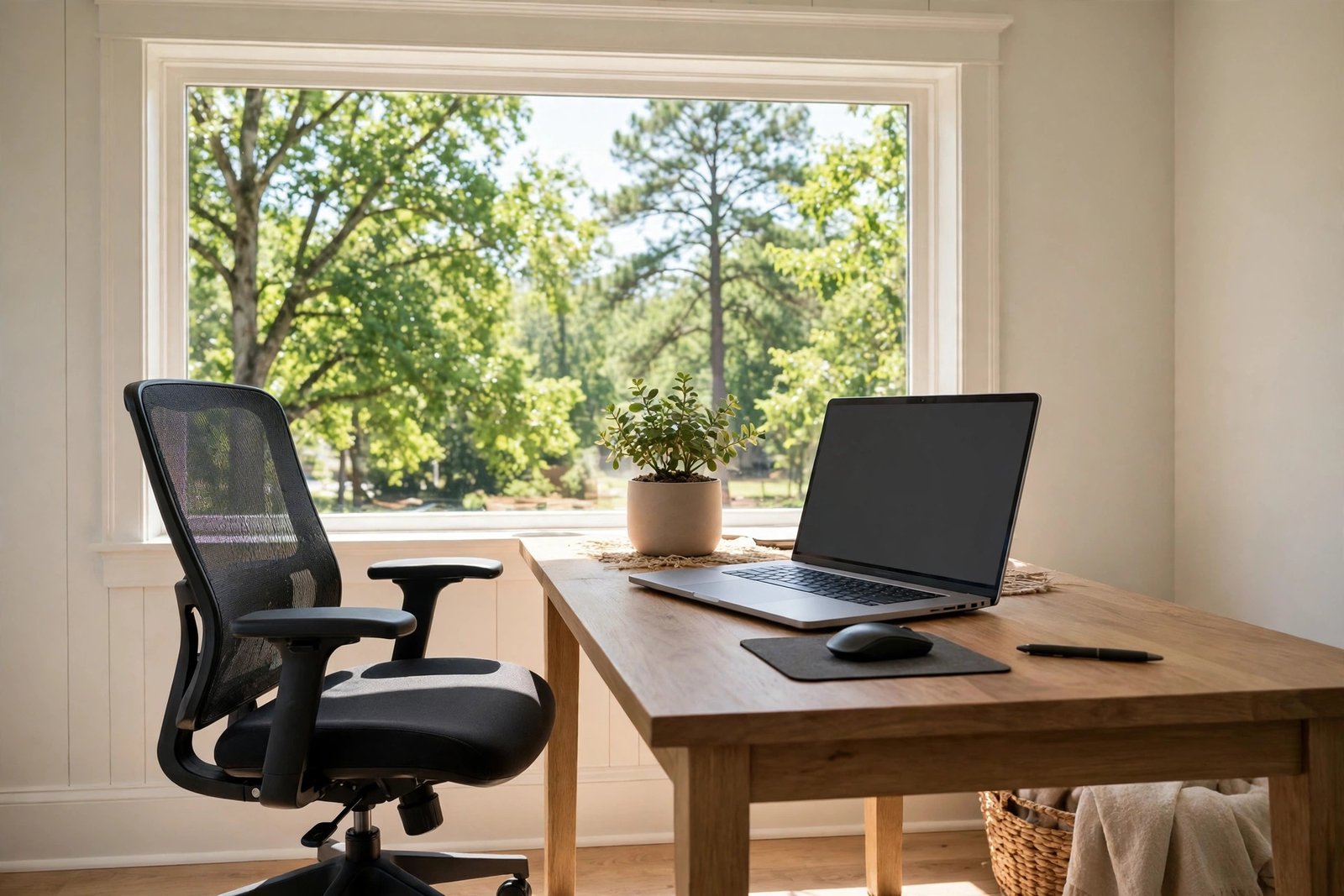
A tested, tidy setup signals professionalism before you say a single word.
6. Typical Responsibilities of Remote Roles
Adverts differ, but the daily duties behind work from home jobs georgia listings follow familiar patterns. The list below is drawn entirely from the kinds of work described in this guide — real, ordinary responsibilities you should expect, with nothing inflated or invented.
- Responding to customer queries by chat, email, or phone within the team’s target response times.
- Logging all interactions accurately in the company’s ticketing, CRM, or case-management system.
- Entering, updating, and verifying data across internal databases and spreadsheets.
- Following documented procedures and playbooks for routine issues, and escalating exceptions with clear notes.
- Managing your own schedule of tasks, callbacks, or tickets across the working day.
- Attending virtual team meetings, training sessions, and one-to-ones via video call.
- Coordinating with teammates in shared chat channels to hand over open work at shift changes.
- Protecting customer and company data according to security policy, especially on a home network.
- Tracking your own output against weekly or monthly targets and reporting progress honestly.
- Flagging recurring problems or customer pain points so processes can be improved.
Two things worth noticing. First, communication dominates: most remote responsibilities are really about keeping information moving accurately between people and systems. Second, self-management is assumed rather than taught — nobody will remind you to start work, which is why the discipline items in the previous section matter so much.
7. How to Find and Apply for Remote Work From Georgia
Searching well is a skill of its own. Follow these steps in order and your search for work from home jobs georgia will be focused, efficient, and far safer than scrolling random listings.
- Use location filters deliberately. On job boards, search the role you want plus “remote” and filter or keyword-match for Georgia or USA eligibility. Read the location line of every advert — “remote (USA)” and “remote (Georgia)” are different promises.
- Check official Georgia resources. The Georgia Department of Labor’s job services are a legitimate, free complement to commercial job boards — start at their official job finder linked in the resources section below.
- Set up targeted alerts. Save searches for your top three role types with Georgia/USA-remote filters, so new postings reach you the same day instead of a week late.
- Tailor every application. Mirror the advert’s language in your CV, lead with remote-relevant strengths (written communication, self-management, relevant tools), and keep it to one or two sharp pages.
- State your location honestly. “Based in Georgia, authorized to work in the USA” (if true) answers two screening questions in one line. Never claim a different location to dodge eligibility rules.
- Prepare for video interviews. Test camera, microphone, and lighting the day before; choose a tidy background; keep notes nearby but maintain eye contact. Georgia applicants compete nationally, so polish counts.
- Ask the practical questions. Exact hours and time zone expectations, equipment provided versus required, training structure, pay basis and schedule, and how performance is measured. Clear answers signal a serious employer.
- Move fast on strong matches, slow on doubts. Good remote roles attract many applicants, so apply promptly when a listing fits — but pause and verify anything that feels off before sharing personal data. If speed matters to you, also browse immediate-hire remote roles — just apply the same safety checks there too.

A calm, well-prepared video interview is where Georgia applicants win national remote roles.
8. What to Avoid: Scams Targeting Job Seekers
Remote job seekers in every state face the same predators, and Georgia is no exception. Fraudulent “employers” specifically target work from home jobs georgia searches because they know hopeful applicants are one click away. Genuine employers never do any of the following — treat each item as a hard rule.
- Never pay for the privilege of working. Application fees, refundable deposits, paid training packs, and “equipment bonds” are all versions of the same scam: your money flows to them, and no job exists.
- Reject messaging-app-only hiring. Legitimate hiring uses formal applications and usually a video interview. A “manager” who exists only inside a chat app, with no verifiable company website or careers page, is not hiring you.
- Insist on written terms. A real offer states your duties, schedule, pay basis, pay dates, and employment type in writing. Vague enthusiasm plus missing paperwork equals missing paychecks.
- Protect your identity. Share sensitive personal details only after a signed offer, through secure official channels — never in a chat window during “screening”.
- Never handle money for an employer. Cashing cheques, forwarding payments, or buying gift cards “for clients” is money laundering dressed as employment, and your accounts carry the legal risk.
- Distrust fantasy pay. Listings promising high full-time income for a few easy hours from home are engineered to harvest your data or extract an upfront fee. Compare every offer against ordinary, believable roles.
- Watch for the urgency trick. “Sign in the next two hours or lose the spot” is pressure, not process. Real employers give you time to decide, because they want hires who stay.
If something feels wrong, investigate before you engage: search the company name alongside the word “scam”, confirm the careers page lives on the company’s genuine website, and check official resources. Legitimate work from home jobs georgia employers survive scrutiny — scammers rely on you skipping it.
Frequently Asked Questions
Do I have to live in Atlanta to get work from home jobs in Georgia?
No. Remote means remote — employers hiring across Georgia or the USA do not require an Atlanta address. Listings may say “Georgia” or “USA” for payroll and tax reasons, but your day-to-day location within the state rarely matters as long as your internet and workspace are solid.
Do Georgia remote jobs require any state-specific license?
It depends entirely on the role. Most remote customer service, data, admin, and tech support roles require no license at all. Regulated fields — such as insurance sales, certain financial services, or healthcare roles — may require state licensing, and the advert will say so. Never pay a third party for a “required license” without verifying the requirement independently.
How do taxes work when I work from home in Georgia?
Georgia has a state income tax, so Georgia-based remote workers generally have state tax obligations in addition to federal ones; the specifics depend on whether you are an employee or a contractor and where your employer is located. This is general information, not tax advice — check the official IRS resources linked below and consider consulting a tax professional for your situation.
What internet speed do I need for remote work?
There is no single universal number — it depends on the employer’s systems and whether your role involves video calls or cloud phone software. As a rule of thumb, a stable broadband connection that handles video calls smoothly is the baseline most employers expect. Test your real-world speed, preferably wired, before interviews, and have a mobile hotspot as backup.
Can I apply for Georgia remote jobs if I am not a US citizen?
Some roles are open to anyone legally authorized to work in the USA, while others specify citizenship or particular visa statuses. The advert’s eligibility section governs — read it carefully and apply only where you genuinely qualify. Never misrepresent your work authorization; payroll verification will uncover it.
Are there work from home jobs in Georgia for people with no experience?
Yes. Entry-level remote customer support, data entry, moderation, and some sales development roles regularly hire beginners and provide training. Focus on listings that explicitly welcome entry-level applicants, emphasize your communication skills and reliability, and consider building basic computer skills first if you are starting from zero.
Conclusion: Georgia Is Ready When You Are
You do not need to relocate, reinvent yourself, or wait for permission to start working from home in Georgia. The Eastern Time Zone puts you in sync with most American employers, the range of genuinely remote roles keeps widening, and the only real prerequisites — a quiet workspace, reliable internet, and professional habits — are entirely within your control.
Be strategic rather than hurried. Pick the role types that fit your strengths, prepare your setup and your CV properly, and search with Georgia-specific filters so you spend energy only on listings you can actually take. Verify every employer through official channels, and walk away from anything that asks for money or rushes your decision.
The opportunity in work from home jobs georgia is real, but it rewards the prepared. Do the groundwork this week — test your internet, tidy your workspace, tailor one strong application — and you will already be ahead of most applicants. Georgia is ready when you are.



Pingback: Remote Job Near Me No Experience: How to Start