The phrase remote home working jobs gets typed into search boxes across the UK thousands of times a day, usually by someone picturing the same thing: no commute, a comfortable workspace, and work that fits around real life. The good news is that this picture is achievable. The challenge is that the adverts behind the phrase vary wildly in quality — from excellent permanent roles to vague listings that waste your time or worse.
This guide gives you a clear, honest picture of home working in the UK: what counts as a genuine home working job, which roles are commonly offered, what employers expect from people they cannot see, how to apply well, and how to spot the adverts you should avoid. No invented salaries, no named companies, no promises — just practical guidance you can act on today.
Whether you are in Glasgow, Cardiff, Belfast, or anywhere in England, the fundamentals of finding legitimate home working jobs are the same. Let us go through them.
JOB DETAILS — AT A GLANCE
| Detail | At a glance |
|---|---|
| Category | Remote Jobs UK |
| Location | UK — work from home |
| Job Type | Full-time / Part-time / Contract — varies |
| Work Mode | Remote / home working |
| Education Required | Varies by role — check the advert |
| Experience Required | Varies by role — check the advert |
| Skills Required | Self-discipline, written communication, digital tools, role-specific skills |
| Salary/Pay | Varies by role — check the official advert; no figure is stated here |
| Who Can Apply | Candidates with the right to work in the UK who meet the role’s stated requirements |
| How to Apply | Online — tailored CV and cover letter, via the employer’s official listing |
Note: details vary by role and employer. Always check the official advert before applying.
Table of Contents
- 1. What remote home working jobs mean in the UK
- 2. Common home working roles advertised in the UK
- 3. Typical responsibilities of home workers
- 4. Skills employers expect from home workers
- 5. How to find and apply for home working jobs
- 6. Red flags: avoiding home-working scams
- 7. Creating a productive home workspace
- 8. Growing your career while working from home
- Frequently Asked Questions
- Conclusion
1. What Remote Home Working Jobs Mean in the UK
Not everything labelled “home working” means the same thing, and the distinction matters before you apply. In the UK, remote home working jobs generally fall into four patterns.
Employed home working is the most common: you are an employee with a contract, payslips, holiday entitlement, and all the usual employment rights, but your place of work is your home. Acas publishes guidance on home working arrangements, and your contract should state your working pattern clearly. This is the arrangement most people mean when they search for remote home working jobs.
Hybrid home working splits your week between home and an employer’s premises. Adverts should state the expected split — “two days in the office” means something very different from “occasional visits”. If you cannot travel to the stated location, a hybrid role is not a home working job for you, whatever the headline says.
Self-employed home working covers freelancers and contractors who work from home for multiple clients. This offers maximum flexibility but no employment rights, no paid holiday, and full responsibility for your own tax through Self Assessment. It suits some people well, but go in with your eyes open.
Casual or gig home working includes task-based platforms and piecework. Some of it is legitimate; much of it pays poorly once you count the unpaid time. Treat adverts in this space with extra scepticism and always calculate your real hourly rate.
One more UK-specific point: your employer must still meet health and safety duties for home workers, and you have the right to request flexible working. The details are on GOV.UK and Acas, both linked at the end of this guide. Knowing your rights makes you a more confident applicant.
2. Common Home Working Roles Advertised in the UK
Home working in the UK is not limited to one industry. Here are the role families behind most genuine remote home working jobs adverts.
Customer service and live chat roles are the most numerous. You answer customer queries by phone, email, or chat from home, following the company’s scripts and systems. Employers provide training and usually the equipment. Clear written English and a calm manner matter most.
Administration and virtual assistance covers diary management, inbox handling, document preparation, data organisation, and general office support done remotely. If you are naturally organised, this family is worth exploring — our guide to remote admin jobs in the UK covers it in depth.
Data entry, transcription, and data processing suit accurate, focused workers. These are frequently advertised as entry-level, which also makes them a favourite disguise for scams — so verify carefully. Our genuine work from home jobs guide explains how to tell real data roles from fake ones.

Sales, fundraising, and appointment setting roles are widely offered as home working, often with performance-related pay. Read the advert’s pay description carefully so you understand the balance of basic pay and commission.
Writing, editing, and content roles — from copywriting to proofreading to social media — are naturally home-based. A portfolio of your work usually counts for more than qualifications.
Bookkeeping and finance support roles are increasingly home-based, with cloud accounting software making location irrelevant. Relevant experience or qualifications help here.
Tutoring, coaching, and training let you teach over video calls. Academic tutoring, music teaching, language coaching, and professional skills training all appear regularly among remote home working jobs listings.
IT support and technology roles round out the list. Some need deep technical skills; others, like first-line support, are realistic targets for organised beginners with good communication. For text-based support that avoids phone work entirely, see our remote non-phone jobs guide.
3. Typical Responsibilities of Home Workers
Whatever the job title, home working adds a layer of responsibility that office work does not: you are the manager of your own working day. The responsibilities below are built from the role types above.
- Completing your assigned tasks to the required standard without direct supervision.
- Communicating proactively with your manager and team in writing.
- Attending video calls punctually, prepared, and with working equipment.
- Keeping the employer’s systems updated accurately and on time.
- Following data-protection rules, including UK GDPR basics, on every task.
- Protecting company equipment and information in your home.
- Reporting problems early instead of hiding them until deadlines slip.
- Managing your time so that agreed hours and deadlines are met.
- Keeping your workspace suitable for the work, including confidentiality where required.
- Completing required training, including health and safety and data protection modules.
The thread running through all of these is trust. Employers hiring for remote home working jobs cannot watch you work, so they hire people who demonstrate reliability from the very first application. Every tailored CV, every prompt reply, every kept commitment is evidence.
4. Skills Employers Expect from Home Workers
Home working rewards a particular set of strengths. Some you will already have; others you can develop deliberately.
Self-discipline is the foundation. Without colleagues around you, the working day is yours to structure — or to waste. Employers look for evidence that you manage your own time well, in any context: meeting deadlines, juggling responsibilities, or completing qualifications alongside work.
Written communication carries extra weight at home. Most of your interaction with colleagues will be written, so clarity, tone, and accuracy matter enormously. Your application materials are the employer’s first sample — make them flawless.
Digital confidence means handling video calls, shared documents, messaging platforms, and whatever specialist software the role uses. You will be expected to solve minor technical hiccups yourself rather than calling IT for every frozen screen.
Focus and organisation keep home workers productive amid domestic distractions. Simple systems — a daily task list, time-blocking, a tidy desk — signal to employers that you take the arrangement seriously.
Role-specific skills complete the picture. A home-based bookkeeper needs accounting knowledge; a chat agent needs typing speed and product knowledge; a tutor needs subject expertise. Match the advert honestly and never invent experience.
Right to work in the UK is non-negotiable for employed remote home working jobs. Keep your documents ready, because checks happen during onboarding even when you never visit an office.
5. How to Find and Apply for Home Working Jobs
Searching well is a skill in itself. Work through these steps and your search for remote home working jobs will be far more productive.
- Define your target roles, your available hours, and anything you cannot do — before browsing.
- Use job boards’ home-working and remote filters, but always read the advert’s location terms.
- Be cautious with social media adverts; prefer established job boards and employer careers pages.
- Tailor each CV to the advert, using its language for skills you genuinely possess.
- Write a brief cover letter explaining why home working suits you and what makes you reliable at it.
- Apply only through official channels named in the advert.
- Log every application with dates and links so you can follow up sensibly.
- Prepare a quiet, professional video-interview setup before you are invited to one.
- Treat rejections as data: adjust your targeting, not just your volume.
A note on volume: sending thirty identical applications rarely works. Sending ten carefully tailored ones, each showing you read the advert, works far better. Employers filling remote home working jobs receive huge numbers of applications; the tailored ones stand out precisely because most are not.
London-based readers may also want to check our guide to work from home jobs in London, which covers capital-specific patterns in home working adverts.

6. Red Flags: Avoiding Home-Working Scams
The UK home-working market attracts scammers because the dream — earning from your sofa — is so widely shared. Learn these warning signs as a single clear list.
- Never pay upfront for a “starter kit”, training, or background checks.
- Reject any role that only interviews via text chat with no voice or video.
- Never share bank details, National Insurance numbers, or ID documents before a verified offer.
- Avoid adverts with no company name, vague duties, and earnings claims that sound effortless.
- Never agree to receive, repackage, or forward parcels or money.
- Verify the employer’s email domain matches their real website.
- Ignore pressure tactics like countdown timers or “last place” warnings.
- Never install software at a stranger’s request during “hiring”.
Genuine employers expect scrutiny — it signals you are careful, which is exactly what they want in a home worker. If an advertiser becomes evasive when you ask basic questions about the company, walk away. Report suspicious adverts to the platform where you found them, and to Action Fraud if money or identity details are involved.
7. Creating a Productive Home Workspace
You do not need a designer home office, but you do need a workspace that lets you work professionally. Here is how to build one sensibly.
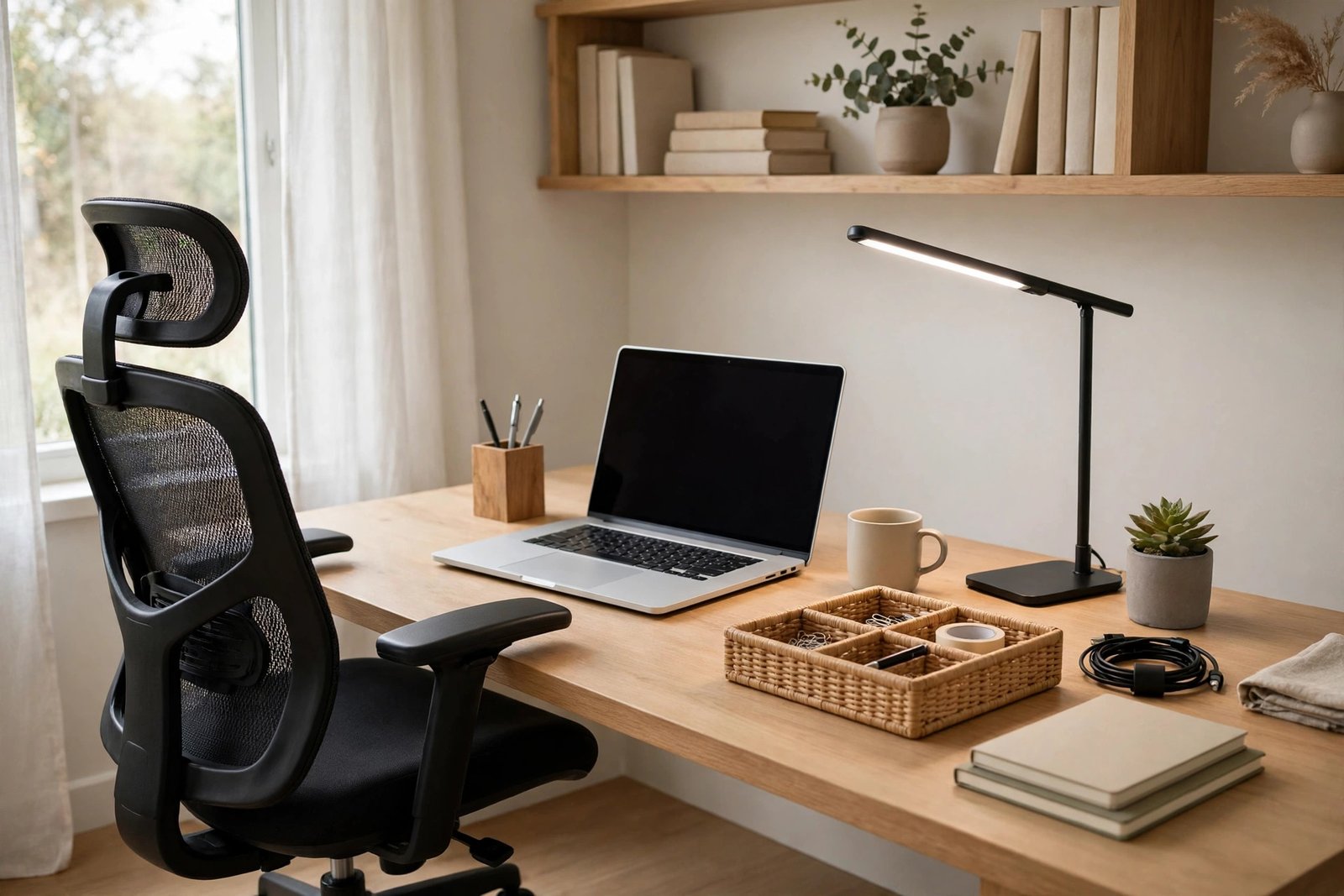
Choose a consistent spot — a desk in a spare room is ideal, but a defined corner works. Consistency trains your brain: when you sit there, you are at work. Keep it tidy, because clutter competes for attention all day.
Get the basics right: a comfortable chair, a screen at eye level, decent lighting, and reliable broadband. If video calls are part of the role, check what your camera shows behind you and keep it neutral and uncluttered.
Separate work from home life with boundaries. Agree your working hours, communicate them to your household, and build a small end-of-day ritual — shutting the laptop, tidying the desk, changing clothes — that tells your brain work is over.
Protect your health. Home workers sit for long stretches, so build movement into the day: a walk at lunch, stretching between calls, and regular breaks from the screen. Eye strain and back pain are the quiet career-killers of remote home working jobs.
Finally, plan for isolation. Working from home can be lonely, especially in winter. Schedule real contact — team chats, a coworking day occasionally, or simply working from a café for an afternoon if your role allows it. Connection is part of the job.
8. Growing Your Career While Working from Home
Home working is not a career pause — it can be a career accelerator if you play it deliberately.
Start with mastery. Become excellent at your role’s fundamentals. The home worker who resolves queries first time, keeps immaculate records, or writes outstanding copy becomes indispensable — and indispensable people get promoted, trained, and recommended.
Add visibility. Remote workers must be deliberately visible: send concise progress updates, share wins with your manager, document your contributions, and volunteer for projects others can see. Out of sight must not mean out of mind.
Invest in learning. The UK’s National Careers Service, free online courses, and professional bodies all offer routes to new skills. Pick learning that deepens your current role or opens the next one — not random certificates.
Build a network anyway. Join online professional communities, attend virtual industry events, and keep in touch with colleagues who move on. Many of the best remote home working jobs are filled through word of mouth before they reach job boards.
And review your arrangement yearly. Is your pay keeping pace? Are your hours still working for your life? Home working gives you leverage — use it thoughtfully, and your career can grow every bit as fast from your spare room as from any office.

Frequently Asked Questions
Are remote home working jobs in the UK legitimate?
Yes — huge numbers of genuine home working roles are advertised across the UK every week, from customer service to technology to finance. Scams exist alongside them, so verify every employer, never pay fees, and apply through official channels.
Do I need experience to get remote home working jobs?
Some entry-level home working roles welcome beginners, especially in customer service, admin, and data work. Emphasise transferable strengths — communication, reliability, organisation — and apply where the advert’s requirements genuinely match your background.
Will I need to buy my own equipment for remote home working jobs?
It varies. Many employers provide a laptop and headset; some offer a home-working allowance instead. The advert or offer should state what is provided. Never buy expensive equipment before a confirmed offer, and never pay an “employer” for equipment.
What are my employment rights as a UK home worker?
Employed home workers have the same core employment rights as office-based staff, including holiday pay and protection from unfair dismissal (subject to qualifying periods). Acas and GOV.UK publish detailed guidance on home working arrangements.
How do I stay motivated working from home?
Routine is everything: fixed start and end times, a dedicated workspace, a daily task list, regular breaks, and real human contact during the week. Most home workers find motivation follows structure, not the other way round.
Can remote home working jobs become permanent careers?
Absolutely. Many people build entire careers from home, progressing into senior, specialist, and management roles. The key is treating home working as a professional arrangement — visible work, continuous learning, and deliberate career planning.
Conclusion: Home Working Done Properly
Remote home working jobs in the UK are real, numerous, and open to people at every stage of their careers — but they reward the careful and punish the hasty. The careful applicant reads adverts fully, tailors every application, verifies every employer, and sets up a workspace that supports real work. The hasty one clicks “apply” fifty times and wonders why nothing comes back.
Choose to be the careful one. Define what you want, search consistently, apply thoughtfully, and protect yourself from the minority of adverts that are not what they seem. Done properly, home working is not just a way to earn — it is a way to build a career on your own terms, from your own home.