


Genuine work from home jobs UK: how to spot real roles and avoid scams.
JOB DETAILS — AT A GLANCE
| Category | Work From Home Jobs |
| Location | UK — work from home |
| Job Type | Full-time and part-time (varies by role) |
| Work Mode | Work from home (check the advert for any hybrid requirement) |
| Education Required | Varies by role |
| Experience | Varies by role; some roles suit beginners |
| Skills | Communication, organisation and digital confidence (vary by role) |
| Salary | Varies by role — check the official advert; no figure is stated here |
| Who Can Apply | Jobseekers in the UK who meet the employer’s eligibility and right-to-work requirements |
| How to Apply | Online, with a tailored application, via the employer’s official listing or verified channel |
Note: details vary by role and employer. Always check the official advert before applying.
Finding genuine work from home jobs in the UK should feel straightforward, but for many jobseekers it does not. A search for remote work can return a confusing mix: real vacancies from real employers, vague adverts that lead nowhere, and outright scams designed to steal money or personal information. When you are already juggling bills, caring responsibilities, or a career change, that confusion is more than annoying. It can cost you time, confidence, and, in the worst cases, money you cannot afford to lose.
This guide is different from a simple list of job titles. Its purpose is to help you judge any work-from-home opportunity for yourself, so you can tell a genuine role from a scam before you apply, before you share sensitive details, and before you pay for anything. You will learn what genuine work-from-home jobs in the UK normally look like, the most common scam types and their red flags, how to verify an employer and a listing step by step, and the safe application habits that protect you every time. You will also find out where genuine roles are most often found, what to do if you suspect a scam, and a practical checklist you can use for every application from now on.
The central rule is simple, and it is worth keeping in mind throughout: a genuine employer hires you because they need your work. A scammer contacts you because they want your money, your personal details, or your bank account. Once you learn to spot which of those two things is really happening, most fake opportunities become much easier to recognise.
What Genuine Work From Home Jobs in the UK Actually Look Like
A genuine work-from-home job is a real job that happens to be done from home. That sounds obvious, but it is the most useful test you have. Real remote work still has the structure of real work: a defined role, a named employer or agency, clear duties, a proper application process, and a contract and pay arrangement that are explained before you start. If an opportunity has none of that structure, yet promises easy money, treat it with caution, no matter how professional the advert looks.
The hallmarks of a real remote role
Genuine work-from-home jobs in the UK usually share several features. The job title is specific, not vague. Instead of "online worker wanted" or "earn from home today", you will see a recognisable role, such as a customer service adviser, administrator, data entry clerk, content writer, virtual assistant, tutor, or IT support analyst, together with a description of what the person in that role actually does day to day. The advert explains the working pattern, whether the role is full-time or part-time, fully remote or hybrid, and whether fixed hours, shift patterns, or flexible hours apply. It states the location requirement honestly, for example that applicants must be based in the UK, and it explains what equipment, if any, you are expected to provide, and what the employer provides.
A genuine employer also has a visible, checkable presence. The company has its own website, a company profile you can find independently, and contact details that match the domain name of that website. The advert is posted through a recognisable channel, such as the employer’s own careers page, a well-known job board, or a recruitment agency with a real office and a real client list. When you apply, you are asked for a CV and, in most cases, invited to an interview, which may be by phone or video call. References or background checks, where they are needed, are discussed at the right stage, not demanded in the first message, and any check that carries a fee is handled through a proper, transparent process, never through a personal bank transfer to an individual.
Pay is another useful clue. A genuine advert describes pay in a normal, verifiable way, such as an hourly rate or annual salary, and it explains how and when you will be paid. It does not promise unusually high earnings for very little work, it does not guarantee income regardless of hours or performance, and it does not ask you to buy something first in order to start earning. Real employers pay you. They do not charge you for the privilege of working for them.
What genuine remote work is not
Genuine work from home is also not a single thing. Some roles are employed positions, where you work for one employer, receive a contract, and are paid through payroll. Others are freelance or self-employed roles, where you work for several clients and manage your own tax. Some are part-time or flexible roles that fit around study or caring responsibilities. Understanding which type you are looking at matters, because it changes what you should expect: an employed role should come with a contract, payslips, and proper onboarding, while a freelance role should come with a clear written agreement about the work, the rate, and the payment terms. If an advert blurs these distinctions, or uses the language of employment while asking you to work as an unpaid "trial" for an indefinite period, ask questions before you agree to anything.
It is also worth remembering that genuine remote work still requires real skills and real effort. Many legitimate home-based roles involve customer service, administration, writing, data handling, tutoring, bookkeeping, design, or technical support, and each of them expects a certain standard of communication, reliability, and attention to detail. That is good news in one sense: if you can demonstrate those qualities, you are employable. It is also a warning: any advert that says no skills, no experience, no interview, and no effort are needed, yet the pay is high, is describing something that real employers rarely offer.
Common Scam Types: What Fake Work-From-Home Offers Look Like
Scammers do not use one method. They adapt their approach to whatever jobseekers are searching for, and remote work is an attractive target because it appeals to people who want flexibility and because the whole interaction can happen online, without ever meeting in person. The scam types below are described generically, by method rather than by naming any company, because the same methods are reused under many different names. If you recognise the method, you can recognise the scam even when the name changes.
The upfront-fee scam
This is one of the most common patterns. You are offered a job, sometimes very quickly and with little or no interview, and then you are asked to pay for something before you can start: training materials, a starter kit, equipment, a background check, a work permit, software, or a deposit. The fee may be presented as refundable, or as a small amount compared with the earnings you have been promised. Once you pay, the job disappears, the contact stops replying, or further fees are requested. A genuine employer may provide equipment or training, but will not ask you to send money to a personal account, pay by gift card or voucher, or transfer funds through an untraceable method in order to secure a role.
The fake-task and reshipping pattern
Another pattern involves simple-sounding tasks, such as reviewing products, processing parcels, moving money, or completing small online jobs for payment per task. Some versions ask you to receive goods at your home address and forward them elsewhere, which can draw you into handling stolen goods or fraudulent purchases without your knowledge. Others ask you to use your own bank account to receive and forward payments, which can amount to money laundering, even if you believed you were simply doing a job. A genuine job does not require you to pass other people’s money through your personal account, and it does not pay you to act as a courier for goods you did not order from a business you cannot verify.
The identity-theft and data-harvesting advert
In this pattern, the "job" is mainly a way to collect your personal information. The advert or the recruiter asks early for details that a real employer would only need at a later, secure stage: your full date of birth, National Insurance number, passport or driving licence copies, bank account details, or passwords. Sometimes this arrives as a long application form on an unfamiliar website, or as a request sent by email or messaging app before any interview has taken place. That information can then be used for identity fraud, to open accounts in your name, or to target you with further scams. A genuine employer will collect sensitive information through a secure, explained process, at the appropriate stage, and will never ask for your passwords or your online banking login details.
The impersonation scam
Here, a scammer pretends to be a real employer, a real recruitment agency, or even a government body. The advert may copy a genuine company’s name, logo, and job descriptions, and the emails may look convincing. The difference is in the details: the email address does not match the company’s real domain, the interview happens only over a messaging app, the job offer arrives without any real conversation, or the contact details provided cannot be found on the company’s official website. Official bodies, including government departments, will not contact you out of the blue to offer you a job and ask for payment or personal details, and genuine recruiters will not conduct their entire hiring process through an anonymous messaging account.
The pay-to-apply and training-course trap
Some fake opportunities charge you to apply, to be added to a list, or to complete a training course that is presented as essential for the role. The course may be poor quality, generic, or entirely invented, and completing it does not lead to a job. There is an important distinction here: genuine training and qualifications do exist, and paying for a course from a recognised provider is not in itself a scam. The warning sign is when the fee is tied to a specific job offer that has not been properly verified, when the course is sold by the same person who offered you the job, and when you are pressured to pay quickly or lose the opportunity. Always separate the two decisions: check the job independently, and check the training provider independently, before paying for either.
The too-good-to-be-true advert
Finally, there is the advert that is not asking for money straight away, but is designed to hook you with an unrealistic promise: very high pay for a few hours a week, work that anyone can do with no experience and no interview, or earnings that are guaranteed regardless of what you do. Sometimes these adverts are used to build a list of interested people who are later targeted with fee requests, fake investment schemes, or other scams. Even if no money is requested at first, an advert that makes promises no real employer could keep deserves the same careful checks as any other suspicious offer.
Red Flags: Warning Signs That Should Make You Pause
No single warning sign proves that an opportunity is a scam, and genuine employers can occasionally make mistakes in an advert. But when several of these signs appear together, you should pause, verify, and, if you cannot verify, walk away. It is always better to miss a doubtful opportunity than to lose money or personal information to a fake one.
You are asked to pay to start. This includes fees for training, equipment, checks, software, deposits, or administration. A genuine employer does not charge you to begin work.
You are offered the job without an interview. A brief, vague chat on a messaging app is not a proper interview. Genuine hiring usually involves a conversation about your skills, experience, and availability, and a chance for you to ask questions.
You are pressured to decide immediately. Phrases such as "only one place left", "offer expires today", or "pay now or lose the role" are pressure tactics. Genuine employers give you time to consider an offer, read a contract, and ask questions.
The pay seems far too high for the work described. If a simple, low-skill task is advertised at a rate far above what similar roles normally pay, ask yourself why an employer would pay that much when many people could do the work.
The job description is vague or copied. If the advert does not explain what you will actually do, who you will work for, or what hours you will work, or if the same text appears under many different company names, be suspicious.
Communication is unprofessional or inconsistent. Poor spelling and grammar in a formal offer, a free email address that does not match the company domain, different company names in different messages, or a recruiter who refuses a phone or video call are all warning signs.
You are contacted out of the blue. If you did not apply for a role and a stranger messages you about a job, especially on social media or a messaging app, treat it as unverified until you can confirm it independently.
You are asked for sensitive information too early. Bank details, National Insurance numbers, passport copies, or passwords should not be requested before you have verified the employer and reached the appropriate stage of a real hiring process.
You are asked to keep the opportunity secret. A genuine employer has no reason to ask you not to tell anyone, not to check with the company, or not to discuss the offer with family or friends. Secrecy is a control tactic.
The employer cannot be found independently. If you cannot find the company through your own search, if its website is newly created and thin, if its address and phone number do not check out, or if nobody at the company can confirm the vacancy when you contact them directly, the opportunity is not verified.
You are asked to use your own bank account or address for other people’s transactions. Receiving and forwarding money or parcels for strangers is not normal remote work, and it can put you at legal and financial risk.
If you notice three or more of these signs, or even one serious sign such as a payment request or a request for bank details, stop and verify before you continue. A genuine employer will understand and respect careful questions. A scammer will usually become evasive, impatient, or aggressive when you ask them.

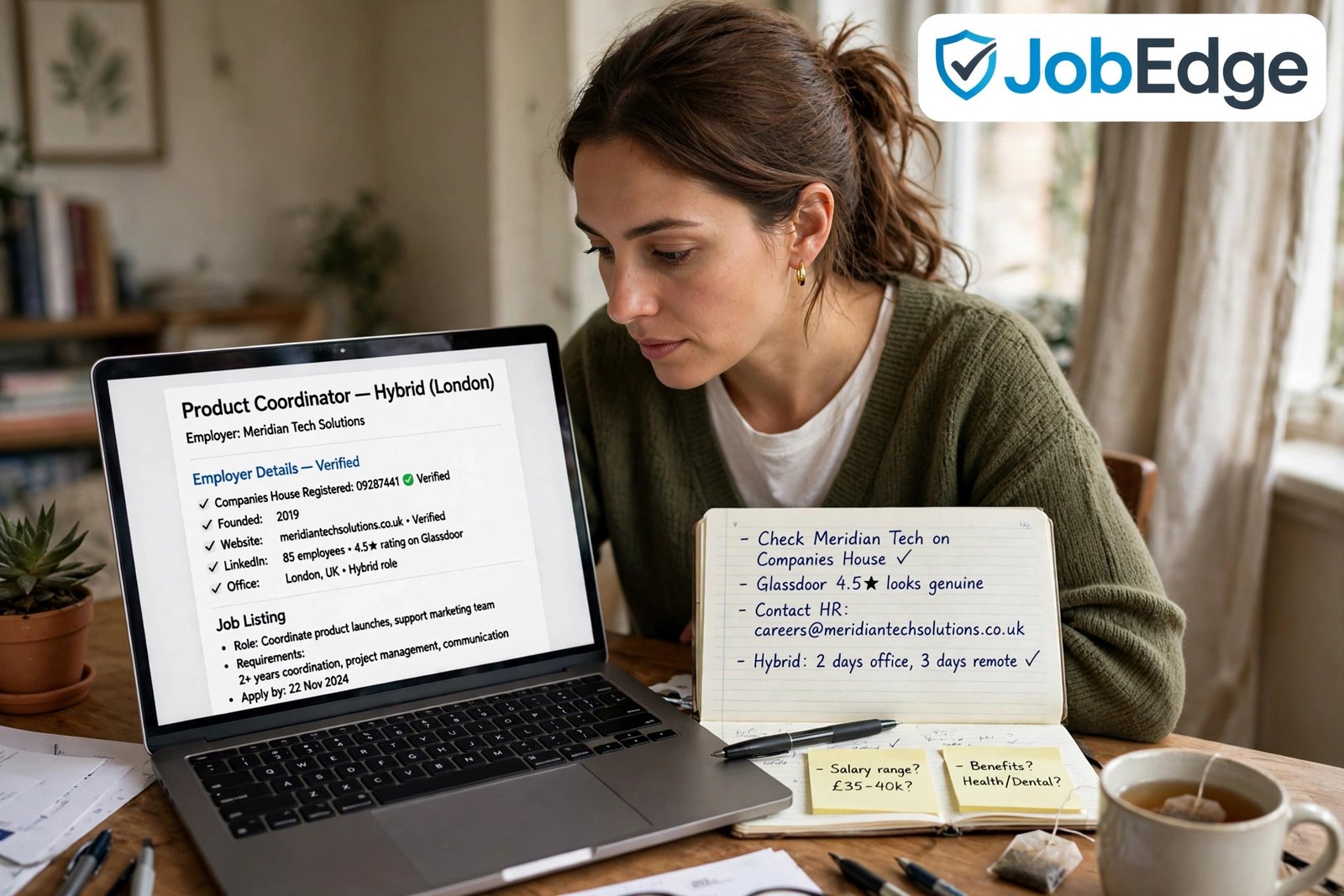
A jobseeker checking an employer’s official website on a laptop to verify a listing.
How to Verify an Employer and a Listing, Step by Step
Verification is not complicated, but it does need to be done independently. That means using contact details and websites you find yourself, not the ones given to you in the suspicious message. A scammer can easily provide a fake phone number, a fake website, or a fake reference. The check only works when you go around them and confirm the opportunity from another source.
Step 1: Find the employer yourself
Start with the company name from the advert and search for it independently, using a search engine rather than clicking links in the message. Look for the company’s official website, its careers or vacancies page, and its contact details. Check whether the vacancy is listed there. If the company is real but the vacancy is not on its own site, that does not automatically prove a scam, because some roles are advertised only through agencies, but it does mean you need further confirmation before proceeding.
Step 2: Check the contact details match
Compare the email domain in the message with the domain of the official website. A genuine recruiter for a company will normally email from that company’s domain, not from a free email service or a lookalike domain with a small spelling change. Check the phone number and address against the official website, and be wary of adverts that provide only a mobile number, a messaging-app username, or a form with no company address at all. If you decide to contact the employer, use the contact details from the official website, not the ones in the suspicious message, and ask directly whether the vacancy is genuine and whether the person who contacted you works for them.
Step 3: Check the company’s background
Look for basic, consistent information about the company: how long it has been operating, what it does, where it is based, and whether it has a normal online footprint, such as a company profile, reviews from employees or customers, and a presence on professional networks. Be cautious about a company with almost no footprint, a website that was created very recently, or a profile that contains only vague claims and stock images. You can also check official company records where relevant, and look for whether the company is registered and trading under the name it is using. Inconsistencies, such as a company claiming a large UK office while its address traces to a residential property or a serviced office with no connection to the business, deserve further questions.
Step 4: Read the advert critically
A genuine advert reads like a job description: duties, requirements, working pattern, location, and application instructions. Read it slowly. Does it explain what you will do each day? Does it state the skills or experience needed, even if the role is entry-level? Does it explain how to apply and what happens next? Does the language match the standard of a professional employer? Vague promises, repeated emphasis on earnings rather than duties, and instructions to contact someone urgently on a messaging app are all reasons to investigate further.
Step 5: Test the hiring process
A genuine hiring process has stages, and it gives you information as well as asking for it. You should expect to learn the job title, the team or department, the working hours, the pay structure, and the start date, and to have the chance to ask questions. If you are offered a job after a single short message, if you are not asked about your availability or right to work where relevant, or if the "interview" consists only of a few questions by text, treat the offer as unverified. Ask for a written offer, a contract or terms, and a named contact at the company, and see how the other party responds. A genuine employer will provide these; a scammer will often avoid them.
Step 6: Check the payment arrangement
Before you accept any role, make sure you understand how you will be paid, when, and through what method. Employed roles in the UK are normally paid through payroll into your bank account, with payslips and tax handled properly. Freelance roles should have a written agreement stating the rate, the invoicing process, and the payment date. Be suspicious of payment by gift card, voucher, cryptocurrency, or cash transfer, and of any arrangement where you must pay money first in order to receive your wages. If you are unsure about the tax or employment status of a role, seek advice before you start, rather than after you have already done unpaid work.
Safe Application Habits: What Never to Pay or Share
Good habits protect you even when a scam is well disguised. Make these rules automatic, so you do not have to decide under pressure in the middle of an exciting-looking offer.
Never pay to get a job
Do not pay an upfront fee for training, equipment, a background check, software, a deposit, or administration in order to start a job. Do not pay by gift card, voucher, cryptocurrency, wire transfer to a personal account, or any method that cannot be traced or reversed. If a role genuinely requires a background check, find out how that check is normally arranged for that type of work, and confirm the process with the employer through independently verified contact details before you pay anything to anyone. If you are asked to buy equipment, ask whether the employer provides it, whether it is optional, and whether you can source it yourself from a retailer of your choice after you have a signed contract. A request to buy a specific kit from a specific seller, chosen by the recruiter, is a warning sign.
Share personal information in stages, not all at once
At the application stage, a CV with your name, contact details, work history, and skills is normally enough. You do not need to include your full date of birth, your National Insurance number, your bank details, or copies of identity documents in an initial application. Those details, where they are needed, come later, through a secure process, once the employer has been verified and you have progressed in a real hiring process. Never share passwords, PINs, one-time codes, or online banking login details with a recruiter or employer, for any reason. No genuine employer needs those to hire you.
Keep your job search organised
Keep a simple record of every role you apply for: the job title, the employer, where you saw the advert, the date you applied, and the name and contact details of anyone who replies. This record is surprisingly powerful. When an unexpected message arrives offering you a job, you can check whether you actually applied for it. Scammers often contact people who never applied, hoping the excitement of an offer will override that basic check. A short note for each application also helps you spot inconsistencies, such as a recruiter claiming to represent a company you never contacted, or a job title that changes between messages.
Use separate, secure channels
Apply through official application pages or established job boards where possible, rather than sending personal details to an individual over social media or a messaging app. Use a dedicated email address for job searching if you can, keep your CV free of sensitive details, and check your privacy settings on job boards and professional networks so that your personal contact details are not visible to everyone. If a recruiter moves the conversation from a job board to a private messaging app very quickly, and then asks for sensitive information there, slow down and verify the opportunity independently before continuing.
Trust the pause
If you feel rushed, flattered, or worried, pause. Scammers rely on emotion: excitement about a high-paying role, fear of missing out, or worry that you will be in trouble if you do not act. Genuine employers expect you to take time to read an offer, check the details, and ask questions. It is perfectly reasonable to say, "Thank you for the offer. I would like to check a few details and will reply by tomorrow." A genuine employer will accept that. A scammer will often push harder, which in itself tells you what you need to know.
Protect yourself if you work freelance
If you take on freelance or self-employed remote work, agree the scope, rate, deadline, and payment terms in writing before you start, and keep copies of all messages and agreements. Be cautious about large unpaid trial tasks: a short, reasonable skills test is normal in some fields, but a full project completed for free, with a promise of paid work later, is not a safe arrangement. If a client repeatedly expands the work without agreeing payment, or delays payment while asking for more, stop and reassess before doing further unpaid work.
Where Genuine Work From Home Jobs Are Found
Knowing where to look reduces your exposure to scams, because genuine roles cluster in places where employers and vacancies can be checked. Start with the most verifiable channels, and treat unsolicited approaches with extra care, wherever they come from.
The government’s own job service is a sensible starting point for UK jobseekers, and GOV.UK provides a Finding a job page that points you to official job-search services. Employer careers pages are another strong channel: if you want to work for a particular organisation, go to its official website and look for its vacancies section, rather than trusting a copied advert elsewhere. Established job boards, recruitment agencies with verifiable offices and client lists, and professional networks can also be useful, provided you still check each individual vacancy and employer, because even well-known platforms can occasionally host a fake listing.
Within JobEdge, you can narrow your search by the type of remote work that suits you. For example, if you want roles that are specifically based in the UK, browse the remote jobs in the UK listings, and if you want a broader view of home-based work, explore the wider work from home jobs section. If flexibility around other commitments matters most, the part-time remote jobs listings are a useful place to start, and if you enjoy helping customers, the remote customer service jobs listings cover a common entry point into remote work. Whichever section you use, apply the same verification steps in this guide to every individual role, because a genuine category of work can still contain a fake advert, and a genuine employer can still be impersonated.
Local support can also help. Careers advisers, Jobcentre Plus services, libraries, and community employment projects can help you search, prepare a CV, and practise interviews, and they can often sense-check an opportunity that worries you. If you are unsure about a role, talking it through with a trusted person, an adviser, or a family member is not a sign of weakness. It is one of the most effective checks there is, because a second pair of eyes often spots the inconsistency you missed when you were focused on the opportunity itself.
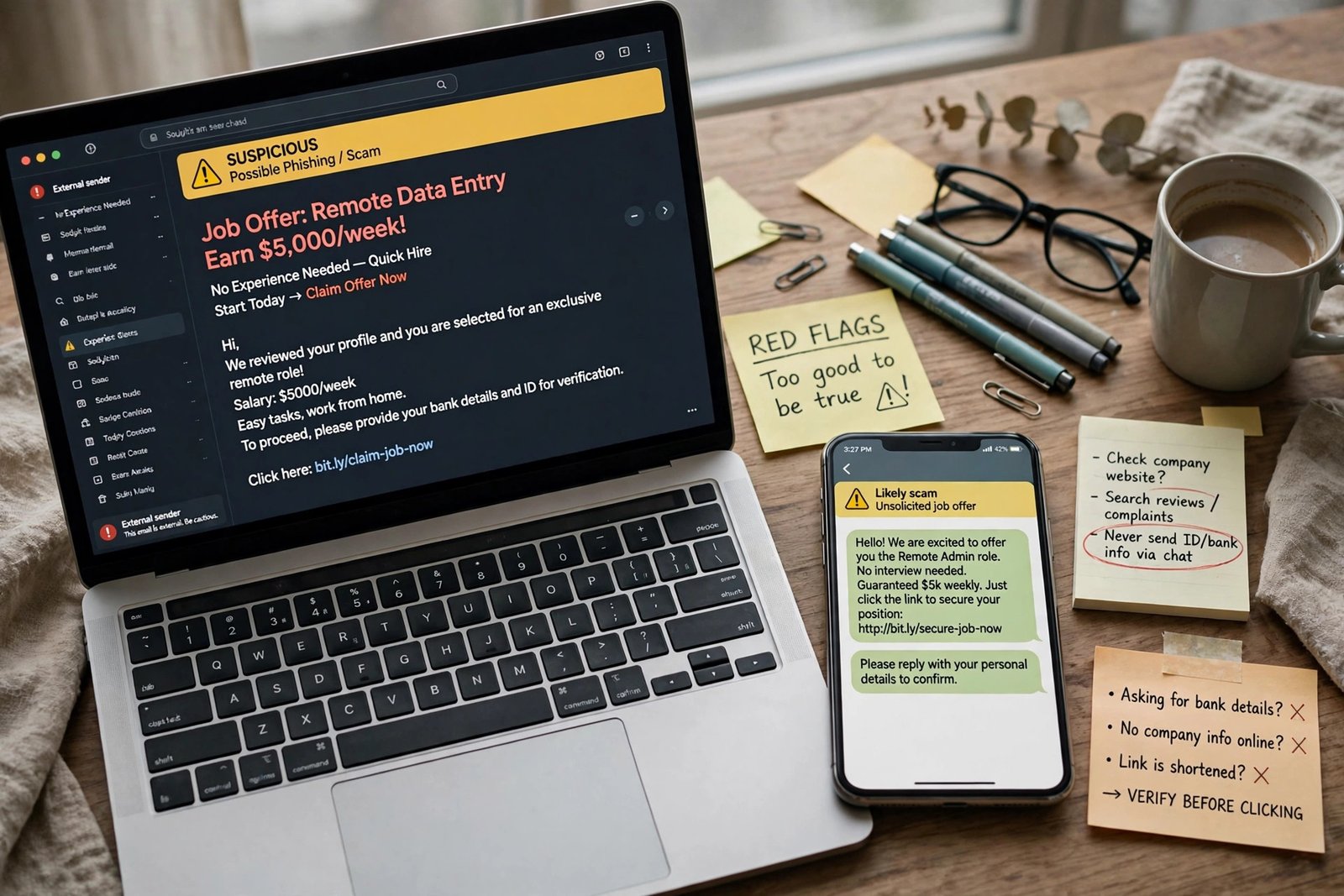
Red-flag warning signs beside a suspicious job message on a phone and laptop.
What to Do If You Suspect a Scam
If you think an opportunity is a scam, the most important thing is to stop the interaction before you share more information or pay more money. Do not argue with the scammer, do not try to test them by sending further details, and do not click links or download attachments from suspicious messages. Break contact, save the evidence, and then report it through the proper channels.
First, preserve what you have: screenshots of the advert and messages, email addresses, phone numbers, website addresses, and any payment details you were given. Do not delete the messages yet, because they may be useful for a report. If you have already shared personal information, change any passwords that might be affected, especially if you reused a password elsewhere, and consider setting up additional security on your accounts. If you have shared bank details or made a payment, contact your bank as soon as possible using a number you find independently, such as the number on the back of your card, and explain what happened. Your bank can advise you on protecting your account and on any options for recovering a payment.
Next, report the scam. In the UK, fraud and suspected fraud can be reported to Action Fraud, and suspicious phishing messages can be forwarded for investigation; Action Fraud provides guidance on how to report a phish, including what to do with suspicious emails, texts, and calls. If you have lost money or shared financial information, reporting promptly matters, because it helps build the national picture of fraud and may help protect others, even if recovery is not always possible. You can also report a suspicious job advert to the platform where you saw it, so it can be removed and other jobseekers are not targeted by the same listing.
For wider official guidance on the tricks scammers use, including fake job websites and requests for payment, GOV.UK publishes fraud, tricks and scams guidance that explains the warning signs and how to report suspicions. If you are not sure whether something is a scam, Citizens Advice can help you work through what happened and what to do next, and its advisers can point you to the right reporting route for your situation. If you feel threatened, or if someone is pressuring you in person or by phone, consider contacting the police, and if you are in immediate danger, call the emergency number.
Finally, do not blame yourself. Scams are designed by people who practise deception full-time, and they use professional-looking websites, copied branding, and persuasive language. Many careful, intelligent people are targeted, and reporting what happened helps others avoid the same trap. The goal is not to feel foolish for being approached; it is to stop the scam, protect your accounts, and apply the lessons to your next application.
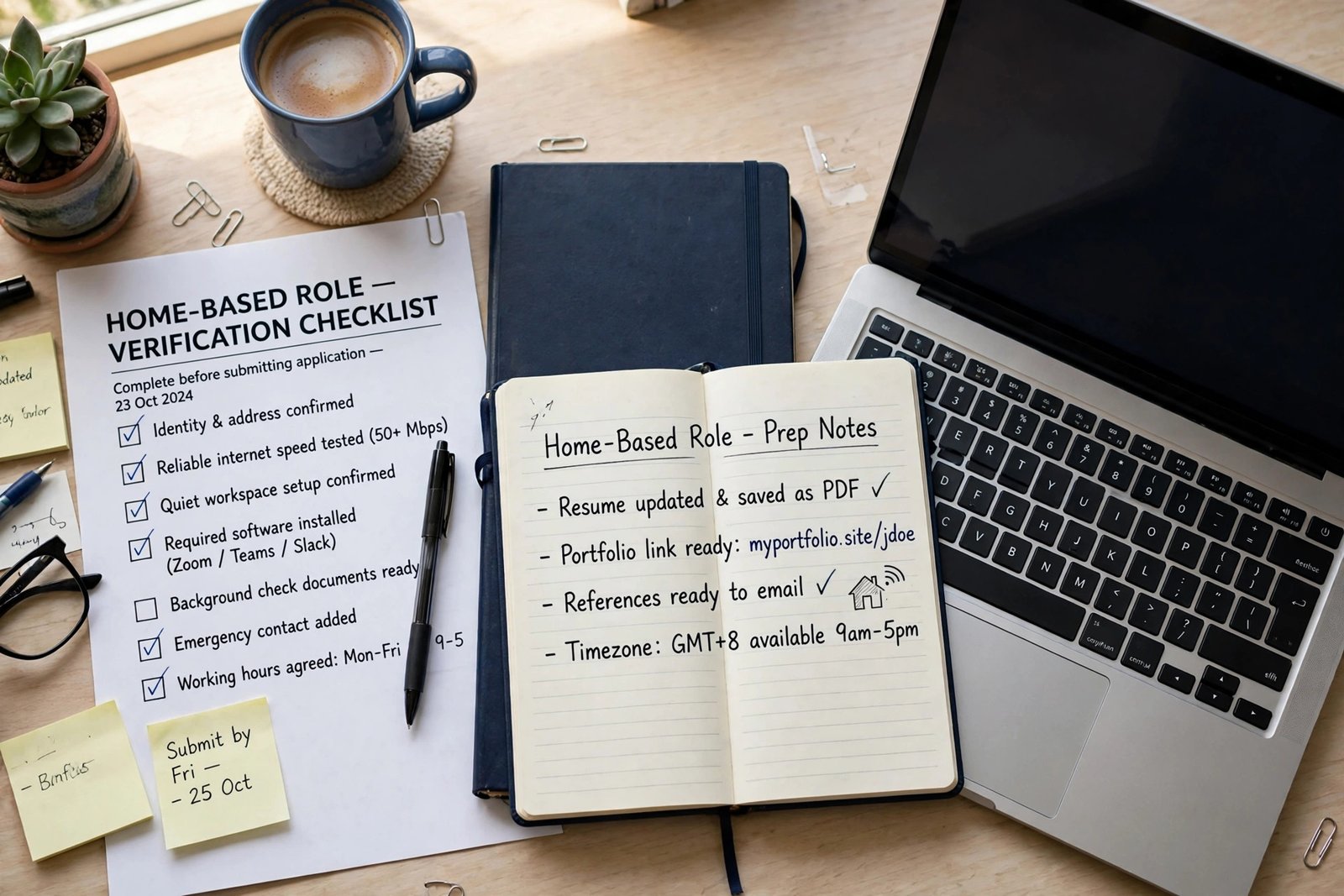
A verification checklist and notebook beside a laptop, ready before applying.
Your Practical Verification Checklist and Action Plan
Use this checklist for every work-from-home application, especially for any opportunity that arrived unexpectedly or looks unusually attractive. You do not need to complete every step for a vacancy on a well-known employer’s own careers page, but you should complete the core checks for any role you are unsure about.
Before you apply
- [ ] I can name the employer, and I found its official website myself.
- [ ] The vacancy, or a way to confirm it, exists through an independent channel.
- [ ] The job title, duties, working pattern, and location are clearly described.
- [ ] The email domain matches the employer’s official domain.
- [ ] The advert does not ask me to pay anything to apply or start.
- [ ] The advert does not promise unusually high pay for very little work.
During the hiring process
- [ ] I have had a real conversation about the role, not just a short text exchange.
- [ ] I know the team, hours, pay structure, and start date, or I have asked for them.
- [ ] I have not been asked for bank details, National Insurance details, identity copies, or passwords at an early stage.
- [ ] I have not been pressured to decide or pay immediately.
- [ ] I have a written offer, contract, or terms to read before I accept.
- [ ] I have contacted the employer through independently verified details, where anything was unclear.
Before you start work
- [ ] I have a signed contract or written agreement stating the role, rate, and payment terms.
- [ ] I understand how and when I will be paid, and through what method.
- [ ] I know who my manager or main contact is, and how to reach them through official channels.
- [ ] I have not paid any fee, bought any kit from a seller chosen by the recruiter, or forwarded money or parcels for strangers.
- [ ] I have kept copies of the advert, offer, and agreement.
Your seven-day action plan
Day one, define what you want: the type of remote work, the hours you can offer, and the skills you can demonstrate. Day two, set up a dedicated job-search email address and a simple application tracker, and update your CV without sensitive personal details. Day three, search through verifiable channels first, such as employer careers pages and established job boards, and save only those vacancies you can check. Day four, apply to a shortlist of well-described roles, and keep a note of each application. Day five, verify any replies using the steps in this guide before you share further information, and pause on any reply that asks for payment or sensitive details. Day six, prepare for interviews by researching each employer independently and preparing questions about duties, hours, pay, and equipment. Day seven, review your tracker, follow up politely on applications you have not heard about, and discard any opportunity that cannot be verified, without guilt. Repeating this cycle weekly is more effective, and much safer, than applying to dozens of unverified adverts in a single rushed session.
Frequently Asked Questions About Genuine Work From Home Jobs in the UK
Are genuine work from home jobs in the UK real, or are most of them scams?
Genuine work from home jobs in the UK are real, and many employers now offer remote or hybrid roles across customer service, administration, writing, data handling, tutoring, and technical support. At the same time, remote work is a popular target for scammers, so you will encounter fake adverts alongside real ones. The existence of scams does not mean remote work itself is fake; it means each opportunity needs checking, using the verification steps in this guide, before you share sensitive details or pay for anything.
Should I ever pay for training, equipment, or a background check to get a job?
As a general rule, no. A genuine employer does not charge you to start work, and you should not pay an upfront fee to a recruiter or to an individual who offered you a role. If a role genuinely requires equipment or a check, confirm the requirement and the proper process with the employer through independently verified contact details, and be suspicious of any request to pay by gift card, voucher, cryptocurrency, or transfer to a personal account. Separate the decision about a job from any decision about buying a training course, and check each one independently.
How can I tell if a recruiter email is genuine?
Check whether the email domain matches the employer’s official website domain, and whether the vacancy can be confirmed through that website or by contacting the employer using details you found yourself. Be cautious about free email addresses, lookalike domains with small spelling changes, interviews conducted only by messaging app, and offers that arrive without a proper conversation. If you are unsure, contact the employer directly through its official channels and ask whether the recruiter works for them and whether the vacancy is real.
What should I do if I have already paid money to a suspected scam?
Stop further payments, break contact, and save all evidence, including messages, adverts, and payment details. Contact your bank as soon as possible using a number you find independently, change any passwords that might be affected, and report the fraud to Action Fraud. You can also report the advert to the platform where you saw it. Acting quickly gives you the best chance of protecting your accounts, even though recovery of money is not always possible.
Can a genuine employer ask for my bank details?
Bank details are normally needed only at the payroll stage, once you have been offered a role, verified the employer, and are being set up for payment through a proper process. A genuine employer will not ask for your bank details, National Insurance number, or identity documents in an initial application or in an unsolicited message, and will never ask for your passwords, PINs, or online banking login details. If such details are requested early, pause and verify the employer independently before sharing anything.
Is it safe to apply for work-from-home jobs on social media?
Social media can be a place where genuine roles are advertised, but it is also a common place for fake adverts and impersonation, because anyone can create a profile that copies a real company. If you see a role on social media, treat it as a lead, not as a verified vacancy: find the employer independently, check whether the vacancy exists through official channels, and apply through the employer’s own application route where possible, rather than sending personal details to an unverified account.
What if a job looks genuine but I still feel unsure?
Trust that feeling and verify further. Contact the employer through independently verified details, ask for a written offer and contract terms, and talk the opportunity through with a trusted person or adviser. A genuine employer will respect careful questions and give you time to decide. If the other party becomes evasive, impatient, or aggressive when you ask reasonable questions, that response is itself useful information, and walking away is the safer choice.
Conclusion: Finding Genuine Work From Home Jobs in the UK With Confidence
Searching for genuine work from home jobs in the UK does not have to mean living in fear of scams, but it does mean searching with a clear method. Genuine roles have structure: a specific job title, clear duties, a verifiable employer, a proper hiring process, and a pay arrangement that is explained before you start. Scams, by contrast, rely on urgency, secrecy, vague promises, upfront fees, and requests for sensitive information before you have had a chance to check anything. Once you know that difference, you can judge opportunities for yourself, rather than relying on how professional an advert looks or how exciting an offer sounds.
Keep the habits in this guide with you for every application. Verify the employer independently, never pay to start a job, share personal information in stages, keep a record of your applications, and give yourself time to pause before deciding. Use verifiable channels first, such as official careers pages and established job boards, and treat unsolicited approaches with extra care. If something cannot be verified, let it go, however attractive it looks, because a missed doubtful opportunity costs you nothing, while a scam can cost you money, personal information, and confidence.
Most importantly, do not let the existence of scams put you off remote work altogether. Genuine work-from-home jobs in the UK are available across many fields, and with a careful, organised search, you can find a role that fits your skills, your hours, and your life at home. Start with the checklist, apply it to your next application, and build your confidence one verified opportunity at a time. Your next genuine role is worth the extra few minutes it takes to check.



Pingback: Remote Home Working Jobs: UK Guide