


Fully remote jobs UK: 100% remote roles, not hybrid — and how to check the promise.
JOB DETAILS — AT A GLANCE
| Category | Remote Jobs UK |
| Location | UK — work from home |
| Job Type | Full-time and part-time (varies by role) |
| Work Mode | Fully remote (not hybrid) |
| Education Required | Varies by role |
| Experience | Varies by role; some roles suit beginners |
| Skills | Communication, self-organisation and digital confidence (vary by role) |
| Salary | Varies by role — check the official advert; no figure is stated here |
| Who Can Apply | Jobseekers in the UK who meet the employer’s eligibility and right-to-work requirements |
| How to Apply | Online, with a tailored CV and cover note, via the employer’s official listing |
Note: details vary by role and employer. Always check the official advert before applying.
If you are searching for fully remote jobs UK, you probably have one clear requirement: you want to work from home, every working day, without a regular trip to an office. That sounds simple, but many job adverts use the word “remote” loosely. Some roles described as remote still expect you to attend an office one or two days a week, travel to a regional hub for team days, or live within commuting distance of a particular site. For some people, that hybrid pattern is ideal. For others, it is a deal-breaker — because of caring responsibilities, health needs, transport, where they live, or simply because they want the stability of a genuinely home-based working life.
This guide is written for the second group. It focuses only on 100% remote roles in the UK. It explains what “fully remote” really means, how it differs from hybrid working, which kinds of roles are commonly offered on a fully remote basis, and — most importantly — how to filter out hybrid roles before you waste time applying for them. You will also find practical advice on checking a role is genuinely fully remote, questions worth asking an employer, setting up a comfortable home workspace, avoiding scams, and preparing applications and interviews that show you can work well without being in an office.
You do not need to be an expert in technology, or to have worked remotely before, to benefit from this guide. You do need a clear definition of what you will and will not accept, a careful way of reading job adverts, and a short checklist to use before you accept an offer. With those three things in place, your search for fully remote jobs UK becomes faster, less frustrating, and much more likely to end with a role that actually fits your life.
What Does Fully Remote Really Mean?
A simple definition to use
A fully remote job is a job in which your normal place of work is your home, or another location agreed with your employer, rather than an employer’s office. You are not expected to attend an office on a regular, recurring basis as part of the normal pattern of the job. Meetings, training and collaboration happen online, by phone or by video call, and the work itself is designed to be completed away from a central workplace.
That definition is worth holding on to, because job adverts do not always use words in the same way. One employer may call a role “remote” when it is based at home four days a week with one office day. Another may call a role “remote” when the team is spread across the country but meets in person every month. A third may mean that you can work from anywhere in the UK, with no office attendance at all. All three adverts might look similar at first glance. Only the third matches a strict fully remote requirement.
Fully remote versus hybrid: the key differences
Hybrid working is a mixture of working remotely and working in the employer’s usual workplace. GOV.UK guidance on flexible working describes hybrid working in exactly those terms: a combination of working remotely and working in the employee’s usual workplace. A hybrid role might involve three days at home and two days in the office, or mostly home-based work with a weekly team day. The pattern can be fixed, flexible, or decided by a manager, but the office remains part of the normal working pattern.
Fully remote working is different in kind, not just in degree. The home is the normal workplace. There is no regular office day built into the contract or the working pattern. That does not mean you will never meet colleagues in person. Some fully remote employers hold occasional social events, training days or planning sessions. The important distinction is whether those occasions are occasional and exceptional, or regular and expected. If an advert says “one day a week in the office,” “two days a month in London,” or “must be able to attend the office at short notice,” it is not describing a fully remote role in the strict sense, even if most of the work is done from home.
Other phrases can also hide a hybrid expectation. “Remote-first” usually means remote work is the default, but it does not always guarantee that office attendance will never be required. “Work from home” can mean the same as fully remote, but it can also be used loosely for a hybrid role with home days. “Flexible working” is broader still: it can include flexible start and finish times, compressed hours, part-time hours, job sharing, or a change in where you work. None of those phrases, on their own, proves that a role is 100% remote. The details in the advert, and the written terms you are offered, matter more than the headline label.
Why the distinction matters so much
For many jobseekers, the difference between fully remote and hybrid is not a minor preference. It affects where you can afford to live, how much time and money you spend travelling, how you arrange childcare or other caring responsibilities, and whether you can manage a health condition in a familiar environment. It also affects the practicalities of starting a job: if you accept a hybrid role believing it to be fully remote, you may face a long commute you did not plan for, or a difficult conversation with a new employer in your first weeks.
Being clear about this distinction also helps employers. A hiring manager would rather hear, politely and early, that you are looking for a fully remote role than discover after an offer that the working pattern does not suit you. Clarity saves everyone time. It also protects your confidence during a job search. When you filter firmly for fully remote roles only, you will see fewer adverts — but the adverts you do pursue will be far more relevant, and your applications will be stronger because you are applying for roles you genuinely want.
Fully remote, home-based, and working from anywhere: are they the same?
Not quite. “Home-based” usually means your home is your base, which is close to fully remote, but you should still check whether travel to clients, sites or meetings is part of the job. Some home-based roles involve regular travel, even if there is no office day. “Working from anywhere” can mean anywhere in the UK, anywhere within certain time zones, or anywhere with a suitable internet connection — but it can also come with restrictions for tax, security or customer-service reasons. Always ask what “anywhere” means in practice, and whether there are limits on where you can be based.
A fully remote role can still have a location requirement. For example, an employer may need you to be based in the UK for legal, tax or data-protection reasons, or to work UK hours so you can support UK customers. That is not the same as requiring office attendance. The question to ask is not “can I live anywhere in the world?” but “is my normal place of work my home, with no regular office attendance required?” If the answer is yes, the role fits this guide, even if the employer asks you to be UK-based.
What Kinds of Fully Remote Jobs Are Available in the UK?
Fully remote roles exist across many sectors, but they tend to share one feature: the work can be done well using a computer, a phone and an internet connection, without needing to be physically present with customers, equipment or colleagues. That still leaves a wide range of possibilities, from entry-level administrative work to specialist professional roles.
Customer service and support
Customer service is one of the most common areas for fully remote work in the UK. Remote customer service roles may involve answering phone calls, replying to emails or live chat messages, helping customers with orders, accounts or technical problems, and recording information accurately. These roles suit people who communicate clearly, stay calm under pressure, and can follow processes carefully. Some are full-time, some are part-time, and some involve shift patterns including evenings or weekends, so it is worth checking working hours as carefully as the location.
If this area interests you, it is worth exploring related roles in more depth, including the range of positions covered in the Remote Customer Service Jobs category. Many customer service employers provide equipment, training and structured support for home-based staff, but arrangements vary, so ask what is provided and what you are expected to supply yourself.
Administration, data entry and operations
Administrative and data-focused roles also lend themselves to fully remote working. These can include general administration, diary and inbox management, document preparation, data entry, data checking, order processing, and supporting a team with scheduling or record-keeping. Accuracy, organisation and attention to detail matter a great deal in this kind of work. Employers often value reliability and consistency over formal qualifications, particularly for entry-level roles, although some positions ask for experience with particular systems or software.
Data entry in particular can be a useful starting point if you are looking for home-based work and are comfortable working carefully with information on screen for extended periods. As with any remote role, check whether the work is genuinely ongoing and employed, or freelance and project-based, because the rights, pay arrangements and stability can differ.
Technology, design and digital roles
Technology and digital roles are frequently offered on a fully remote basis, especially where teams already collaborate online. Examples include software support, IT helpdesk work, web and graphic design, content production, digital marketing support, and quality checking for websites or applications. Some of these roles require specific technical skills or a portfolio of work, while others — such as entry-level support roles — focus more on problem-solving, communication and a willingness to learn.
If you are considering a move into technology, think about the skills you can evidence, not just the job title you want. A short course, a personal project, or experience helping colleagues with technology can all strengthen an application, even if you have not held a formal technology job before.
Writing, content, research and professional services
Writing, editing, research, bookkeeping support, recruitment administration, and other professional services can also be fully remote. These roles often involve producing documents, checking information, communicating with clients by email or video call, and managing your own workload to deadlines. They suit people who can work independently, organise their time well, and communicate clearly in writing.
Some professional roles are advertised as remote but still involve occasional client visits or in-person meetings. That may be acceptable to you, or it may not. The same rule applies: read the advert carefully, ask about travel expectations, and decide whether the pattern fits your definition of fully remote before you apply.
Part-time and flexible fully remote roles
Fully remote does not have to mean full-time. Many people look for part-time remote work that fits around study, caring responsibilities, health needs or another commitment. Part-time fully remote roles exist in customer service, administration, data work and other areas, although the pattern of hours — for example, fixed shifts versus flexible hours — can vary a great deal. If you need part-time hours, search for both “fully remote” and “part-time” together, and check the advert for the number of hours, the days required, and whether the hours are fixed or flexible.
It can help to browse part-time options alongside fully remote roles, so you can compare patterns and see which combination suits you best. The Part-Time Remote Jobs category is a useful starting point for that comparison, especially if you want to avoid roles that are part-time in hours but hybrid in location.

A person working from home at a tidy desk, with no office commute.
How to Filter Job Searches for Fully Remote Only
Filtering well is the single most useful skill in a fully remote job search. Job boards use different filters, and the word “remote” is used inconsistently, so you need a method that works even when the filter itself is imperfect. The approach below is designed to remove hybrid roles early, before you invest time in applications.
Step 1: Start with the strictest location filter available
On most job boards, begin by selecting “Remote” as the location or work-type filter, rather than typing a city or region. Then add a keyword such as “fully remote” in the search box, in quotation marks if the site supports exact-phrase searching. Quotation marks help because they tell the search to look for that exact phrase, rather than for adverts that contain the words “fully” and “remote” separately.
If the site offers separate filters for “Remote,” “Hybrid” and “On-site,” select “Remote” only. Do not select “Hybrid” as well in the hope of finding more roles: that will undo the filter and bring hybrid roles back into your results. If a site only offers a general “Work from home” filter, use it as a first pass, then apply the manual checks in the next steps to remove hybrid roles from the list.
Step 2: Read the location line before you read anything else
The location line of an advert often reveals a hybrid role immediately. Be cautious with adverts that show a city or office location alongside the word “remote,” such as “Remote (London)” or “Remote, Manchester.” That combination often means the role is attached to an office in that city, even if much of the work is done from home. A genuinely fully remote advert is more likely to say “Remote (UK),” “Fully remote,” “Home-based (UK),” or simply “Remote” with no office city attached.
This is not a perfect rule. Some fully remote employers still list a head-office city for administrative reasons. Treat the location line as a warning sign, not a final judgement. If the location line raises a doubt, read the full advert before deciding, and look for the phrases in the next step.
Step 3: Search the advert for hybrid warning phrases
Once you open an advert, use your browser’s find function to search for words that suggest office attendance. Look for “hybrid,” “office,” “on-site,” “in-office,” “attend,” “commute,” “within travelling distance,” “hub,” “team day,” and “days per week in.” If any of those phrases appear, read the surrounding sentence carefully. An advert might say “no office attendance required,” which is reassuring, or it might say “two days per week in our Leeds office,” which rules the role out if you need fully remote work.
Also look for softer phrases that can hide a hybrid pattern, such as “occasional office visits,” “regular team meet-ups,” “willingness to travel to the office as needed,” or “must be based near.” Occasional visits may be acceptable to some jobseekers, but if you need a strict fully remote arrangement, treat any regular or open-ended travel requirement as a reason to ask for clarification before applying.
Step 4: Use exclusion keywords where the site allows them
Some job boards let you exclude terms from a search. If yours does, try excluding “hybrid” from your results. You can also try searching for “fully remote” and then manually skipping any advert that mentions hybrid working in its summary. This manual step takes a little longer, but it is far quicker than applying for a role, attending interviews, and only then discovering that office attendance is expected.
Step 5: Set up alerts that protect your filter
Job alerts save time, but they can also reintroduce hybrid roles if they are set too broadly. When you create an alert, use the same strict settings as your manual search: remote location, “fully remote” in the title or keywords where possible, and your preferred hours or sector. Review the first few alerts carefully. If hybrid roles keep appearing, tighten the keywords or change the board you are using. A smaller number of genuinely relevant alerts is more useful than a large number of mixed results.
Step 6: Check the employer’s own careers page
Larger employers often advertise the same role on a job board and on their own website, but the wording can differ. The employer’s own page sometimes gives a clearer description of the working pattern, including whether the role is home-based, hybrid, or office-based, and whether there are any travel expectations. If a job-board advert is unclear, checking the employer’s careers page — and, where available, the original job description — can resolve the question before you apply.
A quick filter checklist to use for every advert
Before you apply, run through this short checklist:
- Does the advert say “fully remote” or “100% remote,” not just “remote”?
- Does the location line show the UK generally, rather than a specific office city?
- Is there any mention of regular office days, hub days or travel to an office?
- Does the advert explain how the team works together remotely?
- Are the working hours and any shift pattern clearly stated?
- Is there anything about equipment, training or support for home-based staff?
If you cannot answer the first three questions from the advert alone, make a note to ask the employer. Do not assume that silence means fully remote. In a fully remote search, an unclear advert is a reason to ask, not a reason to guess.
How to Check a Role Is Genuinely Fully Remote
Filtering helps you find promising adverts. Checking helps you avoid disappointment after you apply. These checks are best done in stages: first from the advert, then during the recruitment process, and finally in the written offer.
Read the whole job description, not just the summary
Summaries on job boards are often shortened, and the working pattern may be described more precisely in the full job description. Look for a section on “location,” “working pattern,” “place of work,” or “what we offer.” A clear fully remote description will usually state that the role is home-based, explain how the team communicates, and mention any equipment or support provided. A vague description that only says “flexible working available” without explaining the pattern should prompt further questions.
Ask direct questions early, politely and specifically
You do not need to wait until the final interview to clarify the working pattern. A short, polite question at application stage or early in the process can save everyone time. For example, you might ask: “Is this role fully remote, with no regular office attendance required?” That is clearer than asking “Is this role remote?” because it removes the ambiguity around the word remote.
Other useful questions are covered in the next section. The key principle is to ask about the normal pattern, not just the current arrangement. A role might be home-based for now because an office is being refurbished, or because a team is temporarily dispersed. Ask whether the fully remote pattern is permanent, and whether it is written into the contract or offer letter.
Check the contract and offer letter before you accept
The most reliable check is the written terms you are offered. Before you accept a role, look for the place of work stated in the contract or written statement of employment particulars. If it names an office as your place of work, with home working described as an occasional or discretionary arrangement, that is not the same as a fully remote contract. If it names your home as your place of work, or states that the role is fully remote, that is much stronger evidence.
If the wording is unclear, ask the employer to clarify it in writing before you resign from a current job or turn down other opportunities. A reputable employer should be willing to explain the working pattern clearly. If an employer is evasive, changes the description during the process, or asks you to accept a role without written terms, treat that as a warning sign and consider whether to proceed.
Watch for changes during the recruitment process
Sometimes a role is advertised as fully remote, but the working pattern changes during interviews. A hiring manager might mention “a weekly team day in the office” that was not in the advert, or suggest that “most people come in once a week.” If that happens, do not assume it is a minor detail. Ask whether office attendance is expected, how often, and whether it is a formal requirement or an optional social occasion. If the answer changes the role from fully remote to hybrid, you are entitled to reconsider, even if you have already invested time in the process.
Questions to Ask Employers About Fully Remote Work
Asking good questions shows that you have thought seriously about remote working, not that you are trying to avoid work. Employers who manage remote teams well usually welcome these questions, because they show you understand what makes remote work successful. Choose the questions that matter most to you, and ask them in a straightforward way.
Questions about location and attendance
- Is this role fully remote, with no regular office attendance required?
- Is my normal place of work my home, and will that be stated in writing?
- Are there any regular in-person meetings, training days or team events, and how often do they happen?
- Do I need to live in a particular part of the UK, or can I be based anywhere in the UK?
- If I move home within the UK, would that affect the role?
Questions about equipment, support and working hours
- What equipment, software and internet requirements will I need, and what does the employer provide?
- Who do I contact if equipment fails or I have a technical problem while working from home?
- What are the core working hours, and how much flexibility is there around start and finish times?
- How does the team communicate day to day, and how often will I speak with my manager?
- What training and induction will I receive, and how is it delivered for remote starters?
Questions about performance, progression and wellbeing
- How is performance measured in this role, and how often will I receive feedback?
- What opportunities are there for training, development and progression for remote staff?
- How does the team support wellbeing and avoid isolation for people who work from home?
- What happens if my home working arrangements need to change, for example because of caring responsibilities or a health need?
You do not need to ask every question in a first interview. Start with location and attendance, because those answers determine whether the role fits your core requirement. The remaining questions help you judge whether the employer has thought carefully about remote working, and whether you will be supported once you start.
Setting Up for Fully Remote Work at Home
A fully remote job removes the commute, but it still needs a workable home setup. You do not need an expensive home office to work remotely well, but you do need a space where you can concentrate, take calls without constant interruption, and work safely and comfortably.
Creating a practical workspace
Choose the quietest available space in your home, ideally with natural light and a door or screen that helps you separate work from the rest of your day. A stable table or desk, a supportive chair, and a screen at a comfortable height make a real difference over a full working day. If you share your home with others, agree on working hours, call times and signals for when you should not be disturbed. Small agreements at the start prevent many frustrations later.
Think about background noise, privacy and confidentiality as well. If your role involves handling customer information, you will need a space where conversations cannot easily be overheard and screens cannot easily be seen by others. Ask your employer about any security requirements, such as using a work device, a secure connection, or a private workspace for calls.
Technology, connectivity and backup plans
Most fully remote roles require a reliable internet connection, a computer or laptop, a headset for calls, and access to the employer’s systems. Some employers provide a laptop, monitor, headset and other equipment; others expect you to use your own device within agreed standards. Clarify this before you start, including who is responsible for repairs, replacements and software updates.
It is also worth having a simple backup plan for technical problems. Know who to contact if your internet connection fails, whether you can work from another location temporarily if your employer allows it, and how to let your manager know promptly if you cannot work as normal. Remote employers expect occasional technical issues; what matters is clear, prompt communication.
Routines, boundaries and wellbeing
Working from home can blur the line between work and personal life, especially if your workspace is also your living space. A consistent routine helps: a regular start time, planned breaks, a lunch break away from your screen, and a clear finish time. Short breaks, movement and time outdoors during the day support concentration and wellbeing, even on busy days.
Staying connected matters too. Remote work can feel isolating, particularly in the first weeks. Make use of team chats, video calls and check-ins, and do not hesitate to ask colleagues questions. Asking for help early is a strength in remote work, not a weakness. If you begin to feel isolated or overwhelmed, raise it with your manager. Guidance from Acas on managing staff who work from home emphasises treating home-based staff fairly and equally, including giving them the same support and opportunities as office-based colleagues, which is a useful standard to keep in mind when judging an employer’s approach.
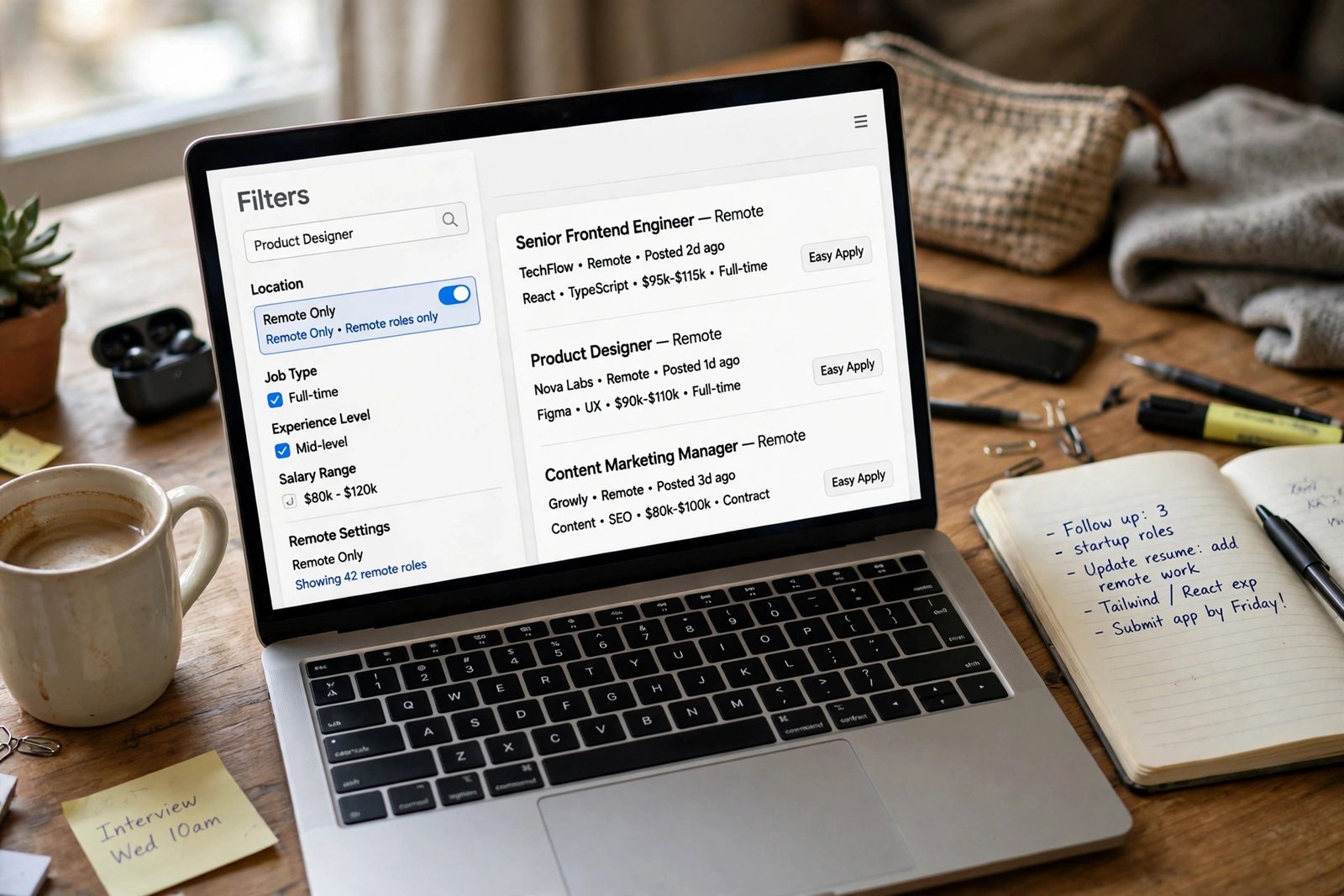
A job search filter on a laptop screen set to remote-only roles.
Scams to Avoid in the Fully Remote Job Market
Unfortunately, the popularity of remote work has also attracted scams. Some fraudulent adverts promise easy, high-paid, home-based work with little effort, then ask for money, personal information or unpaid work. Knowing the warning signs helps you protect yourself and focus on genuine opportunities.
Common warning signs
Be cautious if a role:
- Asks you to pay a fee for training, equipment, background checks, software or “registration” before you start.
- Offers work with unusually vague duties, such as “simple tasks from home,” without a clear employer, job description or working pattern.
- Pressures you to accept quickly, share bank details early, or move the conversation away from a professional recruitment platform to a personal messaging app.
- Uses an employer name that does not match the email address, website or job advert, or provides no verifiable company information.
- Asks you to receive money, forward parcels, or handle payments on behalf of someone else as part of the job.
- Requires you to buy equipment or supplies from a specific seller chosen by the “employer.”
Genuine employers may ask for identity documents and bank details at the appropriate stage, once an offer has been made and through secure, verifiable channels. They should not ask you to pay to get a job, and they should be able to explain the role, the employer and the recruitment process clearly.
How to check an employer before you apply
Before applying, search for the employer’s name alongside words such as “careers,” “reviews” or “contact,” and check whether the company has a credible website, a consistent address or contact details, and a professional recruitment process. Be especially careful with adverts that copy the name of a well-known company but use a slightly different email address or website. If something feels wrong, pause and verify before sharing personal information.
Keep copies of job adverts, emails and offer letters, and do not share sensitive documents, such as passport details or bank information, until you are confident the employer and offer are genuine. If you believe you have encountered a scam, stop communicating, do not send money, and consider reporting it through the appropriate official channels in the UK. Taking a cautious approach may slow your search slightly, but it protects you from far more costly problems.
Applying and Interviewing for Fully Remote Jobs UK
Applying for fully remote roles is similar to applying for any job, with one important difference: you need to show, through your application and interview, that you can work independently, communicate clearly online, and manage your time without direct supervision. Employers hiring for fully remote jobs UK are not only assessing your skills for the tasks involved; they are also assessing whether remote working will suit you and whether you will thrive in a distributed team.
Tailoring your CV for remote work
Tailor your CV to each role, rather than sending the same document everywhere. Highlight experience that is relevant to remote work, such as working independently, managing your own workload, communicating with colleagues or customers by email, phone or video call, using online systems, and meeting deadlines without close supervision. If you have worked from home before, say so briefly and explain what you learned. If you have not, draw on transferable experience: study completed independently, voluntary work organised remotely, or a previous role in which you managed your own diary and priorities.
Be specific. Instead of writing that you are a “good communicator,” give a short example: the kind of customers you helped, the systems you used, or a situation in which you resolved a problem by phone or email. Specific examples are more convincing than general claims, and they help a hiring manager picture you in a remote team.
Writing a cover letter or supporting statement that addresses remote working
If an application asks for a cover letter or supporting statement, use a short paragraph to explain why fully remote work suits you and how you work well from home. Mention your home setup in general terms, your availability for the required hours, and your experience with remote communication. Avoid oversharing personal details. You do not need to explain every reason you want remote work; a clear, professional statement about your working style and reliability is enough.
Also address the practical requirements of the role. If the advert asks for UK-based applicants, experience with particular software, or availability for certain shifts, make it easy for the hiring manager to see that you meet those requirements. A well-structured application that answers the advert directly stands out, especially when many applicants send generic CVs.
Preparing for a remote interview
Most interviews for fully remote roles take place by video call, which is itself a useful test of remote working skills. Test your camera, microphone and internet connection beforehand, choose a quiet, tidy background, and have a glass of water and a pen nearby. Join the call a few minutes early, dress as you would for an in-person interview, and keep your notes within reach without reading from them word for word.
During the interview, speak clearly, listen carefully, and give structured answers with brief examples. Because the interviewer cannot see you in an office setting, your communication style matters even more: be concise, check understanding when needed, and show enthusiasm for the role itself, not just for working from home. It is fine to say that fully remote working suits your circumstances, but balance that with genuine interest in the work, the team and the employer.
Prepare a few questions of your own, including the location and support questions from earlier in this guide. Asking thoughtful questions shows engagement and helps you confirm that the role is genuinely fully remote before you accept an offer.
After the interview: confirming the working pattern
If you are offered a role, thank the employer, ask for the offer in writing, and check the working pattern, hours, equipment arrangements and start date before accepting. If anything differs from what was advertised or discussed, raise it politely and ask for clarification. It is much easier to resolve a misunderstanding at offer stage than after you have started. A clear written offer protects both you and the employer, and it gives you confidence that the role you accept is the role you applied for.
Pay, Contracts and Rights in General Terms
Pay for fully remote roles varies by sector, experience, hours and employer, just as it does for office-based roles. This guide deliberately does not quote salary figures, because a figure that is accurate for one role or sector may be misleading for another, and adverts themselves are the reliable source for pay in a specific vacancy. When you compare roles, look beyond the headline pay: check the number of hours, whether the role is employed or freelance, holiday entitlement, pension arrangements, and any allowances or equipment provision mentioned in the advert or offer.
Employment status matters too. An employed role, a freelance or self-employed arrangement, and an agency role can involve different rights, tax arrangements and levels of stability. Do not assume that a home-based role is automatically employed, or that a freelance role offers the same protections as employment. Read the advert and the contract carefully, and ask the employer to clarify your status if it is not clear.
In general terms, UK employees have the legal right to request flexible working, including a change to where they work, and employers must deal with such requests in a reasonable manner. GOV.UK guidance on flexible working explains that employees can request a change to where they work, and sets out the process for making a statutory application. That right to request is not the same as an automatic right to work from home, and an employer can refuse a request for a good business reason. For a fully remote role you are applying for, however, the working pattern should be part of the job itself, not something you need to request after starting.
Your written terms should state your place of work, hours, pay arrangements and other key conditions. If you are unsure about any part of a contract, take time to read it, ask the employer for clarification, and consider seeking independent advice before signing. Acas provides guidance for employers and employees on working from home, including fair treatment and support for home-based staff, which can help you understand what good practice looks like.
If you are looking for work through official channels as well as commercial job boards, GOV.UK’s finding-a-job pages point jobseekers to the official routes for searching and applying for jobs in Great Britain. Using official sources alongside reputable job boards can widen your search without increasing your exposure to misleading adverts.
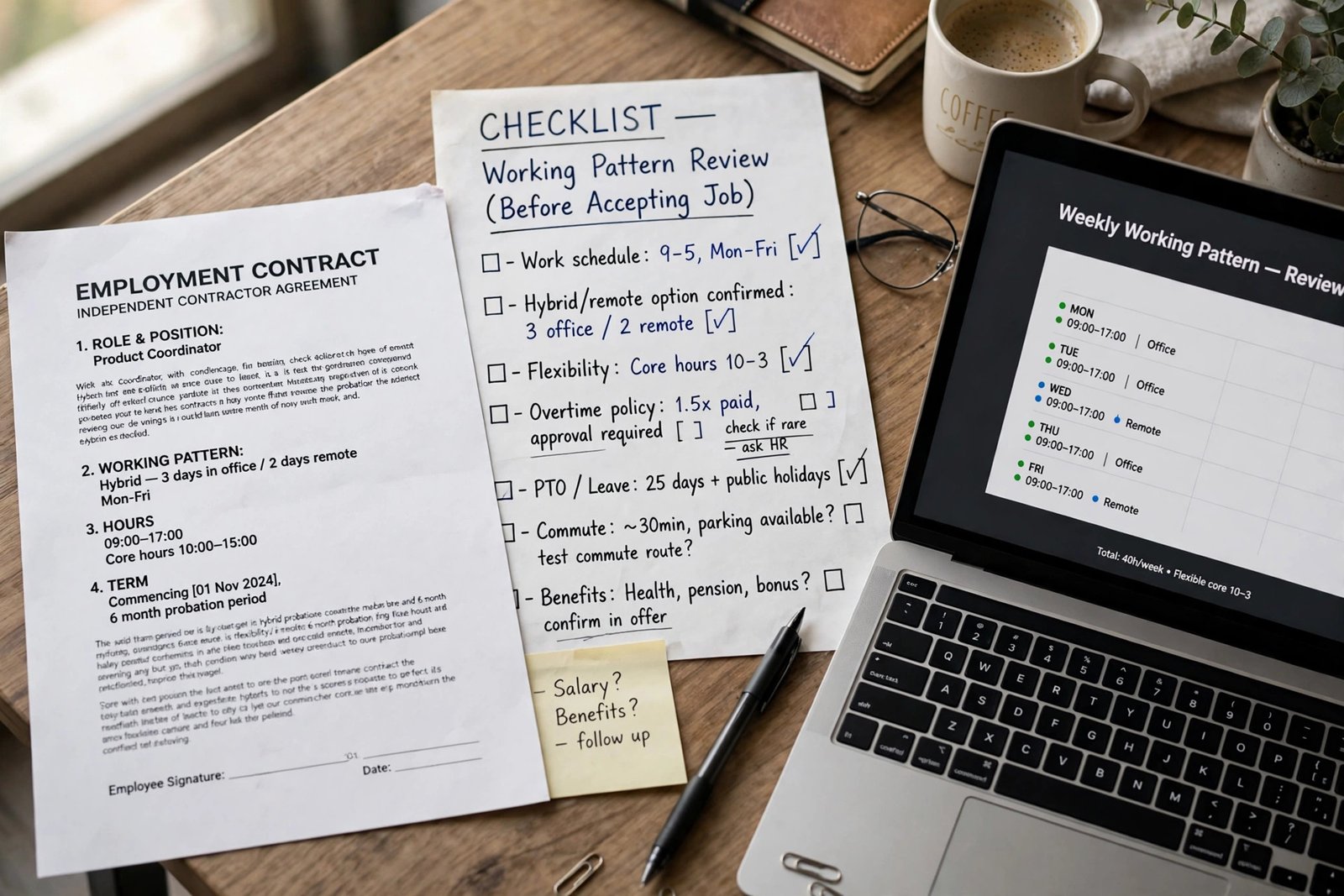
A contract and checklist on a desk, checking the working pattern before accepting.
Your Practical Action Plan for Fully Remote Jobs UK
A clear plan turns a broad search into steady progress. Use this seven-day-style action plan as a starting point, and adapt the pace to your circumstances. The aim is not to apply for as many roles as possible, but to apply well for roles that genuinely fit.
Day 1: Define your non-negotiables
Write down your definition of fully remote, your required hours, any shift patterns you can or cannot work, and any location limits, such as needing to be UK-based. Decide in advance whether occasional in-person events are acceptable to you, and if so, how often and how far you are willing to travel. This short list becomes your filter for every advert you consider.
Day 2: Prepare your core application materials
Update your CV for remote work, prepare a short supporting statement, and gather any evidence of skills or experience that remote employers value, such as examples of independent work, customer-service experience, or familiarity with online tools. Keep a simple spreadsheet or notebook to track roles you apply for, dates, contacts and outcomes.
Day 3: Set up strict job alerts
Create alerts on two or three job boards you trust, using “fully remote” as a keyword and “Remote” as the location filter. Also check official and employer careers pages directly, since not every vacancy appears on every board. Review your alerts for a few days and tighten them if hybrid roles keep appearing.
Day 4: Shortlist and check, before you apply
For each promising advert, run the filter checklist from earlier in this guide. Read the full description, search for hybrid warning phrases, and note any questions you need to ask. Shortlist a small number of strong matches rather than applying for every advert that mentions remote work.
Day 5: Apply with tailored applications
Send tailored applications for your shortlisted roles, addressing the specific requirements in each advert and explaining briefly how you work well remotely. Keep copies of everything you send, and note closing dates and next steps.
Day 6: Prepare for remote interviews
Practise answering common interview questions by video call, prepare your location and support questions, and test your technology. If you are invited to interview, confirm the format, timing and who will be present, and prepare a quiet space for the call.
Day 7: Review, follow up and refine
Review which adverts were genuinely fully remote and which turned out to be hybrid. Refine your keywords, alerts and checklist based on what you learned. Follow up politely on applications where appropriate, and keep applying steadily rather than in a single burst. A consistent, focused search is more sustainable — and more effective — than applying for everything at once.
If your circumstances change, or if you decide that a hybrid pattern could work for you after all, that is a valid choice. The point of this guide is not to argue that fully remote work is right for everyone, but to help you find it reliably if it is right for you. If you broaden your search later, you can explore wider remote and work-from-home options, including general work-from-home roles, while keeping the checks in this guide to avoid misunderstandings about location.
Frequently Asked Questions About Fully Remote Jobs UK
What is the difference between fully remote and hybrid jobs in the UK?
A fully remote job has your home as your normal place of work, with no regular office attendance required. A hybrid job combines remote work with regular work in the employer’s usual workplace, such as set office days each week. The distinction lies in whether office attendance is part of the normal pattern, not in how much of the work happens online.
How can I tell if a job advertised as “remote” is actually hybrid?
Read the full advert, not just the title or summary. Search for “hybrid,” “office,” “on-site,” “attend,” and “days per week in,” and check the location line for a specific office city. If the advert is unclear, ask the employer directly whether the role is fully remote with no regular office attendance required, and check the written offer before accepting.
Do fully remote jobs UK always mean I can live anywhere?
Not necessarily. Many fully remote employers require you to be based in the UK, to work UK hours, or to be available within certain time zones. Being UK-based for a fully remote role is different from being required to attend an office. Ask about location limits early, so you know whether the role fits where you live or plan to live.
Do I need previous remote-work experience to get a fully remote job?
Not always. Many employers value transferable skills such as independent working, clear written and spoken communication, time management, reliability and experience with online systems. If you have not worked remotely before, give examples from study, voluntary work or previous roles that show you can manage your workload and communicate well without direct supervision.
What equipment do I need for a fully remote job?
Requirements vary by employer and role. Some employers provide a laptop, monitor, headset and software; others expect you to use your own equipment to an agreed standard. Always clarify what is provided, what you need to supply, what internet speed or setup is expected, and who to contact for technical support.
Are part-time fully remote jobs available in the UK?
Yes, part-time fully remote roles exist, particularly in customer service, administration and data-focused work. Check both the hours and the location pattern carefully: a role can be part-time in hours but hybrid in location. Search for both criteria together, and confirm the shift pattern and working days before applying.
Should I pay for training or equipment to secure a remote job?
Be very cautious about any role that asks you to pay upfront for training, equipment, registration or checks before you start. Genuine employers should explain costs and recruitment steps clearly through verifiable channels. If you are asked to pay to get a job, pause, verify the employer independently, and do not send money or sensitive personal information until you are confident the opportunity is genuine.
Can a fully remote role change to hybrid after I start?
A working pattern should be set out in your contract or written terms, and an employer should not change it without following the proper process and, where required, your agreement. That is why checking the written offer matters so much. If a role is advertised as fully remote but the contract names an office as your place of work, ask for clarification in writing before accepting.
Conclusion: Find Fully Remote Jobs UK With Confidence
Searching for fully remote jobs UK does not need to mean wading through hybrid roles, vague adverts and uncertain promises. When you know what fully remote means, filter strictly for it, check adverts carefully, and ask direct questions about location, attendance and written terms, you take control of your search. You will apply for fewer roles, but each application will be for a role that genuinely fits your life — and that focus shows in the quality of your applications and interviews.
Start with your non-negotiables: 100% remote, no regular office attendance, and a pattern you can sustain. Use the filter checklist for every advert, confirm the working pattern in writing before you accept an offer, and set up a home workspace and routine that help you work well from day one. Stay alert to scams, use official guidance when you need to understand your rights, and keep your search steady and organised rather than rushed.
Fully remote work can offer real freedom: no daily commute, more control over your environment, and the chance to build a career from home in the UK. The key is to make sure the role you accept is truly fully remote — not hybrid in disguise. With a clear definition, careful filtering and confident questions, you can find a role that matches that promise and supports the working life you want.
For a broader view of remote opportunities across the UK, you can explore the Remote Jobs UK category, and for other patterns of home-based work, the general Jobs listings can help you compare options without losing sight of your fully remote requirement.



Pingback: Remote Jobs in the UK: Complete Guide